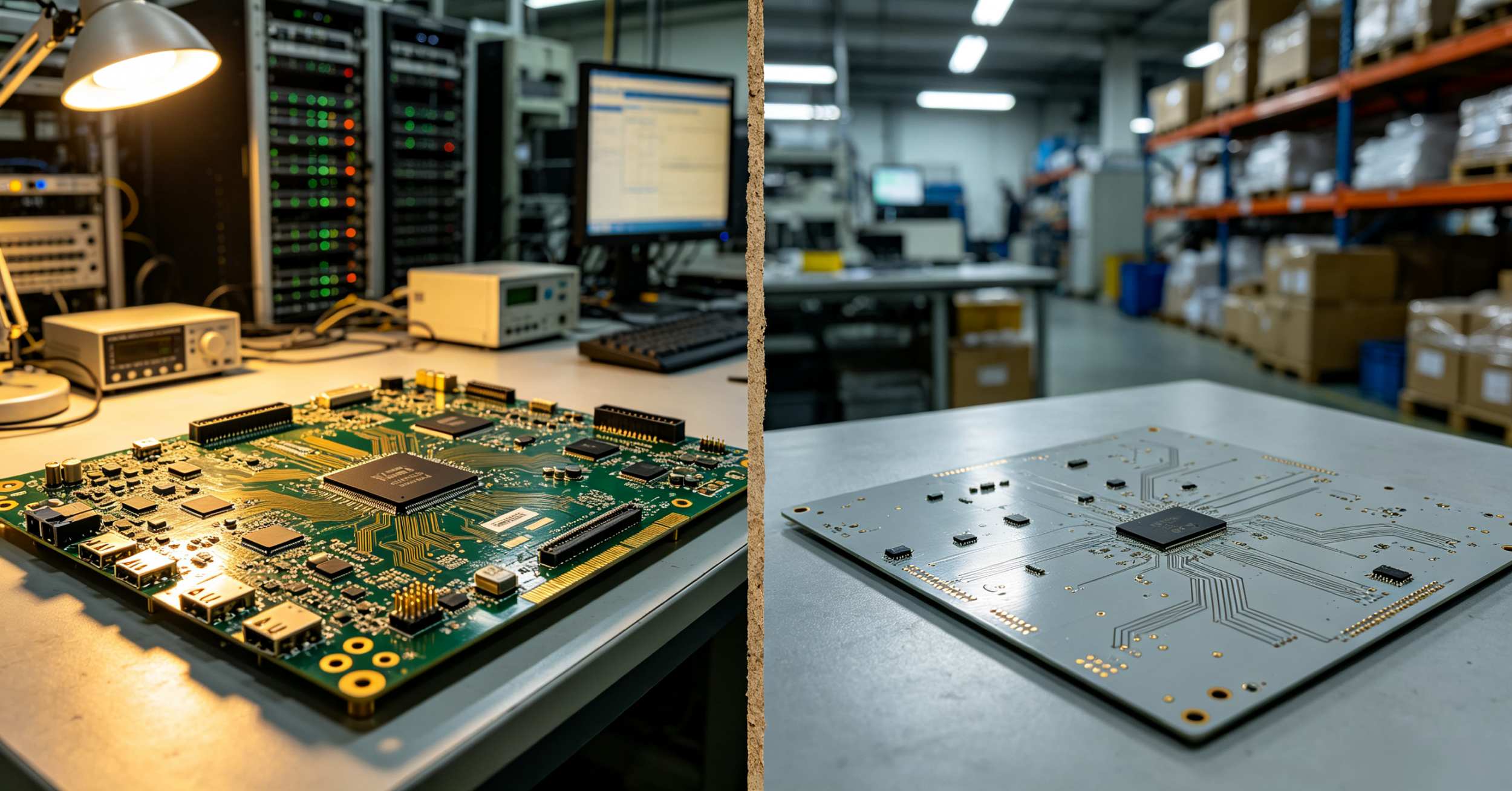
If you've sourced PCBs in 2026, you've likely felt a strange "disconnect" — some boards are in such high demand that lead times stretch beyond a year, while others are priced so competitively that margins have become razor-thin.
Behind this lies a structural divergence that is reshaping the entire PCB industry. Giants are investing tens of billions in high-end AI capacity, while low-end margins have fallen below 1% — barely enough to beat a bank deposit.
In a response to a stock exchange inquiry, Man Kun Technology disclosed a stark reality: the gross margin for its single and double-sided PCBs — which accounted for over one-third of the company's revenue — fell steadily from 4.52% to 1.20% and eventually to just 0.68% in 2025.
What does this number mean? It underperforms a bank time deposit and cannot even cover the depreciation and capital costs of production lines. This is not an isolated case. In Q1 2026, global PCB leader Avary Holding (Pengding) reported a 1.25% year-over-year decline in revenue and a 5.21% decline in net profit. The competition in the low-end market has reached the point where "the more you produce, the more you lose."
At the same time, industry leaders are building moats with real capital. In the first half of 2026, publicly listed PCB companies in China announced expansion plans totaling nearly $60 billion. Every dollar flowed toward high-end segments: AI server ultra-high-layer boards, advanced HDI, and IC substrates. Not a single cent was directed toward 4-6 layer standard boards or single/double-sided PCBs.
AI servers are the primary driver of this divergence. Compared to traditional servers, AI server PCBs require 20-40 layers — up from 8-16 layers — with value per board 8 to 12 times higher. More importantly, NVIDIA's Rubin platform CoWoP solution has directly broken the boundary between PCBs and packaging substrates — elevating PCBs from "interconnect" to "the last layer of chip packaging."
Goldman Sachs raised its global AI server PCB market forecast to $37.5 billion in 2027 and $84 billion in 2028, representing a 148% CAGR from 2026 to 2028.
But there is a catch. Industry experts note that the effective high-end capacity capable of serving AI server orders accounts for less than 20% of the total announced expansion. New high-end PCB production lines typically require 12-18 months to reach stable production, with complex HDI products for AI servers taking over 24 months to fully ramp up.
Supply-side constraints are not limited to PCB manufacturing — they have spread throughout the upstream chain.
E-glass fabric prices have surged significantly. The price of standard 7628 e-glass fabric (August 2026) has risen approximately 170% since September 2025. Kingboard Laminates issued its sixth price increase of the year in July 2026, with FR-4 prices rising over 270% cumulatively.
But the cost pass-through is uneven — high-end boards can pass on 100% of the increase, while low-end boards can pass on only about half. This gap widens the profit divide further.
Goldman Sachs expects high-end PCB capacity utilization to remain elevated over the next two years. The simple reason: high-end products consume more equipment time, require more labor, and yield lower initial rates. New nominal capacity cannot be converted into effective supply at the same ratio.
The conclusion from industry research is clear: the PCB industry is ending its era of uniform cycles and entering a "K-shaped divergence" — premium boards in high demand, low-end capacity being flushed out. The industry is shifting from "scale competition" to "technology competition." The battle is no longer about who has the most capacity, but who can secure a position in high-layer boards, advanced HDI, and IC substrates.
This is not just another cycle. It is a class stratification of the industry.
???? www.anypcba.com/contact-us/
???? We specialize in small-to-medium batch PCB and PCBA — from prototypes to production. If you're facing material price increases or lead time pressure, send us your files. We'll provide a DFM review and a transparent quote based on current market conditions.