If you design or procure electronic components in 2026, you've probably already felt it. The supply chain is no longer as "smooth" as it used to be.
Components are suddenly more expensive. Lead times are unpredictable. Tariff policies keep changing. These aren't temporary blips — the global electronics trade landscape is being reshaped.
The situation in 2026 is more complex than ever. The U.S. is stacking tariffs, the EU is tightening compliance, and China is controlling upstream materials. If you're still designing products the "old way," you might lose price competitiveness before your product even ships.
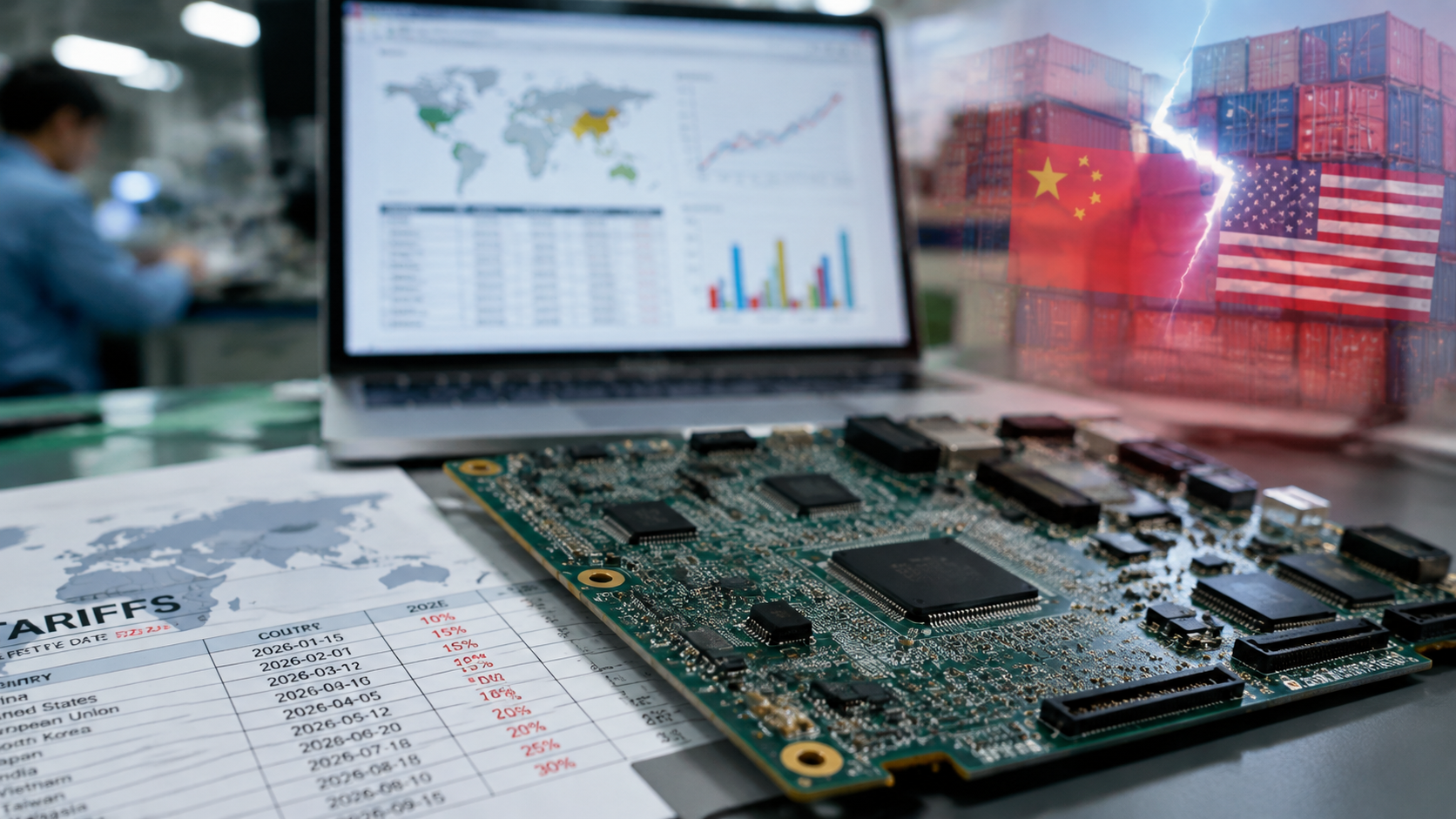
First, the United States. The Section 301 tariffs — introduced during the U.S.-China trade war — still apply to a wide range of China-origin electronic components, including PCBs, semiconductors, connectors, and subassemblies.
On February 24, 2026, the administration invoked Section 122 of the Trade Act of 1974 to impose a temporary 10% global import surcharge. This stacks on top of the existing Section 301 duties.
The Key Dates You Need to Know
November 10, 2026 is the next critical deadline. On that date, 178 Section 301 exclusions are set to expire unless extended by the USTR. This includes high-volume PCB categories — such as 2-layer and 4-layer boards under HTSUS 8534.00.00 — that are currently shielded from the full 25% rate.
Current Tariff Stacks for PCBs
| PCB Type | China Standard Rate | Sec. 301 Status | Current Stack (w/ 10% Sec. 122) | Post-Nov 10 Stack |
|---|---|---|---|---|
| 2L & 4L FR4 PCBs | 25% | Excluded | ~10% | ~35% |
| 6L+, Flex & Non-FR4 | 25% | 0% (no exclusion) | ~35% | ~35% |
The same 6-layer+ China-origin PCB faces a 35% tariff entering the U.S. If you're designing products for the U.S. market, that number is too large to ignore.
For semiconductors, the picture is even starker. China-origin semiconductor ICs currently face a 50% effective duty rate under Section 301. Combined with the Section 122 surcharge, that pushes the rate to 65%.
On July 1, 2026, the EU implemented a major customs reform. The previous rule exempting shipments under €150 from tariffs has been officially abolished. All goods entering the EU must now be declared and taxed.
Meanwhile, regulatory scrutiny continues to increase. RoHS and REACH are tightening. The EU is also moving RoHS's scientific assessment work under the European Chemicals Agency as part of a "one substance, one assessment" initiative, and several lead exemptions are set to expire at the end of 2026. For products entering Europe, PCB material compliance — including flame retardants and surface finish chemicals — must be ensured from the start.
China's response is more interesting — not tariffs, but export controls.
China controls roughly 94% of global gallium production and 83% of germanium production — both critical materials for semiconductors and RF applications. In December 2024, Beijing imposed a ban on exporting these dual-use items to the U.S.
But here's the 2026 twist: In a move to de-escalate tensions following the Xi-Trump meeting in October, China suspended this export ban until November 27, 2026. This is a temporary reprieve — not a permanent removal of the risk.
For hardware engineers, this means:
Short-term: Materials are flowing again, and supply is stable for now
Long-term: The underlying dependency remains. China still controls the vast majority of these critical minerals. If tensions rise again, the controls could be reinstated.
The takeaway? These materials remain a structural risk. Don't design a product that would be crippled if gallium or germanium supply were cut off.
1. Tariff Costs Are Now a Design Decision
Component selection used to be about price and performance. Now you also need to consider origin. A China-origin 6-layer+ PCB entering the U.S. faces 35% duty — a number too large to ignore.
2. BOM Management Needs a "Tariff Field"
Beyond brand, part number, and package, you now need to track country of origin, applicable duty rates, and exclusion status. As Altium notes, "tariffs, compliance rules, and export controls are becoming part of the design process itself".
3. Multi-Sourcing Is No Longer Optional
Single-origin supply carries too much risk in 2026. Primary supplier, backup supplier, different origins — all are now essential.
4. EU BOM Costs Are Rising
For EU customers, the July 1 customs reform means the final cost is no longer "board price + freight + VAT" — there's now an added tariff burden. This may influence their sourcing decisions: continue buying from Asia, or consider local European manufacturing?
5. The Temporary Relief
The suspension of China's export controls on gallium, germanium, antimony, tungsten, and graphite provides temporary stability, but this window is open only until November 27, 2026.
Forward-thinking engineering and sourcing teams are no longer treating tariffs as a procurement issue alone. They're designing products with regional flexibility, alternate sourcing paths, and trade exposure in mind from the very first schematic review.
| Strategy | Description |
|---|---|
| Multi-region design | Consider alternate components from different origins during the design phase |
| HS code planning | Accurate classification prevents overpaying duties |
| Supply chain visibility | Track component origins, not just supplier addresses |
| Alternate part qualification | Identify form-fit-function alternatives warehoused regionally |
| Compliance-first | Consider export compliance requirements during product design, not after |
The 2026 electronics trade environment is no longer about "whether to prepare" — it's about "how to prepare."
These changes are not temporary fluctuations. They are structural. Tariffs, compliance, and export controls are changing the underlying logic of hardware design.
For hardware engineers, beyond drawing circuits, you now need to draw a "trade map." Origin, duty rates, compliance certifications, supply chain backups — these are becoming part of the design itself.
https://www.anypcba.com/contact-us/
We're a Shenzhen-based PCBA manufacturer serving global clients with small-to-medium batch manufacturing. If you're struggling with tariffs, compliance, or supply chain issues — let's talk about your project and see if there's a more flexible solution.