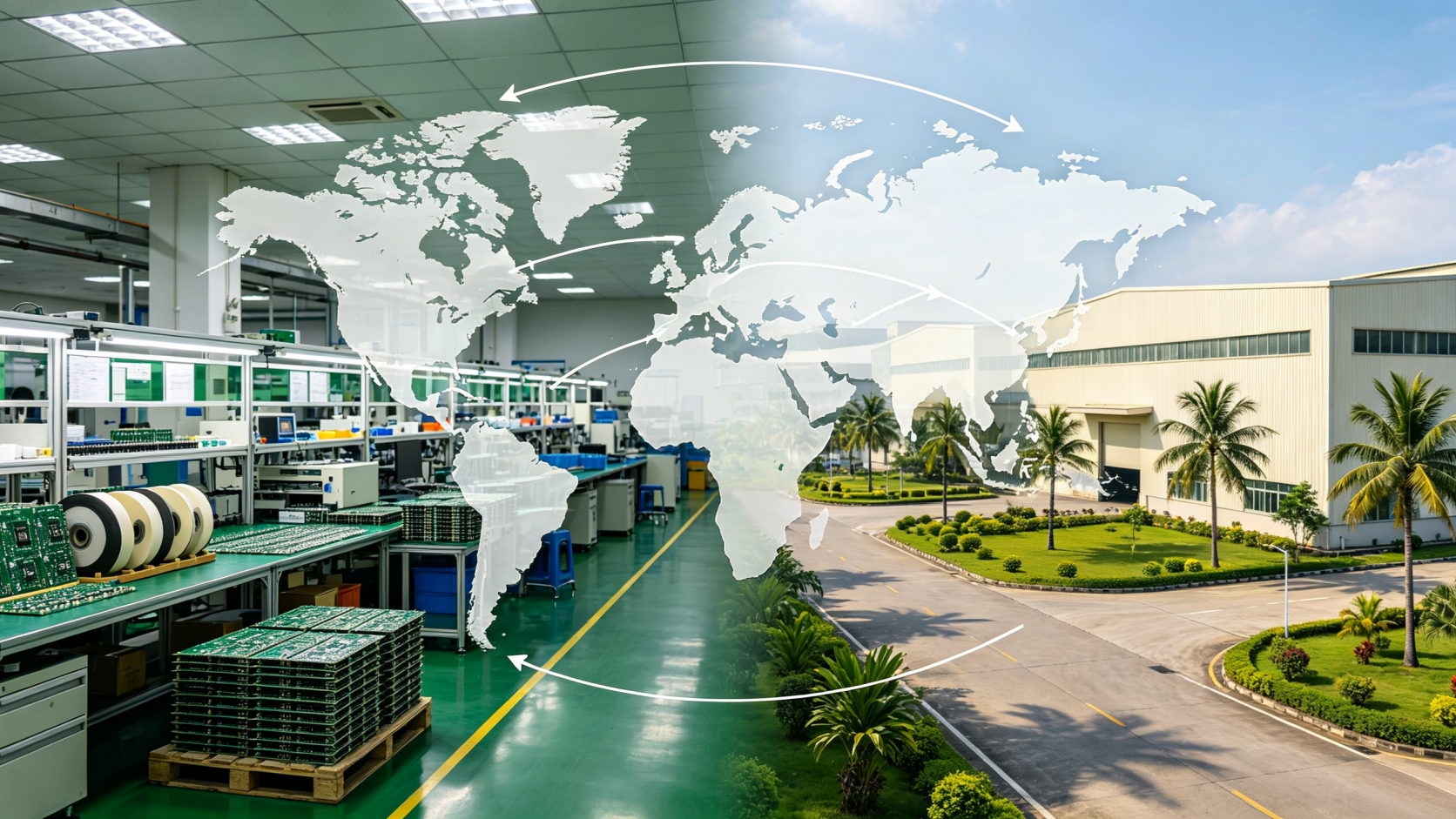
If you've sourced PCBs in 2026, you've likely noticed: orders that once went to China are quietly moving to Thailand, Vietnam, and Malaysia.
This isn't a temporary shift. It's a multi-year restructuring of the global PCB supply chain.
Southeast Asia's share of global PCB production is rising steadily. Prismark data shows global PCB output reached $89.8 billion in 2025, with China accounting for 54.2%, Japan 14.1%, and the rest of Asia (including Southeast Asia) 28.6%.
But changes are accelerating.
Thailand is currently Southeast Asia's largest PCB producer, accounting for approximately 44% of the region's total PCB output. Malaysia and Vietnam each represent about 21% and 18% respectively.
The Thailand Printed Circuit Board Association expects the country's PCB production value to reach 120-150 billion baht ($3.4-4.3 billion) in 2025, leading growth in the region. The industry currently employs about 20,000-30,000 people in Thailand, with demand projected to reach 74,200 by 2030.
Several factors are driving this shift:
US-China trade tensions are the primary catalyst. Section 301 tariffs make China-origin PCBs 25% more expensive for US imports. Even with exemptions, policy uncertainty has pushed OEMs to seek alternative sourcing options.
Customer-driven diversification is accelerating the trend. Global OEMs like Apple, HP, Dell, and Microsoft are pushing manufacturing partners to establish capacity outside China. Major Taiwanese manufacturers including Unimicron, Compeq, and ZDT have already invested in Thailand and Vietnam, with commitments ranging from hundreds of millions to billions of dollars.
Southeast Asia's advantages include relatively stable and competitive production costs, improving infrastructure, and growing local supply chains.
Meanwhile, China's PCB industry is shifting inland. Sichuan's Suining has become one of the largest PCB production bases in Southwest China. Cities like Ji'an in Jiangxi and Huangshi in Hubei are also actively attracting PCB investment.
But capacity migration isn't happening overnight.
Production costs in Southeast Asia remain 10-25% higher than in China. New factories require hiring and training workers — a process that takes time.
China's PCB industry remains massive and difficult to replace in the short term. The country accounts for over half of global PCB output and has the most complete supply chain ecosystem. In the first half of 2026 alone, at least 20 publicly listed Chinese PCB companies announced expansion plans totaling nearly $8.4 billion. These investments are overwhelmingly focused on high-end segments — AI server ultra-high-layer boards, advanced HDI, and IC substrates.
The capacity moving to Southeast Asia is largely mid-to-low-end production. Complex AI server PCBs remain in China.
If you design products that require PCBs, here are key considerations:
1. Supply chains are diversifying. Southeast Asian PCB options are expanding. For US-bound products, Southeast Asia-sourced boards may offer tariff advantages.
2. Supply chains are lengthening. Orders moved from China to Southeast Asia may require longer lead times and more complex logistics.
3. High-end capacity is still concentrated in China. If your design requires boards above 20 layers, advanced HDI, or IC substrates, China remains the primary source.
Global PCB capacity is undergoing a slow but certain realignment. Southeast Asia is gaining share. China is moving up the value chain.
For procurement teams, this means more options — but also more complex supply chain management.
For China's PCB industry, the challenge is: can it hold the high end while finding a new balance as low-end capacity migrates?
We are a Shenzhen-based PCBA manufacturer with a global perspective. If you're looking for a small-to-medium batch PCB or PCBA partner — whether in China or Southeast Asia — we'd be happy to discuss your project requirements.