In our technologically advanced world, electronic components are the unsung heroes enabling everything from smartphone communication to complex radar systems. Among these, the Gunn diode stands out for its peculiar ability to generate high-frequency microwaves using the 'Gunn effect'. This device, though deceptively simple in structure, plays a crucial role in many modern technologies. This article delves into the working principles, applications, and intricacies of the Gunn diode, revealing its significance in our daily lives and the science that powers it.
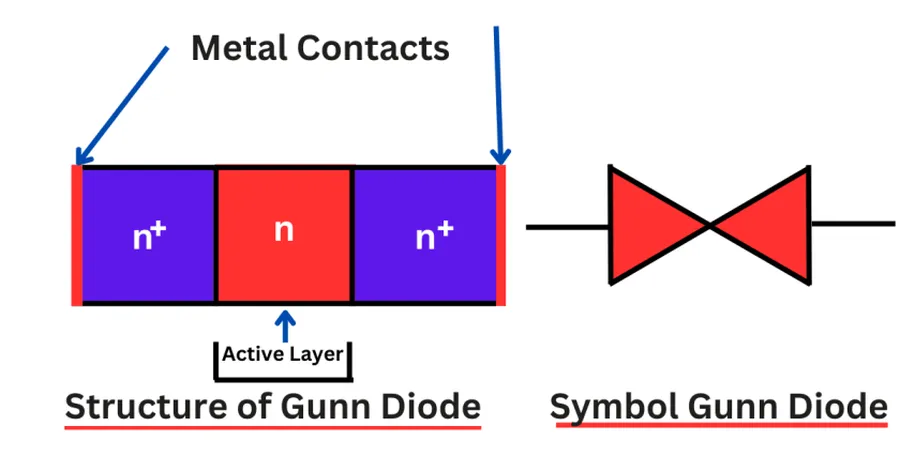
The Gunn diode, unlike conventional PN junction diodes, is a unique semiconductor device characterized by its single n-type doped material construction, typically utilizing materials such as Gallium Arsenide (GaAs) or Indium Phosphide (InP). Its operation hinges on the bulk properties of these materials rather than the junction properties found in standard diodes. The layered structure of the Gunn diode, comprising an active region and doped contact regions, is crucial to its functionality, enabling it to generate microwave frequency oscillations.
The choice of semiconductor material, whether GaAs or InP, significantly impacts the diode's performance characteristics. GaAs, with its higher electron mobility, is commonly used for higher frequency operation, while InP, with its higher peak electron drift velocity, can provide higher power handling capabilities, although other factors such as doping concentration also have a substantial effect.
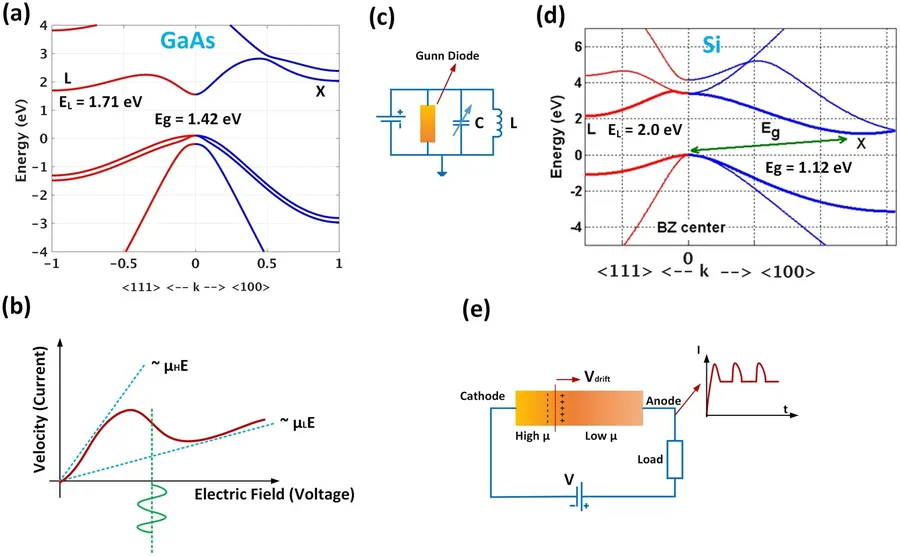
The Gunn effect, the cornerstone of Gunn diode operation, describes the phenomenon where electrons in certain semiconductor materials, such as gallium arsenide (GaAs) or indium phosphide (InP), transfer to higher energy valleys under the influence of a strong electric field. This transfer is key to generating microwave frequencies and is a fundamental aspect of the negative differential resistance exhibited by Gunn diodes.
This phenomenon occurs due to the unique band structure of these materials. When a sufficient electric field is applied, electrons gain enough energy to jump from a lower-energy, high-mobility valley to a higher-energy, low-mobility valley. This transfer results in a decrease in the average electron velocity, creating the negative differential resistance necessary for microwave oscillation. The process involves several key steps:
Gunn diodes generate microwaves through a unique process involving the formation and drift of space charge domains within their active region. This process is a direct consequence of the Gunn effect and the diode's inherent negative differential resistance.
The microwave generation process can be broken down into the following steps:
The frequency of the generated microwaves is primarily determined by the drift velocity of the space charge domain and the length of the active region of the Gunn diode. Precise control over these parameters allows for the generation of microwaves at specific frequencies.
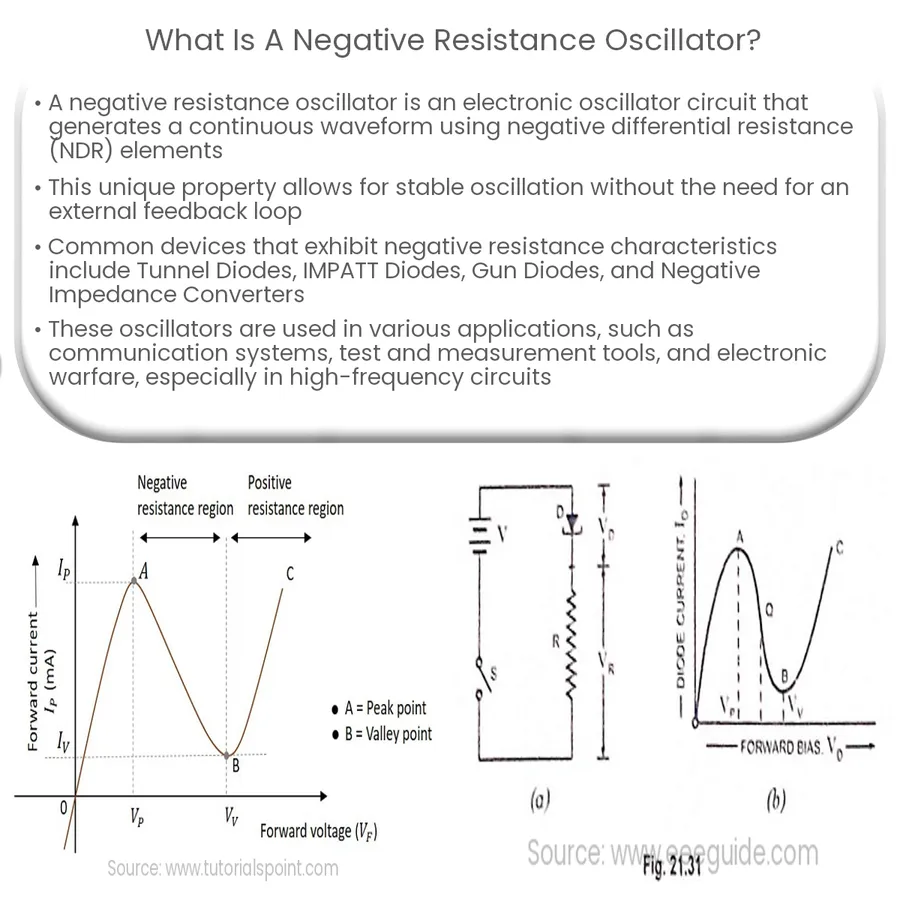
The cornerstone of Gunn diode operation is its unique characteristic of negative differential resistance (NDR). This phenomenon, where an increase in applied voltage leads to a decrease in current, is crucial for the diode's ability to generate microwave oscillations. It's a departure from the typical behavior of most electronic components and forms the basis of its functionality in high-frequency applications.
In conventional conductors and semiconductors, an increase in voltage results in a proportional increase in current, following Ohm's Law. However, within a specific voltage range, a Gunn diode exhibits the opposite behavior; current decreases with increasing voltage. This counterintuitive behavior is not an inherent property of the material itself but arises from the unique energy band structure and electron transfer mechanisms within the diode's active region, primarily when employing materials such as Gallium Arsenide (GaAs) or Indium Phosphide (InP).
The negative differential resistance (NDR) region on the Gunn diode's I-V curve is what makes it act as an oscillator. When a Gunn diode is biased into the NDR region, any small fluctuation in the applied voltage will cause a fluctuation in current. This fluctuating current causes the formation of a high field domain, which then drifts across the diode, creating oscillations.

Gunn diodes, leveraging their capability to generate microwave frequencies, are indispensable components in a variety of applications, spanning from radar technology to advanced communication systems. Their ability to produce high-frequency signals with relative simplicity and reliability makes them ideal for systems needing a compact and efficient microwave source.
Gunn diodes, while offering unique capabilities in high-frequency electronics, come with their own set of advantages and disadvantages. Understanding these trade-offs is crucial for engineers selecting the appropriate components for their microwave and millimeter-wave applications. This section provides a balanced perspective, enabling informed decision-making regarding the suitability of Gunn diodes.
| Advantages | Disadvantages |
|---|---|
| High-frequency operation: Capable of generating microwave and millimeter-wave frequencies. | Limited power output: Generally lower power levels compared to other microwave devices like magnetrons or klystrons. |
| Simplicity: Relatively simple in structure, consisting of a single semiconductor material. | Temperature sensitivity: Performance can be significantly affected by changes in operating temperature. |
| Reliability: Generally reliable and robust under normal operating conditions. | Lower Efficiency: Gunn diode have a relatively low efficiency in converting input power into microwave output, leading to more heat generation. |
| Cost-effective: Can be more economical for certain applications compared to more complex devices. | Harmonic Generation: Gunn diodes generate harmonics which might lead to unwanted interference and require filtering circuitry. |
| Small Size: Compact in size, suitable for space constrained applications. | Bias Sensitivity: The output frequency of a Gunn diode is very sensitive to the applied bias voltage and require stable and precise power supplies. |
Gunn diodes and other microwave diodes, such as IMPATT (Impact Ionization Avalanche Transit-Time) diodes, serve distinct roles in high-frequency electronics. While both are capable of generating microwave frequencies, their underlying physics, operational characteristics, and suitable applications differ considerably. This section provides a comparative analysis to delineate these differences and guide appropriate selection.
| Feature | Gunn Diode | IMPATT Diode |
|---|---|---|
| Operating Principle | Based on the Gunn effect, utilizing negative differential resistance due to electron transfer to higher energy valleys within a single semiconductor material. | Relies on impact ionization and avalanche multiplication, requiring a high reverse bias to initiate this process and generate oscillations. |
| Material Composition | Typically fabricated from n-doped semiconductors such as GaAs or InP, possessing a relatively simple single-layer structure. | Generally composed of p-n junctions with a drift region, exhibiting a more complex multilayer structure (p+-n-n+ or p-i-n). |
| Frequency Range | Suitable for lower microwave frequencies, usually below 100 GHz, with some capability at higher frequencies with advanced material engineering. | Operates at higher microwave frequencies, capable of reaching several hundred GHz. |
| Power Output | Generally provides lower power output compared to IMPATT diodes, often in the range of milliwatts to a few watts. | Generally provides higher power output in the range of watts to tens of watts, at higher microwave frequencies. |
| Noise Performance | Characterized by lower noise levels than IMPATT diodes, offering a cleaner signal for applications requiring higher signal fidelity. | Prone to higher noise levels compared to Gunn diodes due to the inherent nature of the avalanche process. |
| Bias Requirement | Operates with a forward bias in a continuous mode, with a relatively simple biasing circuit. | Requires a high reverse bias to operate in a pulsed or continuous mode, needing a more complex biasing circuit. |
| Applications | Common in low-power microwave oscillators, radar speed guns, and local oscillators in communication systems, where stability and noise are crucial. | Widely employed in high-power radar systems, high-capacity microwave links, and high-power applications where higher output power is needed. |
| Complexity and Cost | Fabrication process is comparatively simpler, translating into lower manufacturing costs. | More complex fabrication process results in higher manufacturing costs. |
This section addresses common inquiries about Gunn diodes, providing concise and authoritative answers to enhance understanding of their operation, characteristics, and applications. We delve into the core questions, ensuring a clear and comprehensive explanation of this vital microwave technology.
Current research in Gunn diode technology is actively focused on overcoming existing limitations and expanding the application scope of these devices. The primary areas of investigation include enhancing power output, achieving higher operating frequencies, and improving thermal management to ensure long-term reliability and performance. These efforts are crucial for enabling Gunn diodes to meet the demands of advanced microwave and millimeter-wave systems.
Several key research directions are currently being explored:
The Gunn diode, while not a traditional diode in construction, is a cornerstone of modern high-frequency technology. Its ability to generate microwaves through the Gunn effect makes it indispensable in numerous applications, from radar to communication systems. Despite its limitations, ongoing research continues to enhance its capabilities and broaden its applications. As technology evolves, the Gunn diode will likely remain a critical component in the world of microwave electronics, continuing to transform ideas into reality with each high-frequency oscillation it produces.

