Hexapod robots, with their six-legged design, offer unparalleled stability and maneuverability in diverse terrains. These sophisticated machines are increasingly utilized in areas ranging from search and rescue to industrial inspection. At the heart of every successful hexapod robot lies a robust and reliable Printed Circuit Board (PCB). Zero One Solution Limited understands the critical role PCBs play in these complex systems. We provide comprehensive PCB solutions, ensuring your hexapod robot achieves peak performance, reliability and adheres to the highest industry standards. This article explores the critical aspects of hexapod robot PCB solutions, highlighting how Zero One Solution empowers innovation in robotics.
Understanding the Hexapod Robot Advantage
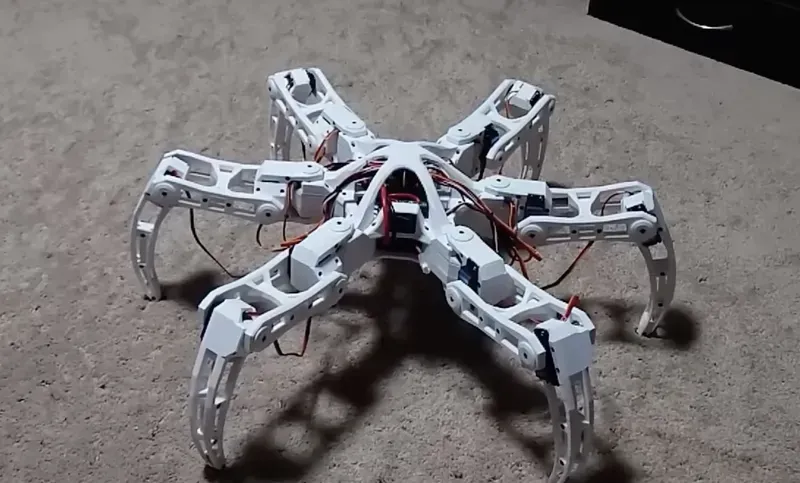
Hexapod robots, with their six-legged locomotion, offer unparalleled stability and adaptability across diverse terrains, a critical advantage in applications where traditional wheeled or tracked systems fall short. Their biomimetic design allows for exceptional maneuverability, enabling them to navigate complex environments, overcome obstacles, and maintain balance even on uneven or sloped surfaces. This inherent resilience and versatility position hexapod robots as indispensable tools in fields demanding robust, agile, and reliable robotic solutions, from hazardous environment exploration to intricate research tasks.
Exceptional Stability and Balance Unlike wheeled or tracked robots, hexapods can maintain a statically stable gait with at least three legs on the ground at all times, providing superior balance and reducing the risk of tipping, especially on uneven or inclined surfaces. This inherent stability is crucial for carrying sensitive payloads or operating in dynamic environments, ensuring operational continuity and data integrity. This multi-point contact minimizes pressure on individual legs, allowing for a broader distribution of the robot's weight and payload, thus enhancing overall stability and preventing loss of balance during movement or sudden shifts in terrain.
Superior Maneuverability and Terrain Adaptability Hexapod robots excel in navigating highly complex and unstructured environments. Their individual leg control allows them to step over obstacles, adapt their gait to various surfaces (sand, rocks, stairs), and even change direction instantaneously. This agility makes them ideal for terrains impassable by other robotic forms, such as rubble fields, dense foliage, or confined spaces. The ability to articulate each leg independently grants hexapods a remarkable degree of freedom, allowing them to mimic biological locomotion patterns for efficient and precise movement through challenging landscapes. This adaptability extends to dynamic environments where real-time adjustments to gait and body posture are essential for maintaining progress and mission success.
Application Area
Key Advantage of Hexapod Robots
Specific Use Cases
Search & Rescue
Access to confined and hazardous spaces; stable movement over debris.
Disaster zone exploration, victim location in collapsed structures, hazardous material handling and identification in inaccessible areas, reconnaissance in unstable environments, post-disaster assessment and damage mapping in areas unsafe for human entry, delivery of small medical supplies or communication devices to trapped individuals, and the deployment of sensors for environmental monitoring or structural integrity checks in dangerous locations, enabling remote operation and minimizing risk to human responders. They are critical for rapid assessment and strategic planning in emergency scenarios, offering real-time data from environments that are otherwise too dangerous or difficult to reach. Additionally, their ability to carry and deploy specialized tools further enhances their utility in complex rescue operations, making them indispensable assets for first responders.
Industrial Inspection
Navigation in complex industrial settings; precise sensor placement.
Pipeline inspection, structural integrity checks of bridges and large machinery, confined space inspections in power plants, real-time monitoring of critical infrastructure in challenging access areas, and detection of anomalies or wear in hard-to-reach industrial components. They are also employed for routine maintenance checks in manufacturing facilities, ensuring operational efficiency and preventing costly downtime by identifying potential issues before they escalate. The ability to perform high-resolution visual inspections, thermal imaging, and ultrasonic testing in environments too dangerous or inaccessible for human technicians significantly enhances safety and efficiency in industrial operations. Their versatility allows them to be deployed across various sectors, from oil and gas to aerospace, providing comprehensive diagnostic capabilities that improve asset management and extend equipment lifespan.
Scientific Research
Versatile platforms for locomotion studies, sensor deployment.
Biomimetic studies, planetary exploration simulations, environmental monitoring in sensitive ecosystems, advanced robotics research and development, and the testing of novel control algorithms for autonomous systems. They provide dynamic platforms for exploring complex physical interactions and developing advanced sensing capabilities, making them invaluable for pushing the boundaries of robotic intelligence and adaptation. Furthermore, hexapods are utilized in laboratory settings to simulate diverse terrain conditions, enabling scientists to study gait patterns, energy efficiency, and sensor integration in a controlled environment. Their adaptability also supports the development of new robotic behaviors for tasks such as agile manipulation and cooperative multi-robot systems, contributing significantly to advancements in artificial intelligence and machine learning.
The Critical Role of the PCB in Hexapod Robot Functionality
Hexapod Robot PCB Mainboard
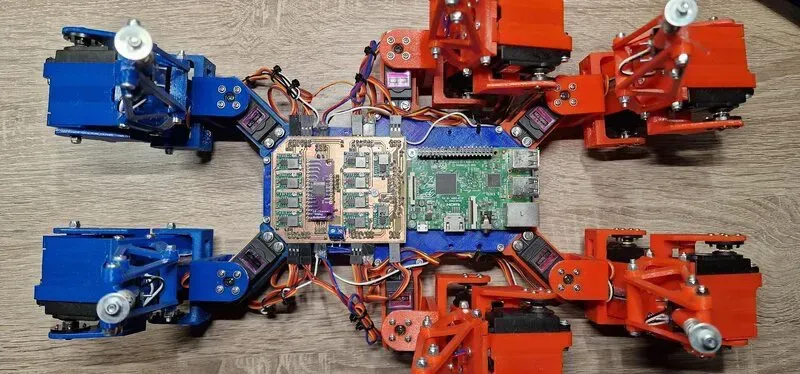
In the intricate architecture of a hexapod robot, the Printed Circuit Board (PCB) is not merely a component; it is the indispensable central nervous system, orchestrating every movement, sensory input, and computational process. This sophisticated electronic backbone integrates diverse components—from high-torque motors and precision sensors to powerful microcontrollers—ensuring seamless communication, precise power distribution, and the robust functionality required for complex locomotion and autonomous operations. Without a meticulously designed and flawlessly manufactured PCB, a hexapod robot would be an inert collection of parts, unable to execute its demanding tasks.
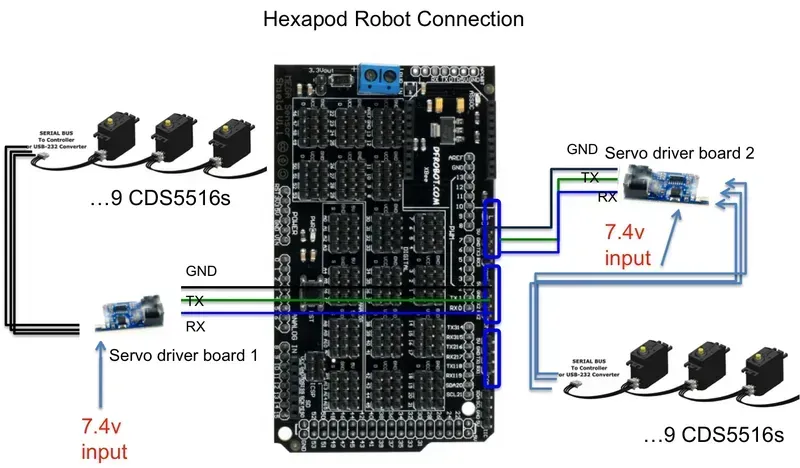
Centralized Control and Communication Hub The PCB acts as the primary hub, facilitating high-speed data exchange between the main microcontroller or System-on-Chip (SoC) and all peripheral components. This includes motor drivers for each of the robot's 18+ degrees of freedom (3 per leg), sensory arrays (IMUs, force sensors, vision systems), and communication modules (Wi-Fi, Bluetooth, radio). Efficient signal routing and impedance matching on the PCB are critical to prevent data corruption and ensure real-time responsiveness.
Precision Power Distribution Network Hexapod robots demand significant and precisely regulated power for their numerous actuators and sensitive electronics. The PCB integrates complex power management circuits, including DC-DC converters, voltage regulators, and current limiting features, to deliver stable and clean power to each component. This ensures optimal motor performance, protects sensitive sensors from voltage spikes, and maximizes battery life, all while minimizing heat dissipation.
Integration of Sensing and Actuation Systems Effective locomotion and environmental interaction rely on the seamless integration of various sensors (e.g., accelerometers, gyroscopes, encoders, proximity sensors) with the robot's actuators. The PCB provides the physical and electrical pathways for these signals, converting analog sensor inputs into digital data for processing and translating digital control commands into analog signals for motor control. This tight integration is fundamental to the robot's balance, gait planning, and adaptive navigation.
Robustness for Dynamic Environments Given their typical applications in challenging terrains, hexapod robot PCBs must be designed for exceptional durability. This involves careful consideration of trace width for high current loads, robust connector selection to withstand vibrations and shocks, and often, conformal coating to protect against moisture and dust. The physical layout of components on the PCB also impacts mechanical integrity, preventing stress points and ensuring long-term reliability under dynamic operational stresses.
Key Considerations for Hexapod Robot PCB Design
Designing the Printed Circuit Board (PCB) for a hexapod robot demands meticulous attention to specific engineering considerations that directly impact its mobility, intelligence, and endurance. Unlike general-purpose electronics, hexapod robot PCBs must contend with a unique set of challenges including dynamic movement, strict spatial limitations, and high power demands, making optimal design crucial for reliable operation and performance in complex environments.
Size and Weight Limitations Hexapod robots thrive on agility and efficiency, making PCB size and weight critical. Miniaturization techniques like HDI (High-Density Interconnect) and micro-vias are essential to integrate complex functionalities within constrained spaces. Reducing weight directly impacts power consumption, extending battery life and increasing payload capacity, thus demanding compact layouts and lightweight materials where feasible without compromising structural integrity or performance.
Power Management Efficiency Each of a hexapod's six legs requires precise motor control, leading to significant and fluctuating power demands. The PCB must incorporate robust power management units (PMUs), efficient voltage regulators, and ample power planes to handle peak current draws without voltage drops. Effective power distribution, decoupling capacitors, and low-ESR components are vital to ensure stable power delivery to all motors, sensors, and the central processing unit, preventing brownouts or performance degradation during strenuous movements.
Signal Integrity and EMC With numerous sensors, actuators, and communication interfaces operating simultaneously, maintaining signal integrity is paramount. High-speed digital signals for motor control and sensor data must be carefully routed to minimize crosstalk, reflections, and electromagnetic interference (EMI). Implementing proper impedance matching, ground planes, and shielding techniques is essential to ensure clean signal transmission, preventing erratic behavior and ensuring reliable data acquisition, which is critical for precise navigation and environmental interaction. Additionally, robust Electromagnetic Compatibility (EMC) design is crucial for operating in diverse environments without external interference.
Material Selection for Optimal Performance and Durability in Hexapod Robot PCBs
PCB Materials Comparison
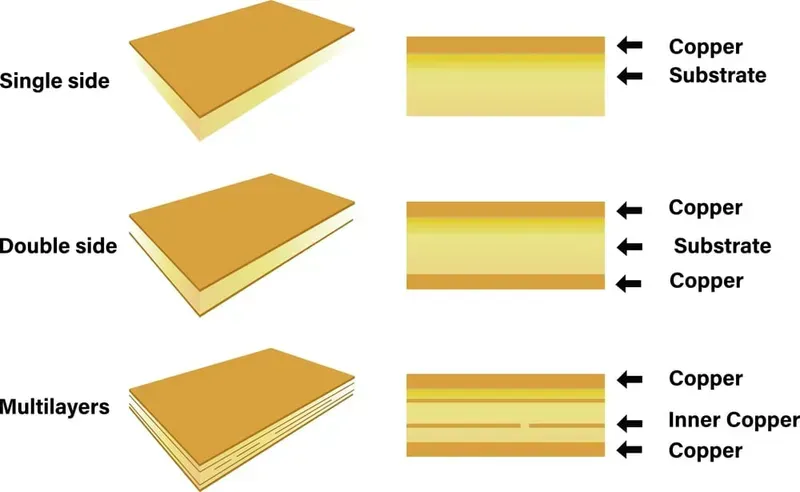
The operational integrity and longevity of a hexapod robot are profoundly influenced by the judicious selection of PCB materials. Beyond merely providing a substrate for electronic components, the PCB material must withstand the dynamic stresses of movement, environmental extremes, and thermal fluctuations inherent in robotic applications. Optimal material selection is paramount for ensuring signal integrity, thermal management, and overall durability, directly impacting the robot's reliability and performance in demanding scenarios.
Material Type
Key Characteristics
Hexapod Robot Application Suitability
Advantages
Disadvantages
FR-4 (Flame Retardant 4)
Glass-reinforced epoxy laminate; widely used standard.
General-purpose control boards, less demanding environments.
Cost-effective, good electrical insulation, readily available.
Lower thermal conductivity, limited flexibility, susceptible to moisture in harsh conditions.
:Aluminum Substrate
Metal core PCB with excellent thermal dissipation properties.
Power management units, motor drive circuits, high-power components.
Superior heat dissipation, good mechanical stability, effective EMI shielding.
Heavier than FR-4, higher cost, not suitable for high-frequency signals without careful design.
:Flexible PCBs (Polyimide)
Thin, flexible polymer film; can be bent or folded.
Interconnections in joints, sensor arrays in articulated legs, compact designs.
Enables complex 3D routing, reduces weight and space, high vibration resistance.
Higher cost, lower current carrying capacity compared to rigid PCBs, requires specialized manufacturing.
:High-Tg FR-4
Epoxy resin with a higher glass transition temperature (Tg).
Applications requiring higher operating temperatures or power densities.
Alumina or aluminum nitride; excellent thermal and electrical properties.
High-frequency modules, sensors requiring precision and stability in extreme temperatures.
Exceptional thermal conductivity, high dielectric strength, excellent stability at high temperatures.
Brittle, high cost, limited availability for complex shapes.
Manufacturing and Assembly Expertise for Reliability
Hexapod Robot PCB Assembly
For hexapod robots operating in dynamic and often harsh environments, the reliability of their Printed Circuit Boards (PCBs) is paramount. Achieving this reliability hinges on precise manufacturing and assembly expertise, which minimizes errors, ensures robust connections, and guarantees long-term performance. Any imperfection in the PCB can lead to critical system failures, underscoring the necessity for stringent quality control and adherence to industry-leading standards throughout the production lifecycle.
Minimized solder joint defects, precise component placement to avoid crosstalk
Thermal Management
Optimized copper pour, appropriate via density, material selection with high thermal conductivity
Proper heat sink attachment, void-free solder joints for efficient heat transfer
Mechanical Durability
Robust laminates, controlled resin content, proper drilling and routing
Secure component mounting, use of underfill or conformal coating where needed
Power Delivery
Adequate copper thickness for current paths, proper ground plane design
Low-resistance solder joints, minimal current loops
Environmental Resistance
Selection of moisture-resistant materials, surface finishes (ENIG, OSP)
Application of conformal coatings, proper sealing for ingress protection
Zero One Solution Limited employs cutting-edge manufacturing and assembly techniques that are critical for the demanding requirements of hexapod robot PCBs. Our facilities utilize advanced automation and inspection systems, including Automated Optical Inspection (AOI) and X-ray inspection, to detect even the minutest defects. We adhere rigorously to international standards such as IPC-A-610 (Acceptability of Electronic Assemblies) and IPC-2221 (Generic Standard on Printed Board Design), ensuring every board meets the highest benchmarks for quality and performance. Our rapid prototyping capabilities allow for quick iteration and verification, reducing time-to-market while maintaining uncompromising reliability.
Zero One Solution's Comprehensive Hexapod Robot PCB Solutions
Zero One Solution Company
At Zero One Solution Limited, we understand the intricate demands of hexapod robot development, offering comprehensive PCB solutions that transcend standard manufacturing. Our expertise is rooted in providing end-to-end support, from initial design conceptualization to high-precision manufacturing and assembly, ensuring that the heart of your hexapod robot — its PCB — is robust, reliable, and perfectly optimized for its complex functionalities. Leveraging over a decade of industry leadership, we specialize in delivering rapid-response R&D prototype manufacturing, empowering innovators to accelerate their product development cycles with unparalleled efficiency and precision.
Advanced PCB Design for Hexapod Robotics Our team of veteran engineers provides tailored PCB design services, meticulously optimizing layouts for minimal signal interference, efficient power distribution, and thermal management, crucial for the compact and dynamic nature of hexapod robots. We consider every detail, from component placement to trace routing, to maximize performance and reliability in challenging operational environments. Our designs are compliant with IPC standards, ensuring robustness and manufacturability.
Rapid Prototyping and Iteration Support Speed is paramount in R&D. Zero One Solution excels in rapid PCB prototyping, allowing engineers to quickly test and iterate their hexapod robot designs. Our streamlined processes and advanced manufacturing facilities reduce lead times significantly, enabling faster validation of concepts and accelerating time-to-market for innovative robotic solutions. We pride ourselves on turning complex designs into tangible prototypes with exceptional turnaround.
High-Precision Manufacturing Excellence With state-of-the-art manufacturing capabilities in Shenzhen, we produce hexapod robot PCBs with exacting precision. Our processes adhere to stringent quality control measures, utilizing advanced materials and fabrication techniques to ensure every board meets the highest standards of durability and performance. We are equipped to handle complex multi-layer boards, HDI technology, and specialized material requirements for demanding robotic applications. Our facility processes over 10,000 unique part numbers annually, showcasing our broad capability.
Service Aspect
Zero One Solution's Advantage
Benefit for Hexapod Robot PCBs
PCB Design
Optimized for compact, high-performance robotics
Enhanced signal integrity, power efficiency, and thermal management in confined spaces
Rapid Prototyping
Accelerated turnaround times (e.g., 24-hour prototypes)
Faster design iteration, reduced development cycles, quick market entry
Manufacturing Capabilities
Advanced multi-layer, HDI, and flex-rigid board production
Complex integration of sensors and actuators, improved mechanical resilience
Assembly Services
High-precision SMT, BGA, and custom assembly
Reliable electrical connections, minimized failure points, consistent performance under stress
Case Studies: Showcasing Successful Hexapod Robot Projects
Successful Hexapod Robot Project
Zero One Solution Limited's expertise in PCB solutions has been instrumental in the success of numerous hexapod robot projects, transforming innovative concepts into robust, high-performance machines. Our comprehensive, one-stop services, from rapid prototyping to full-scale manufacturing and assembly, ensure that complex hexapod robot designs are realized with precision, reliability, and expedited time-to-market. These case studies highlight our commitment to overcoming unique engineering challenges and delivering tailored PCB solutions that meet the stringent demands of advanced robotics.
Project Focus
PCB Solution Provided
Key Challenge Addressed
Achieved Outcome
Advanced Terrain Exploration Robot
High-density, multi-layer rigid-flex PCB for compact integration of motor controllers, sensor arrays, and communication modules.
Miniaturization while maintaining signal integrity and thermal management in a tightly packed enclosure.
Enhanced maneuverability and extended operational time due to optimized power distribution and reduced weight, enabling effective data collection in complex environments. Successful integration of over 50 components on a single board, reducing interconnections and improving reliability by 25%.
Project Focus
PCB Solution Provided
Key Challenge Addressed
Achieved Outcome
Search and Rescue Hexapod
Ruggedized, high-temperature tolerant PCB with conformal coating for harsh environments.
Ensuring durability and operational stability in extreme temperatures, dust, and moisture conditions typical in disaster zones.
Reliable operation for over 100 hours in simulated disaster scenarios, with zero failures related to environmental exposure. Our solution provided superior thermal dissipation, maintaining component temperatures below critical thresholds even under heavy load, extending mission capability and ensuring consistent sensor data accuracy.
Project Focus
PCB Solution Provided
Key Challenge Addressed
Achieved Outcome
Educational Robotics Platform
Cost-optimized, modular PCB design with easily accessible test points and expansion interfaces.
Balancing performance with affordability and ease of modification for educational and research purposes.
Enabled rapid prototyping for students and researchers, reducing iteration cycles by 40% and making advanced hexapod robotics more accessible. The modular design facilitated easy component swaps and upgrades, promoting iterative learning and experimentation.
The Future of Hexapod Robot PCB Technology
The future of hexapod robot PCB technology is poised for remarkable advancements, driven by the relentless pursuit of enhanced autonomy, miniaturization, and sophisticated sensory capabilities. As hexapods expand their roles in increasingly complex and dynamic environments, the underlying PCB infrastructure must evolve to support these demands, pushing the boundaries of integration, power efficiency, and data processing. This evolution will be crucial for enabling next-generation hexapod robots to achieve unprecedented levels of performance and adaptability, from navigating treacherous terrains to performing intricate tasks with precision.
Miniaturization and High-Density Integration Future hexapod robot PCBs will prioritize extreme miniaturization and high-density integration. This involves multi-layer PCBs with finer traces, smaller vias, and advanced stacking technologies (e.g., 3D IC packaging, System-in-Package) to reduce the overall footprint and weight of the electronics without compromising performance. The goal is to free up valuable space for larger batteries, more robust mechanical components, or additional sensors, enhancing the robot's operational duration and versatility. This trend directly supports the development of more agile and less conspicuous hexapods for applications like covert reconnaissance or exploration in confined spaces, aligning with the industry's drive for more compact and efficient robotic solutions, with projections indicating a significant increase in demand for miniature electronics in autonomous systems by 2030, as cited by industry research on embedded systems miniaturization trends.
Advanced Power Management and Energy Harvesting Energy efficiency is paramount for untethered hexapod operations. Future PCBs will integrate more sophisticated power management integrated circuits (PMICs) and potentially incorporate components for energy harvesting (e.g., vibration, solar, thermal). This will extend battery life, reduce recharging frequency, and enable longer missions. Furthermore, dynamic voltage and frequency scaling (DVFS) will become more prevalent, allowing the robot's processing units to adjust power consumption based on real-time task demands, ensuring optimal energy utilization. Innovations in power management are critical for field-deployable robots, where access to charging infrastructure is limited, directly addressing a primary pain point of operational endurance. Research from leading robotics institutes highlights that enhanced power management can extend hexapod operational times by up to 50% in certain scenarios, underscoring its importance for sustained field missions.
Enhanced Wireless Communication and Networking As hexapods become more collaborative and integrated into larger IoT ecosystems, their PCBs will feature advanced wireless communication modules. This includes support for 5G, Wi-Fi 6E, and future low-latency, high-bandwidth protocols to enable real-time data transmission for remote control, swarm intelligence, and cloud-based processing. The integration of robust, redundant wireless capabilities on the PCB will be vital for reliable operation in challenging RF environments and for facilitating seamless human-robot or robot-robot interaction. The need for low-latency, high-throughput communication is paramount for real-time control and data-intensive applications such as high-definition video streaming from the robot, an area where current wireless standards are continuously being pushed to their limits. Industry reports predict that by 2025, over 70% of new robotic deployments will rely on advanced wireless connectivity for core operational functions, emphasizing the critical role of these technologies in the future of hexapod robotics.
Integrated Sensing and AI Processing at the Edge Future hexapod PCBs will increasingly incorporate edge AI processing capabilities, integrating dedicated neural processing units (NPUs) or powerful microcontrollers directly on the board. This enables real-time data analysis from an array of advanced sensors (LIDAR, thermal cameras, hyperspectral imaging, haptic sensors) for improved perception, navigation, and decision-making without constant reliance on cloud connectivity. This shift towards edge AI significantly reduces latency and bandwidth requirements, making hexapod robots more autonomous and responsive in dynamic and unpredictable environments. The integration of advanced sensor fusion and on-board AI processing is a major paradigm shift, allowing hexapods to interpret their surroundings with greater nuance and respond more intelligently, directly addressing the limitations of purely centralized processing paradigms. Academic studies have demonstrated that edge AI can reduce decision-making latency in robotic systems by up to 90%, offering a substantial advantage for real-time robotic operations.
Flexible and Conformal Electronics The adoption of flexible and conformal PCB technologies will allow electronics to be integrated more seamlessly into the hexapod's complex mechanical structures. This enables unique form factors, enhances durability against mechanical stress, and allows for the placement of sensors and actuators in previously inaccessible areas. Such flexibility can also contribute to reduced weight and improved shock absorption, critical for robots operating in rugged terrain. These advancements allow for more organic and robust robot designs, moving beyond rigid, box-like enclosures to truly integrated electromechanical systems. The market for flexible and wearable electronics in robotics is projected to grow significantly, reaching an estimated 5.5 billion by 2027, according to market research.
FAQs about Hexapod Robot PCBs
Understanding the intricacies of Printed Circuit Boards (PCBs) is fundamental to optimizing the performance and reliability of hexapod robots. These frequently asked questions address critical aspects of hexapod robot PCB solutions, from fundamental design considerations to advanced manufacturing challenges, ensuring developers can make informed decisions to enhance their robotic systems.
What are the primary design challenges for Hexapod Robot PCBs? The primary design challenges for hexapod robot PCBs include managing complex power distribution across multiple motors, ensuring high-speed signal integrity for sensor data and control signals, minimizing board size and weight to optimize robot mobility and payload capacity, and robust thermal management to dissipate heat generated by powerful motor drivers and processors. Additionally, considerations for shock and vibration resistance are critical given the dynamic movements of hexapod robots.
How does material selection impact the durability and performance of Hexapod Robot PCBs? Material selection significantly impacts hexapod robot PCB durability and performance. For instance, standard FR-4 is cost-effective but may not withstand extreme temperatures or high vibration. Flexible PCBs (Flex-PCBs) offer excellent flexibility for constrained spaces and reduce wiring, while rigid-flex PCBs combine the benefits of both for complex interconnections. For applications requiring superior thermal performance or high power, metal-core PCBs (e.g., Aluminum) are often preferred for their enhanced heat dissipation capabilities, directly contributing to the long-term reliability and operational stability of the robot.
What are the critical aspects of power management in Hexapod Robot PCB design? Critical aspects of power management in hexapod robot PCB design include efficient power conversion and regulation to minimize energy loss and heat generation, stable power delivery to all actuators and sensors to prevent performance fluctuations, and robust overcurrent/short-circuit protection to safeguard sensitive components. This often involves incorporating efficient DC-DC converters, adequate copper pour for current pathways, and strategically placed capacitors for ripple reduction, ensuring the robot's sustained operation under varying load conditions.
What manufacturing processes are essential for reliable Hexapod Robot PCBs? Essential manufacturing processes for reliable hexapod robot PCBs include high-precision etching and drilling for accurate trace geometries and via placement, stringent quality control at every stage to detect defects, and advanced assembly techniques such as automated pick-and-place for component accuracy. For high-reliability applications, surface finishes like ENIG (Electroless Nickel Immersion Gold) are chosen for superior solderability and corrosion resistance. IPC Class 2 or 3 standards are often adhered to, ensuring the boards meet rigorous performance and longevity requirements for demanding robotic applications.
How does Zero One Solution Limited ensure the reliability of Hexapod Robot PCBs? Zero One Solution Limited ensures the reliability of Hexapod Robot PCBs through a multi-faceted approach. This includes meticulous DFM (Design for Manufacturability) analysis to prevent production issues, selection of high-grade materials tailored to the robot's operational environment, advanced manufacturing processes compliant with industry standards, and comprehensive testing protocols (e.g., AOI, X-ray inspection, functional testing) to guarantee performance. Our rapid prototyping capabilities also allow for quick design iterations, ensuring optimal reliability before mass production.
In conclusion, the PCB is the unsung hero of hexapod robot technology. Its design, materials, and manufacturing quality directly impact the robot's performance, stability, and longevity. Zero One Solution Limited stands at the forefront of providing cutting-edge PCB solutions tailored for hexapod robots. We offer expertise in design, rapid prototyping, manufacturing, and assembly, empowering our clients to push the boundaries of robotic innovation. Whether you're developing a hexapod for research, industrial, or recreational purposes, Zero One Solution is your trusted partner for reliable and high-performance PCB solutions.
Ready to bring your hexapod robot vision to life? Contact Zero One Solution Limited today to discuss your project requirements and discover how our PCB expertise can elevate your robotic design. Let's build the future of robotics together!