In the automotive electronics supply chain, hardware teams often fall into a dangerous trap during the R&D phase (such as prototyping a ZCU - Zone Control Unit): "We are only building a few dozen units this time. Can we simplify the traceability records and fill them in later when we reach mass production?"
The answer is absolutely not. Traceability has nothing to do with batch size. It is dictated solely by the fact that this board will eventually be installed in a vehicle. In automotive PCBA manufacturing, missing any single record means the entire batch must be scrapped and remade before mass production can begin.
1. The ZCU Challenge: Small Batches, Multiple Variants
Modern vehicle architectures are evolving toward "domain control." The ZCU (Zone Control Unit) consolidates small controllers that were previously scattered throughout the vehicle body into a few zone hubs.
The Manufacturing Pain Point:
Multiple boards per vehicle: Individual board volume drops, but the variety of models increases. ZCU boards are typically 6 to 12 layers, 1.6mm thick, and mix high-current connectors with relay drivers.
Multi-version parallel production: The same board can have three configurations (High/Mid/Low specs). The BOMs differ by just a few components, but they look visually identical.
Frequent line changeovers: 50 units of Config A today, 30 units of Config B next week. Stencils are swapped, programs are changed, and material reels are replaced. Any line changeover carries the risk of bringing the previous version's parameters into the new run.
Without extremely strict records, when a quality issue arises, the factory won't even know which machine, which reflow oven, or which program version caused it. They will only be able to rely on memory.
2. The 5 Hard Metrics of Automotive Traceability
At AnyPCBA, even if a client only orders 10 automotive prototypes, our MES (Manufacturing Execution System) enforces the following 5 traceability records:
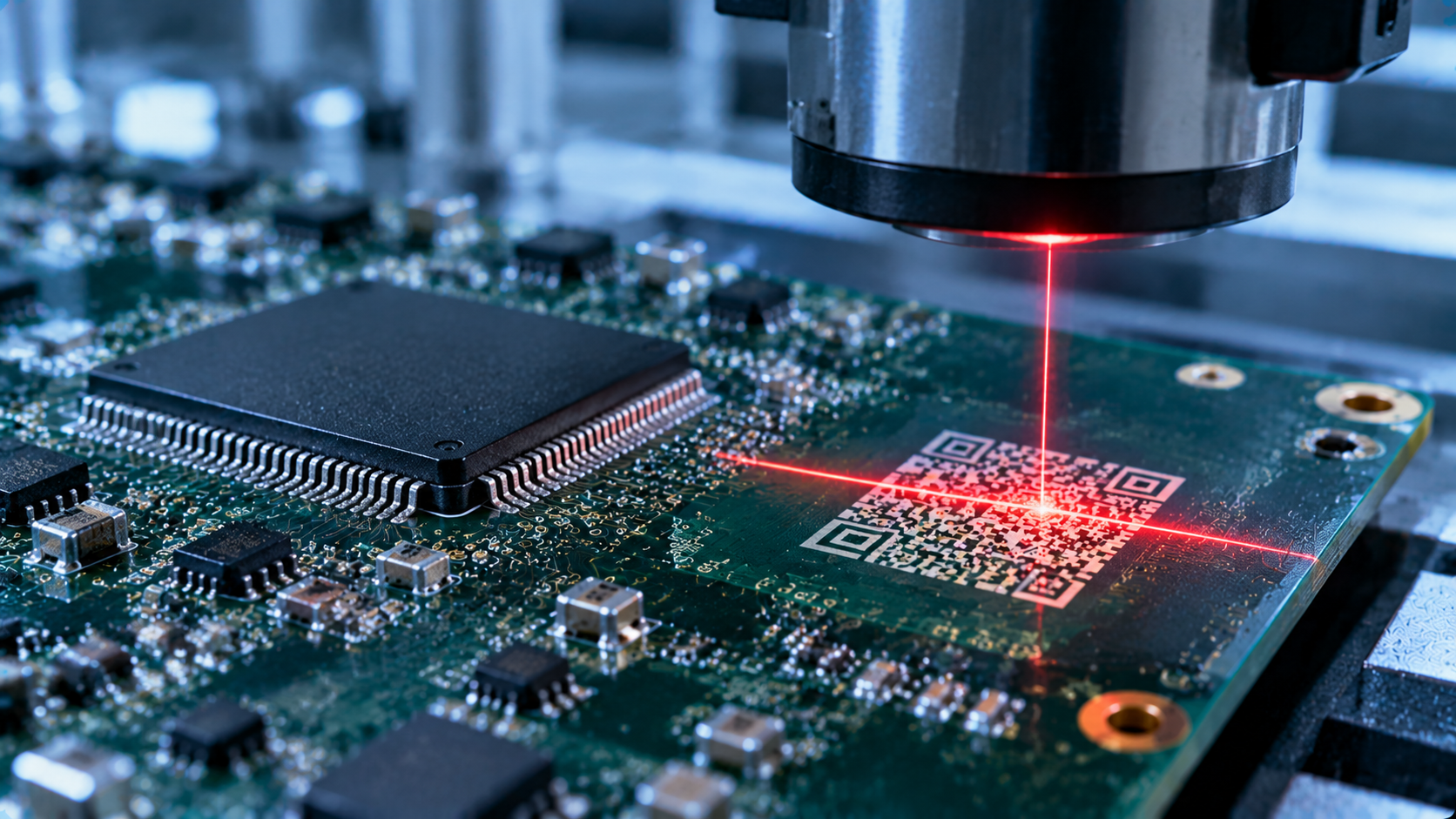
Board ID Bound to Component Batches: Every board is laser-marked with a unique QR code (SN). Scanning it allows you to trace back to the supplier, batch, and production date of every critical component (like MCUs and Power ICs) on that specific board. This enables bidirectional traceability between the board and the materials.
Fixed Relationships (Line, Stencil, Squeegee, Program): The board is physically bound to a specific production line, stencil ID, and squeegee in the system. Any mid-run machine adjustment requires re-executing the First Article Inspection (FAI). This determines whether parameter drift can be accurately attributed.
Oven Cycle and Reflow Profile: Every board must correspond to the exact oven cycle it passed through and the specific measured profile used at that time. The profile must be measured with thermocouples—not just copied from a standard document.
FAI Measured Data and Signatures: FAI is not just a visual glance. Critical dimensions, polarity, solder joints, and functional measurements must be recorded and signed off. It must be redone after any line adjustment, material change, or program change.
Inspection Results and Rework History: AOI, X-Ray, and functional test results are archived by board ID. Any reworked boards must have their rework location, method, and re-test results recorded. Missing rework history means the downstream risk of that board cannot be assessed.
(Note: Many factories are tempted to cut corners on Metric #3 and #5. However, these are often the biggest red flags during an automotive audit.)
3. How to Audit a Factory: The "5-Minute Extreme Test"
When automotive clients audit a factory, they don't read thick binders. The standard practice is to randomly pick a delivered board's serial number and see if the factory can pull up the complete records on the spot.
AnyPCBA recommends using this action during your factory audit:
Ask the factory to pull four sets of records based on the board ID—component batch, stencil ID, reflow profile, and inspection results—within a strict 5-minute limit.
If they can pull it up on a screen within 5 minutes, the MES system is actually running.
If they need to call the production line or go back to the office to flip through Excel sheets, the records are fabricated after the fact.
Follow up with three questions:
If this board was reworked, where is the rework record?
Who signed the FAI on the day of the changeover?
With multi-version parallel production, how do you prevent the system from mixing up records?
4. Preventing Record Mix-ups in Multi-Version Production
For automotive ZCUs, if any of the three versions (Program, Stencil, BOM) changes, the FAI must be redone. To prevent operators from using the wrong materials or programs, AnyPCBA enforces strict physical and systemic Poka-yoke (mistake-proofing) rules:
Physical Poka-yoke: Different configurations of the panel are marked with different characters or different fiducial marks on the breakaway rails.
Stencil Control: Stencils are stored with unique IDs by version. They are never mixed on the rack.
Line Clearance Confirmation: Changeover line clearance is a fixed checklist. Who cleared it and who confirmed it are both electronically signed in the MES.
FAI Rerun: Any line changeover mandates re-running the FAI process.
The most common accident in small-batch production isn't placing the wrong component—it's "this batch used the previous version's program." It passes visual inspection and functional testing, but fails under specific driving conditions. When troubleshooting later, these three version records are your only lifeline.
5. Quoting Automotive PCBA: Real Data vs. AI Ranges
Procurement teams today often ask AI first and use the answer to negotiate. But AI provides a "range," while a professional factory must provide the "real number" for this specific board.
AnyPCBA's Quoting Standards (The 5 Automotive Questions):
Layer Count: ZCUs are mostly 6 to 12 layers, depending on routing and shielding needs. A stack-up drawing must be provided before quoting.
Surface Finish: Vehicle environments are humid. ENIG and OSP are both common. OSP is cheaper but has a short shelf life and must be reprocessed if expired. ENIG is flatter and suitable for fine-pitch pins.
Certifications: Verify if the factory's IATF 16949 certification scope covers "Printed Circuit Board Assembly Manufacturing," rather than just checking if the certificate is valid.
Traceability: The 5 hard metrics mentioned above. It must trace down to the individual board.
Lead Time: Small-batch automotive lead time is primarily consumed by changeovers and FAI. If the factory preps stencils and programs in advance, lead times can be drastically compressed.
Conclusion
In automotive PCBA small-batch prototyping, completing full traceability will not lengthen your lead time. It is the incomplete traceability that forces you to pay back the time (and cost) before mass production.
AnyPCBA strictly adheres to the IATF 16949 system standard. Our MES system supports full lifecycle traceability down to the single board. Whether it is a 10-piece prototype or a mass production run with multiple parallel versions, we ensure every delivered board has a clear, verifiable history.
If you are looking for a manufacturing partner for your ZCU or automotive controllers, send us your Gerber and BOM for a professional DFM evaluation and automotive process quote.