Understanding the 470k Resistor: Applications, Specs, and More
2025.02.06
The humble 470k resistor, a small yet vital component, is found in countless electronic devices around us. From adjusting the tone in your guitar amp to ensuring accurate voltage in a circuit, this resistor plays a crucial role. In this article, we'll delve into the specifications, applications, and significance of the 470k resistor, helping you understand its importance in both the micro and macro worlds of electronics. We will unlock its secrets, demonstrating how a seemingly simple component can have such a broad impact on technology and creativity. Let’s explore!
What is a 470k Resistor?
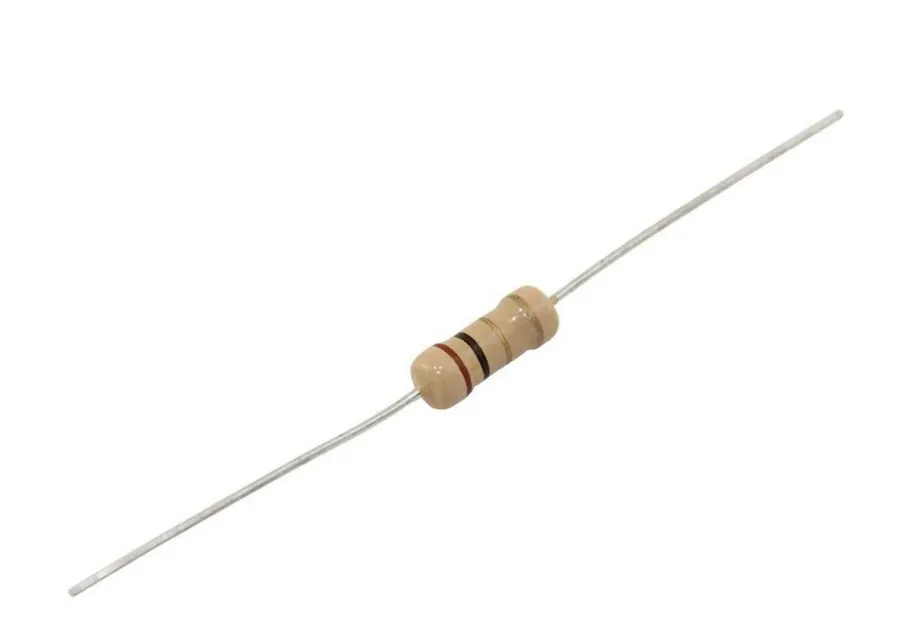
470k Resistor
A 470k resistor is a passive electronic component designed to impede the flow of electrical current, characterized by its resistance value of 470 kilo-ohms (kΩ), equivalent to 470,000 ohms. This component plays a crucial role in controlling current and voltage levels within electronic circuits. The 'k' designation denotes a multiplier of one thousand, a standard notation within electronics for convenience.
470k Resistor Specifications and Characteristics
470k Resistor on PCB
The 470k resistor, a ubiquitous component in electronics, is characterized by specific parameters that define its behavior and suitability for various applications. Understanding these specifications is crucial for effective circuit design and analysis. The primary specification is its resistance value, which is fixed at 470 kilo-ohms, or 470,000 ohms. However, several other factors are essential, including tolerance, power rating, and physical construction.
Specification
Description
Typical Values
Resistance
The opposition to current flow, measured in ohms.
470kΩ (470,000 ohms)
Tolerance
The acceptable deviation from the stated resistance value.
±5% (common), ±1%, ±2% (higher precision)
Power Rating
The maximum power the resistor can safely dissipate as heat.
1/4 Watt, 1/2 Watt, 1 Watt (common)
Resistor Type
The material and construction method of the resistor.
Carbon film, Metal film, Wire-wound
Temperature Coefficient
The change in resistance per degree Celsius.
Varies with resistor type (e.g. ±200ppm/°C)
Construction
The physical form factor and mounting style of the resistor.
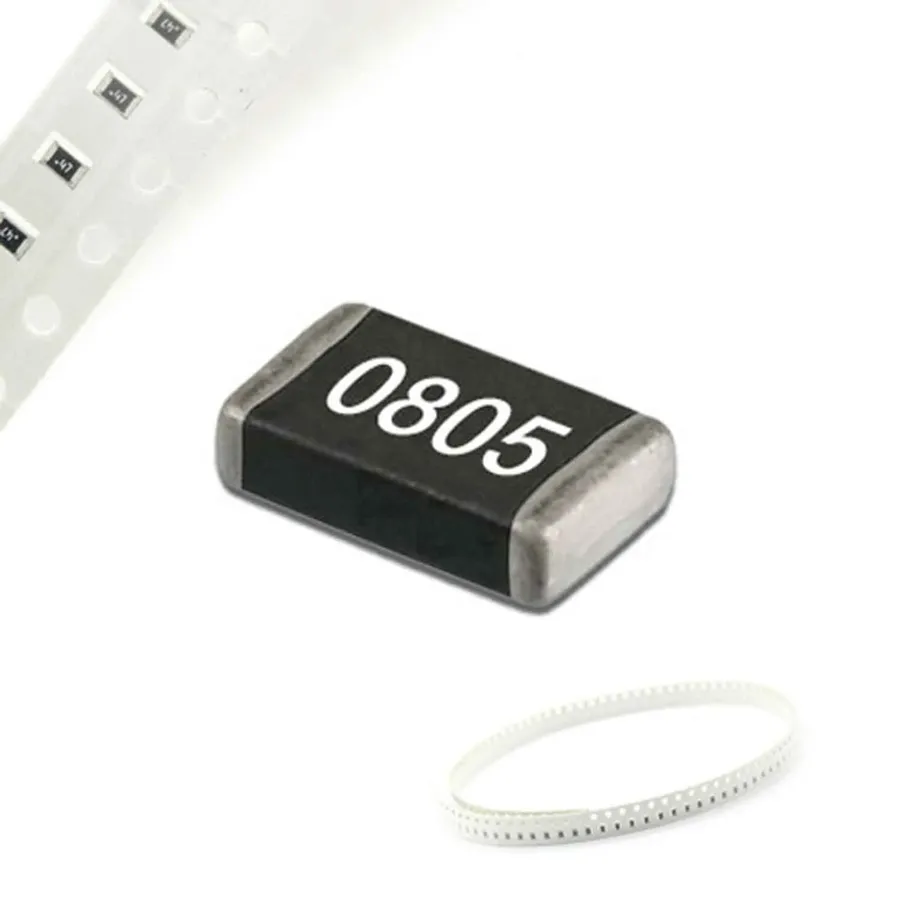
Axial leaded, SMD (Surface Mount Device)
The resistor's tolerance, generally specified as a percentage (e.g., ±5%), defines the permissible range of its actual resistance relative to its nominal value. Power rating, typically given in watts, indicates how much power the resistor can safely dissipate without overheating or failing. Common power ratings for 470k resistors include 1/4 watt and 1/2 watt, though higher ratings are available for more demanding applications. Resistors are also classified by their construction type, the most common being carbon film, metal film and wire-wound. Additionally, axial leaded and surface mount devices (SMD) represent common form factors that determine how the resistor is integrated into a circuit. Axial leaded resistors are commonly used in through-hole mounting, while SMDs are designed to be surface mounted, offering greater component density and automated assembly options.
470k Resistor Color Code
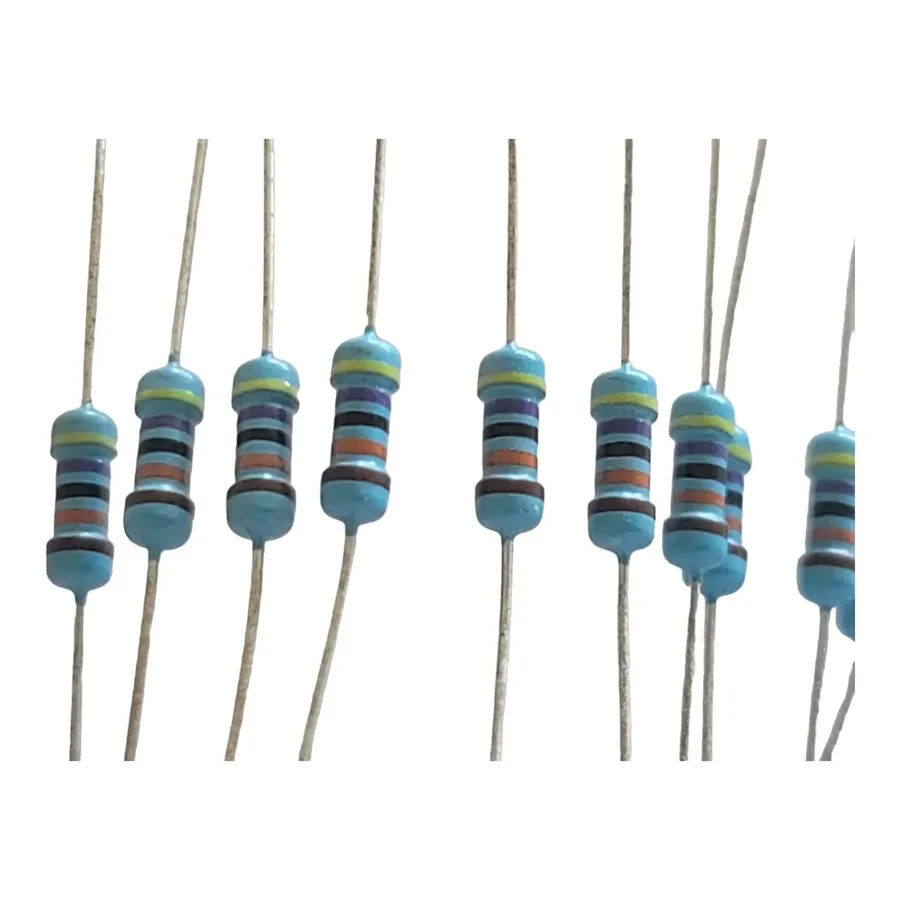
Resistor Color Bands
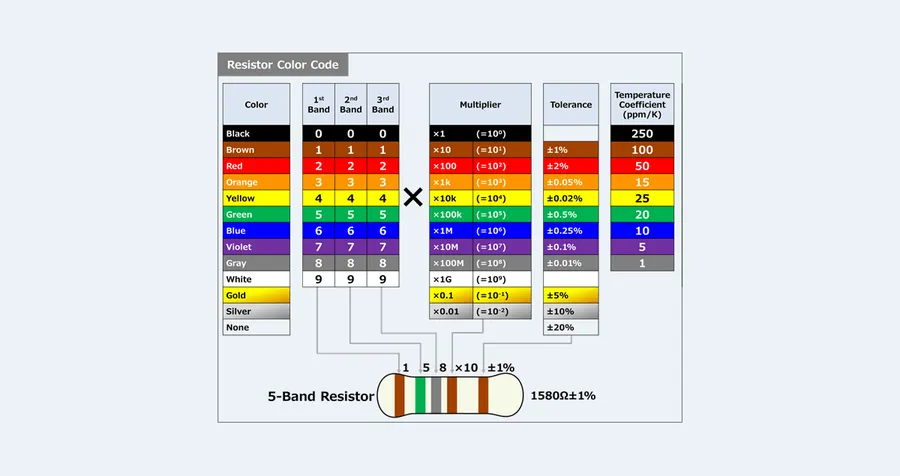
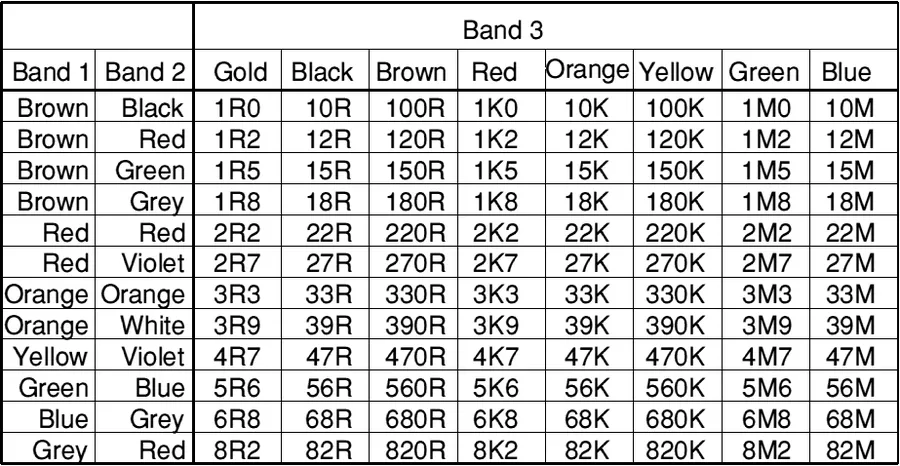
The 470k resistor's value is visually encoded using a system of colored bands, a standard practice for identifying resistance in electronic components. These bands, read sequentially, indicate the resistance value, tolerance, and sometimes temperature coefficient. Understanding this color code is crucial for correctly identifying and using 470k resistors in circuit design and repair.
Band
Color
Digit/Multiplier
Tolerance
1st Band
Yellow
4
-
2nd Band
Violet
7
-
3rd Band
Yellow
10,000 (Multiplier)
-
4th Band
Gold or Silver
-
Gold (5%) or Silver (10%)
For a 470k ohm resistor, the sequence is typically Yellow (4), Violet (7), Yellow (10,000 multiplier), and then a gold or silver band, indicating a 5% or 10% tolerance, respectively. Note that, older resistors or specialized types might have different color band systems, but the typical 4-band system described is by far the most common.
Common Applications of the 470k Resistor
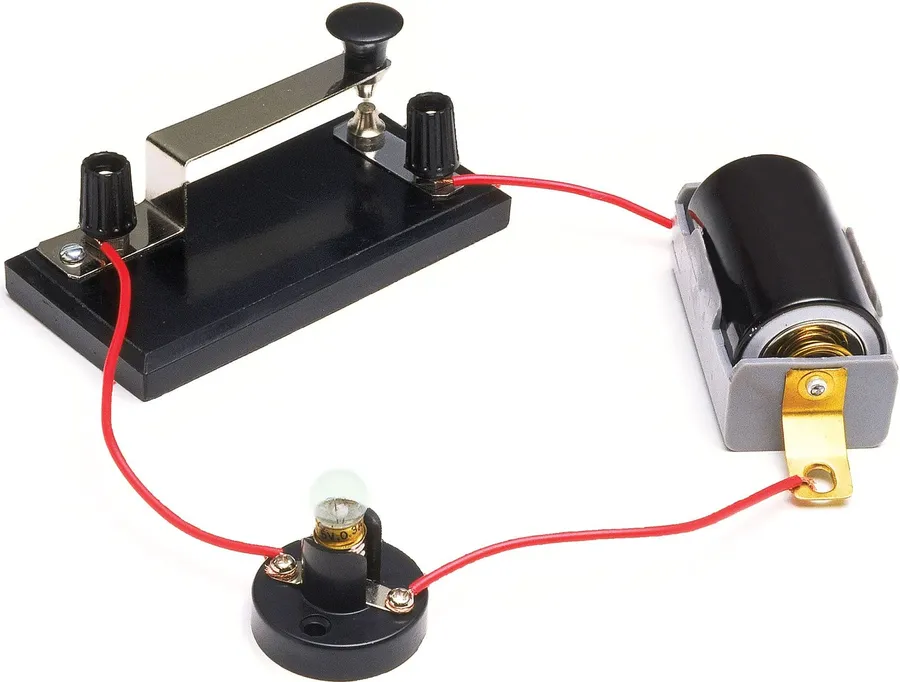
Electronic Circuit
The 470k resistor, with its relatively high resistance value, finds use in a diverse range of electronic applications. These applications leverage its ability to limit current and control voltage levels within circuits. Its specific resistance makes it suitable for both analog and digital circuitry, providing a balance between current limitation and signal integrity.
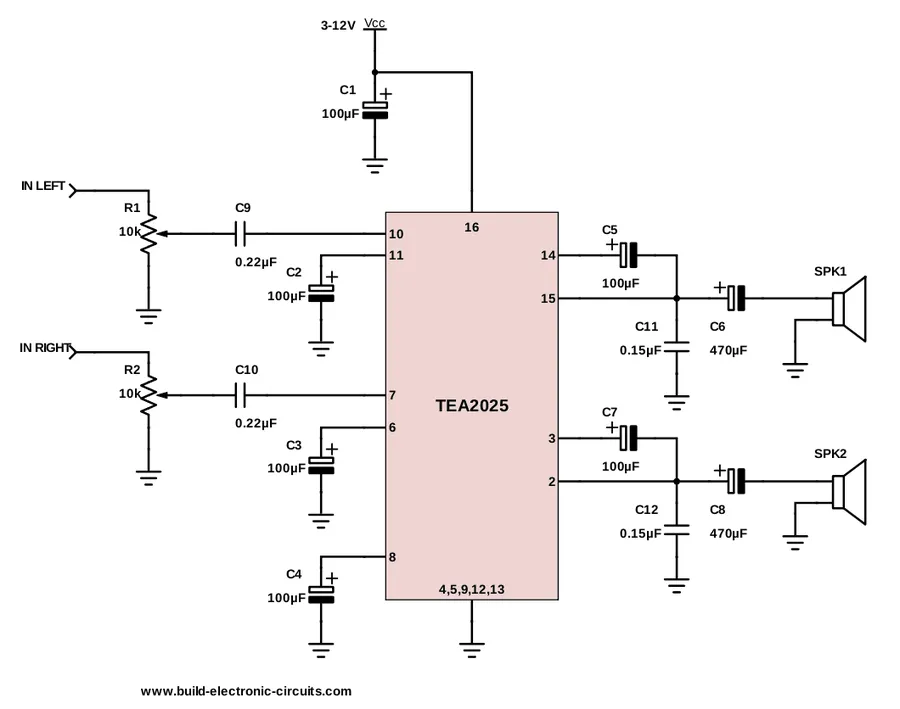
Audio Circuits In audio applications, 470k resistors are commonly used in tone controls and volume adjustments. They act as a load for potentiometers or in passive EQ circuits to modify frequency response and signal levels. For instance, in guitars, 470k resistors are often part of the tone circuitry where they interact with capacitors to shape the overall tonal characteristics.
Voltage Dividers 470k resistors are fundamental components in voltage divider circuits. They can be combined with other resistors to provide a specific fraction of an input voltage as an output. This is useful when scaling voltage levels for sensor inputs or for biasing transistors, essential for providing a stable and predictable reference voltage for various circuit components.
Pull-Up/Pull-Down Resistors In digital logic, 470k resistors are used as pull-up or pull-down resistors. When inputs to microcontrollers or logic gates need to be set to a known state when not actively driven, these resistors provide a default state. They ensure that an input is either pulled high (to the supply voltage) or low (to ground), preventing floating input signals, which can cause erratic behavior.
Timing Circuits 470k resistors are also used in timing circuits with capacitors. These resistor-capacitor (RC) networks create time constants that control the charging and discharging rates of the capacitor, allowing the creation of timed events. This is often used in astable and monostable multivibrators, timers, and other applications requiring time-dependent signal manipulation.
The 470k Resistor in Audio Equipment
Audio Amplifier
In audio circuits, the 470k resistor plays a crucial role in shaping the tonal characteristics and controlling the volume of audio signals. Its moderate resistance value makes it suitable for applications where precise adjustments are needed without significant signal attenuation. The 470k resistor is a frequent component found in audio equipment like guitars, amplifiers, and mixing consoles, which is primarily used for passive control.
Guitar Tone Controls The 470k resistor is commonly employed in the tone control circuits of electric guitars. It works with capacitors to create a low-pass filter, which attenuates high frequencies and adjusts the overall brightness or warmth of the sound. The most common way is to pair a 470k potentiometer with a capacitor to shape tone.
Volume Adjustment The 470k resistor, often in conjunction with a potentiometer, is used to control the volume levels in audio circuits. Its resistance is carefully chosen to offer a wide range of volume levels without excessively distorting the audio signal. It is also used as a load on a potentiometer.
Passive EQ Circuits In passive equalization (EQ) circuits, 470k resistors are used to set the cut-off frequencies or gain for specific frequency bands by working with other passive components. It helps to shape the audio spectrum by boosting or attenuating specific frequency ranges. These EQ circuits are used in effects units and mixing consoles.
Input and Output Impedance Matching In some audio circuits, 470k resistors are used for impedance matching to ensure optimal signal transfer between different stages of the circuit. Matching impedances can minimize signal loss and maximize the power transfer between components. It is also used to ensure that the signal voltage level does not drop excessively from source to load.
470k Resistor vs. Other Resistor Values
Resistor Selection
The 470k resistor occupies a specific niche within the spectrum of resistor values, with its high resistance making it suitable for particular applications. Understanding how it differs from other common values like 10k, 47k, and 1M is crucial for effective circuit design.
Resistor Value
Typical Application
Circuit Behavior
10k
General purpose pull-up/pull-down, feedback networks, bias circuits
Moderate current limiting, allows for relatively strong signals while providing some impedance
Higher resistance than 10k, suitable for higher impedance circuits, less impact on signal loading
470k
Audio tone controls, high-impedance bias, some specialized timing circuits
Very high resistance, minimal current flow, used when minimal signal loading or large time constants are required
1M
High impedance biasing, timing circuits (long time constants)
Extremely high resistance, very little current flow, suitable for extremely high-impedance circuits or very long time constants
The selection of a resistor value depends critically on the intended application. Lower resistance values like 10k are suitable where some current flow is desired, for example, in pull-up/pull-down circuits, or feedback networks of operational amplifiers. Medium resistance values, like 47k are commonly used for signal conditioning or as part of a feedback loop. Comparatively, the higher values, like 470k, and 1M, offer significant resistance, limiting current flow and reducing the impact on the signal or the circuit. Understanding these differences is crucial to selecting the appropriate value for the specific application.
Frequently Asked Questions About 470k Resistors
This section addresses common queries regarding 470k resistors, clarifying their usage, characteristics, and potential issues that users often encounter.
What is the difference between a 4-band and a 5-band 470k resistor? A 4-band resistor uses four color bands to indicate its resistance value, tolerance, and sometimes a temperature coefficient. A 5-band resistor adds a fifth band for increased precision in resistance indication, often used for lower tolerance values. The 470k resistor, in either configuration, still maintains a resistance of 470,000 ohms.
Can a 470k resistor be used as a direct replacement for a different value, and what is the impact on the circuit? Substituting a 470k resistor for a different value will impact the circuit's behavior. Resistor values are chosen based on Ohm's Law and the needs of specific circuit functions. Using a different value will change voltage, current, and signal characteristics, potentially causing malfunction, component damage, or the circuit to not operate correctly. Always refer to the original circuit design specifications.
What are the key electrical characteristics of a 470k resistor and what effect do they have in a circuit? The key characteristics of a 470k resistor are its resistance (470,000 ohms), power rating (how much power it can dissipate without damage), and tolerance (the allowed variance in its stated resistance). These characteristics dictate the current, voltage, and power conditions for the circuit. For example, a higher resistance limits the amount of current flow through the circuit.
What happens if a 470k resistor fails or goes bad? If a 470k resistor fails, it typically results in an open circuit (no current flow) or short circuit (uncontrolled current flow). This can disrupt circuit functionality, causing symptoms like loss of signal, incorrect voltage levels, or potentially damaging other components. Overheating or discoloration may indicate a failed resistor.
How do you test a 470k resistor? A 470k resistor can be tested using a multimeter set to measure resistance. Place the multimeter probes across the resistor leads, and compare the measured value with the specified 470k ohms. A value within the tolerance range indicates the resistor is functioning correctly. A reading of zero ohms indicates a short circuit failure, while a reading of infinite ohms (or an OL message on the multimeter) indicates an open circuit failure.
What does the 'k' mean in '470k' resistor? The 'k' in '470k' stands for kilo, which is a prefix meaning one thousand (1000). Therefore, a 470k resistor has a resistance of 470,000 ohms (470 x 1000 ohms). This designation is used for convenience and to avoid writing large numbers.
Is there a difference between a metal film 470k resistor and a carbon film 470k resistor? Yes, there are differences between metal film and carbon film resistors. Metal film resistors typically have tighter tolerances, lower temperature coefficients, and lower noise than carbon film resistors. Metal film resistors are generally preferred for precision applications, while carbon film resistors can be more cost-effective for general-purpose use.
Choosing the Right 470k Resistor
Resistor Packages
Selecting the correct 470k resistor is crucial for optimal circuit performance and reliability. The choice depends on several key factors, including tolerance, power rating, application, and the physical construction of the resistor. Incorrect selection can lead to performance issues or even component failure. This section provides guidance on these critical aspects, ensuring you choose the most suitable resistor for your specific needs.
Tolerance Tolerance refers to the precision of the resistor's actual resistance compared to its stated value. Common tolerances for 470k resistors include 5% (gold band) and 10% (silver band). A 5% tolerance means that the actual resistance can vary by plus or minus 5% of the stated 470k ohms, i.e. within the range of 446.5k ohms to 493.5k ohms. For most general-purpose applications, 5% is adequate but, in some precise applications, a lower tolerance resistor should be used.
Power Rating The power rating of a resistor indicates the maximum power it can safely dissipate without overheating. Standard power ratings for 470k resistors include 1/4 watt and 1/2 watt. For a 470k ohm resistor in a circuit with 5V voltage drop across it, the power dissipation is calculated using the formula P = V^2 / R = (5V)^2 / 470,000 = 0.000053W. For safety, the selected resistor should have a power rating significantly higher than the calculated power dissipation in the circuit. Overheating can cause the resistor to fail, affecting circuit performance. Resistors with 1/4W or 1/2W power ratings will generally meet the requirement for most signal-level audio and digital applications where current levels are small.
Application The specific application significantly influences resistor selection. For audio circuits, a lower tolerance resistor might be preferred for better consistency across components. In high-frequency digital circuits, the parasitic capacitance of the resistor might be more important than tolerance. The construction type will determine its impedance, for example a carbon resistor will have a higher parasitic impedance, whereas a metal film resistor will be lower, which is important in RF designs. For guitar tone controls and volume adjustments, carbon film resistors are the typical choice because they add a touch of warmth and saturation to the signal compared with metal film types.
Resistor Type (Construction) Resistors come in different types, most commonly, carbon film and metal film for through-hole components. Carbon film resistors are cost-effective and are suitable for most basic applications, but they can exhibit higher temperature dependence and tolerance drift. Metal film resistors, while more expensive, offer better temperature stability and tighter tolerances. Surface Mount Devices (SMD) offer higher densities and smaller sizes for compact designs.
In conclusion, the 470k resistor, despite its seemingly simple form, is a versatile and essential component in electronics. From shaping the sound of your favorite guitar through its use in audio circuits, to ensuring the stability of electronic devices, this resistor plays a vital role. Understanding its specifications, color code, and varied applications, including it's application in circuits using a 470k resistor and more, empowers you to design and build better electronics. As technology advances, the 470k resistor will undoubtedly continue to be a cornerstone in electronic designs, proving that small components can have a huge impact. Now you're equipped with the know-how to confidently incorporate the 470k resistor into your next electronic project.