Imagine a tiny switch controlling a flow of electricity, much like a gate in a canal system. That's essentially what the 2N2222 NPN transistor does, but at an electronic level. This ubiquitous component, a workhorse in countless circuits, is a crucial part of modern electronics, from simple toys to complex industrial machinery. We will dive deep into this powerful little device, exploring its inner workings, uses, and why the 2N2222 NPN transistor is a staple in the world of electronics.
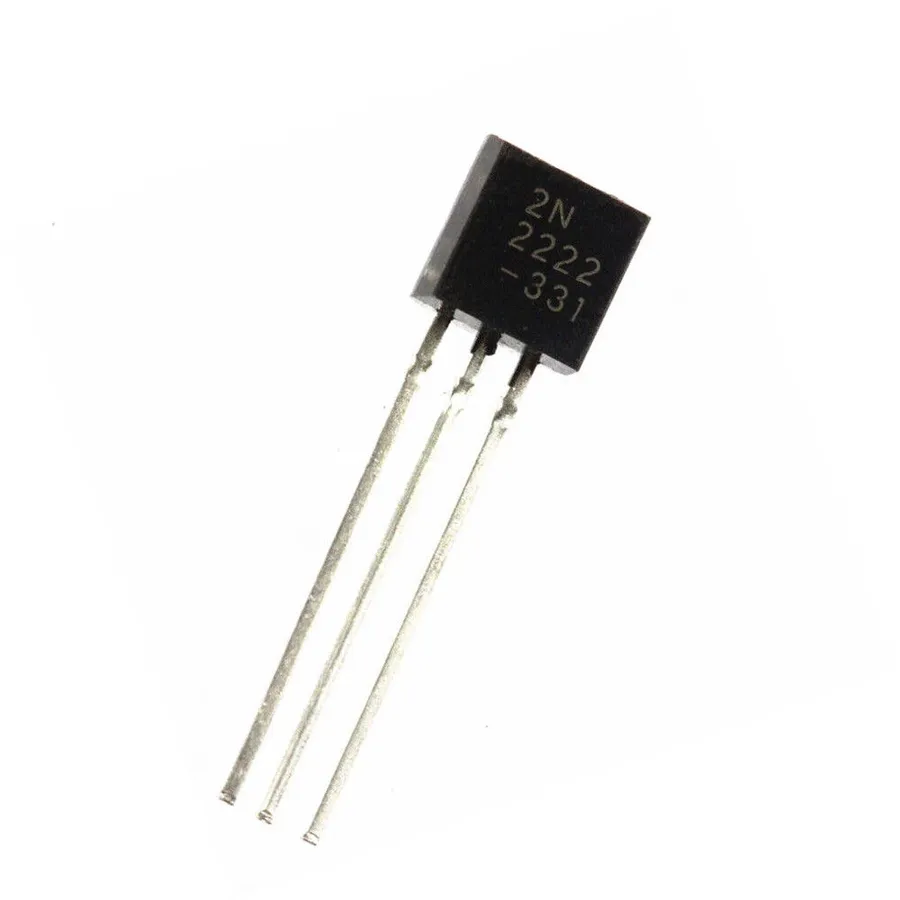
The 2N2222 is a ubiquitous NPN bipolar junction transistor (BJT) renowned for its versatility as both a current-controlled switch and an amplifier. At its core, the 2N2222 is a three-terminal semiconductor device featuring a collector, a base, and an emitter, each playing a crucial role in its operation.
An NPN transistor is constructed from three semiconductor layers. The 'N' regions represent material doped with impurities that provide a surplus of electrons (negative charge carriers), these are the collector and the emitter. The 'P' region, the base, is doped with impurities that have a deficiency of electrons (positive charge carriers). The flow of current is controlled by the base, a small current at the base can control a large current flowing from the collector to the emitter, enabling its dual function as a switch and an amplifier.
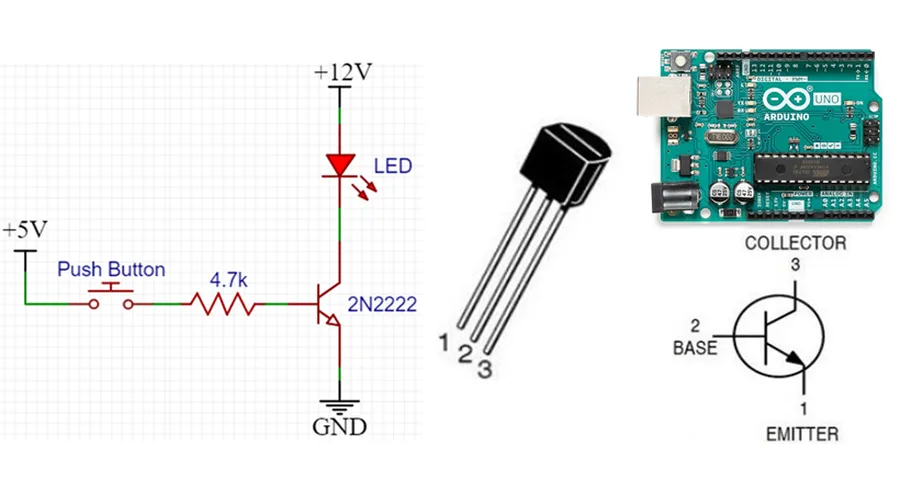
The 2N2222 NPN transistor, commonly housed in a TO-92 package, features three terminals: the emitter, the base, and the collector. Correctly identifying these pins is crucial for the proper operation of any circuit utilizing this transistor. Incorrect pin assignment can lead to circuit malfunction or even damage to the transistor or other components.
It is critical to always confirm the pinout of the 2N2222 before connecting it into a circuit. Datasheets from the manufacturer are the most reliable source of pinout information. Variations in packages from different manufacturers are extremely rare but always should be checked.
Understanding the electrical characteristics of the 2N2222 NPN transistor is crucial for effective circuit design and application. These parameters define the transistor's operational limits and capabilities, ensuring it functions as intended within a circuit. Key characteristics include current gain (hFE), collector current (Ic), collector-emitter voltage (VCE), and power dissipation, each playing a vital role in determining the transistor's performance.
| Parameter | Symbol | Typical Value | Unit | Description |
|---|---|---|---|---|
| Current Gain | hFE | 100-300 | - | Ratio of collector current to base current, indicating amplification capability; Varies with collector current and temperature. |
| Collector Current | Ic | 800 | mA | Maximum continuous current that can flow through the collector; exceeding can damage the transistor. |
| Peak Collector Current | Ic(peak) | 1 | A | Maximum peak current the collector can handle for a short duration. |
| Collector-Emitter Voltage | VCE | 40 | V | Maximum voltage that can be applied between the collector and emitter; exceeding can lead to breakdown. |
| Collector-Base Voltage | VCB | 75 | V | Maximum voltage that can be applied between the collector and base; exceeding can lead to breakdown. |
| Emitter-Base Voltage | VEB | 6 | V | Maximum voltage that can be applied between the emitter and base; exceeding can lead to breakdown. |
| Power Dissipation | Pd | 0.5 | W | Maximum power the transistor can safely dissipate as heat; exceeding can cause overheating and failure. (TA = 25°C) |
| Operating Temperature | Tj | -55 to +150 | °C | The range within which the transistor can operate without damage. |
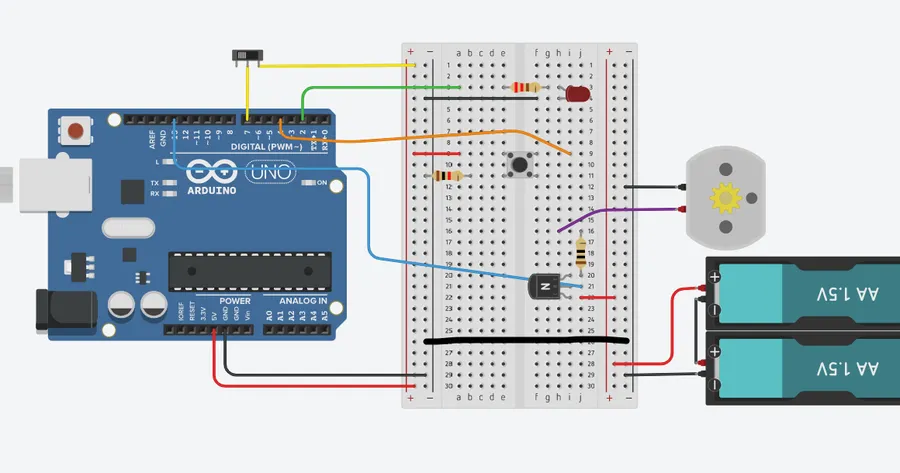
The 2N2222 NPN transistor's versatility makes it a staple in numerous electronic applications, functioning effectively as both a switch and an amplifier. Its cost-effectiveness, combined with its robust performance, contributes to its widespread use in various electronic designs, from basic hobby circuits to more complex industrial systems.
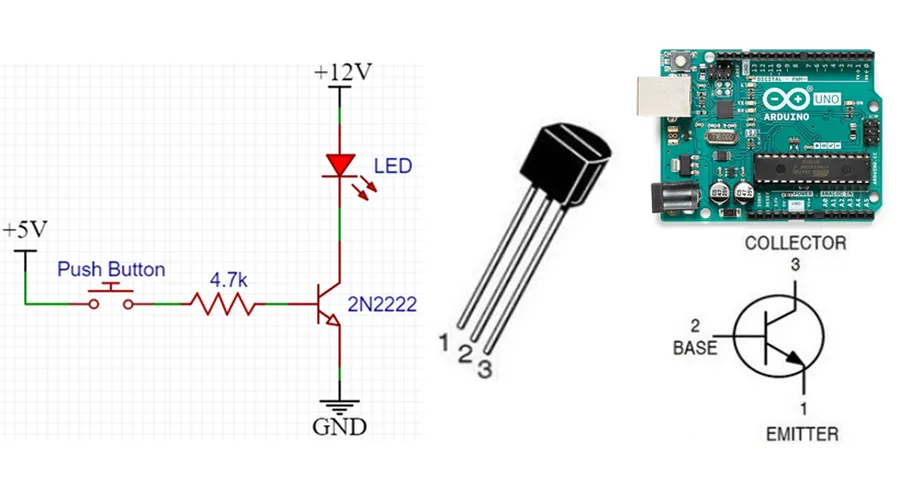
The 2N2222 NPN transistor excels as an electronic switch, leveraging its ability to control current flow between the collector and emitter terminals by manipulating the base current. This characteristic allows the 2N2222 to effectively turn on or off devices or circuits with a small control signal.
In a switching configuration, the 2N2222 operates in two primary states: 'cutoff' and 'saturation'. When no current is applied to the base, the transistor is in cutoff, preventing current flow between the collector and emitter. Conversely, when sufficient base current is provided, the transistor enters saturation, allowing maximum current flow from collector to emitter, effectively closing the switch. This on/off characteristic makes it useful in a variety of switching applications.
A common example is using the 2N2222 to switch an LED. The collector is connected to the LED and a current-limiting resistor, which then connects to a power source. The base is connected through another resistor to a digital output, such as a microcontroller pin. When the microcontroller outputs a high signal, current flows into the base, and the transistor saturates, turning the LED on. When the output is low, the transistor is in cutoff, and the LED is off. This simple circuit demonstrates the transistor's capability as a controlled electronic switch.
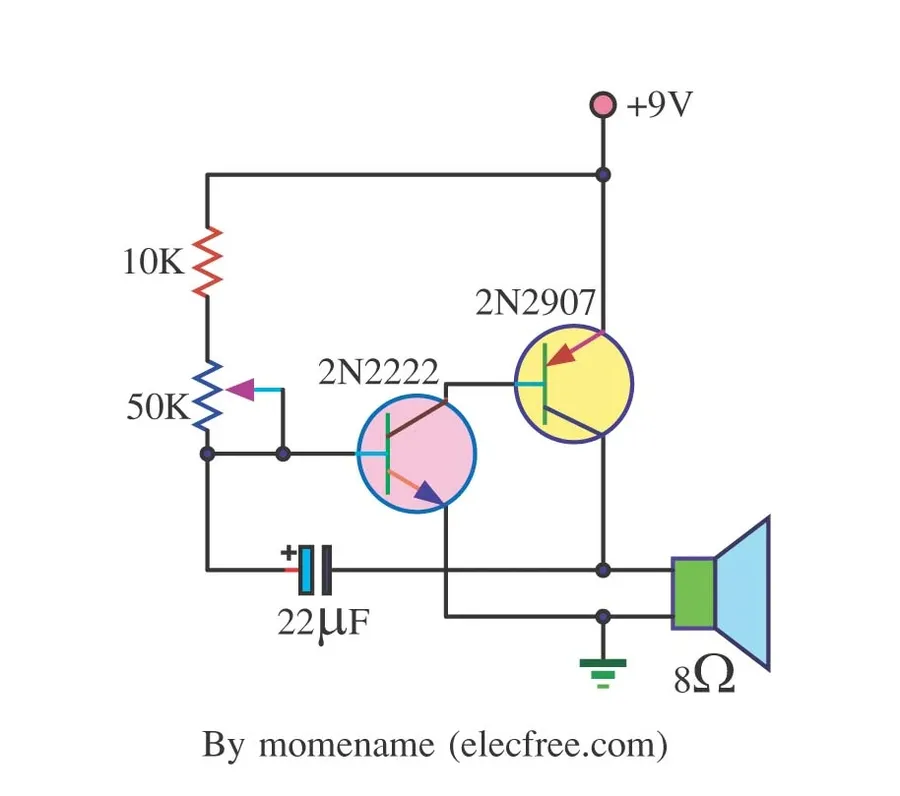
The 2N2222 NPN transistor, beyond its switching capabilities, excels as a small-signal amplifier, leveraging its inherent current gain (hFE) to boost weak electrical signals. This section details the fundamental principles and applications of the 2N2222 in amplifier circuits.
The transistor's amplification relies on the fact that a small change in the base current can produce a much larger change in the collector current. The ratio of the change in collector current to the change in base current is called the transistor's current gain, or hFE (also known as β).
When configuring a 2N2222 as an amplifier, the transistor is biased in the active region, allowing both forward and reverse current flow. This operational region is critical for linear amplification, where the output signal is a faithful reproduction of the input signal, but at a higher amplitude.
Small signal amplifier circuits using the 2N2222 are foundational for numerous electronic devices and systems, enabling the amplification of weak signals to levels that can be further processed, measured, or used to control other devices.
The 2N2222 and 2N3904 are both ubiquitous NPN bipolar junction transistors, frequently employed in a wide array of electronic circuits. While both serve as fundamental building blocks for amplification and switching, they exhibit key differences in their electrical characteristics that influence their suitability for particular applications. This section provides a comparative analysis, emphasizing their dissimilarities to aid in informed component selection.
| Parameter | 2N2222 | 2N3904 |
|---|---|---|
| Collector Current (Ic) Max | 800 mA | 200 mA |
| Collector-Emitter Voltage (VCE) Max | 40 V | 40 V |
| Power Dissipation (PD) Max | 625 mW | 350 mW |
| Current Gain (hFE) Min | 35 (at 150mA) | 30 (at 10mA) |
| Transition Frequency (fT) | 300 MHz | 300 MHz |
| Package Type | TO-92, TO-18 | TO-92 |
| Typical Application | Medium power switching and amplification | Low power general purpose switching and amplification |
The 2N2222 is generally preferred for applications requiring higher current handling and power dissipation capabilities, while the 2N3904 is more suited for lower power and lower current general-purpose circuits. Although they share the same transition frequency, the current gain (hFE) differs slightly across different current levels. The 2N2222 offers a slightly higher current handling capacity, a difference that should be taken into account when deciding between the two. Both come in the TO-92 package.
When seeking replacements or equivalents for the 2N2222 NPN transistor, careful consideration of key electrical parameters and intended application is paramount. The 2N2222, a ubiquitous NPN transistor in a TO-92 package, has various suitable alternatives. Understanding the nuances between different transistor variants ensures seamless integration within a circuit.
This section addresses common questions regarding the 2N2222 NPN transistor, offering concise and technically accurate answers to enhance your understanding and practical application of this versatile component.
The 2N2222 NPN transistor, a seemingly simple electronic component, is in fact a pivotal part of a wide range of circuits and devices. From simple switching mechanisms to complex amplification stages, its versatility and cost-effectiveness make it the go-to choice for engineers and hobbyists. Whether it's controlling a light emitting diode or boosting the gain of an audio circuit, a solid understanding of the 2N2222 is foundational in the world of electronics. As technology continues to advance, the role of transistors, especially the 2N2222 npn transistor and its successors, remains as important as ever in shaping our technological future. Understanding this component unlocks a deeper understanding of electronic circuits and their endless applications.

