Electronic components are the basic units that make up electronic equipment. Whether it is a simple circuit or a complex electronic system, the type and characteristics of the components directly affect the performance and function of the equipment. For beginners, understanding the classification of common electronic components is the first step in learning electronics. This article will introduce several major electronic components and their functions.
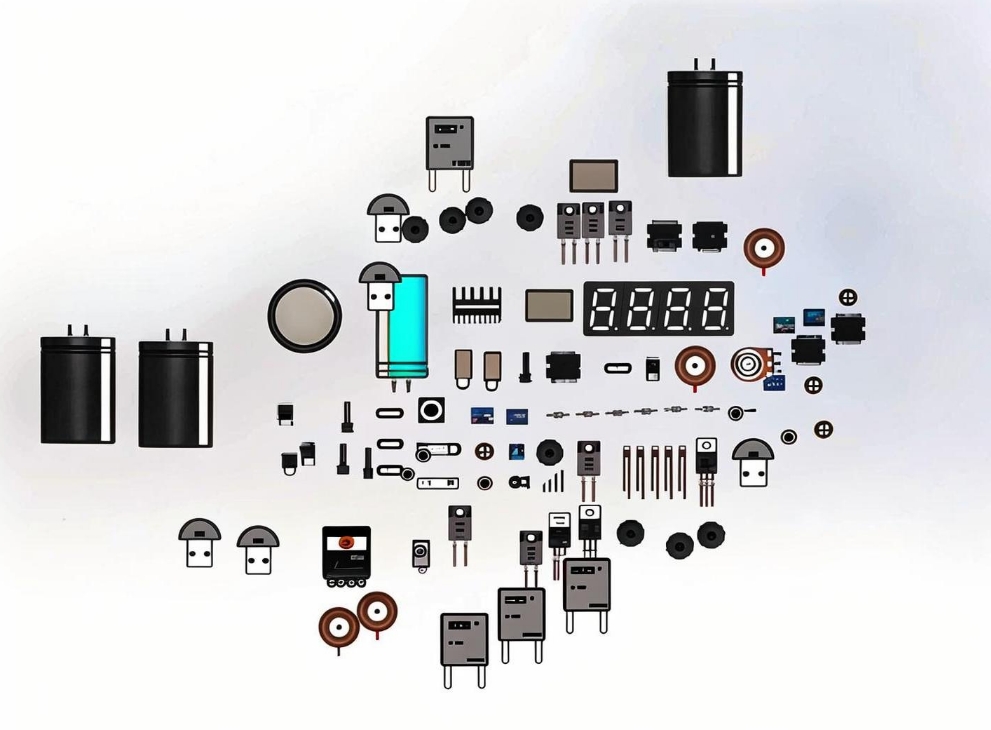
1, semiconductor components
Semiconductor components are the most important part of modern electronic equipment, mainly used to control the flow of current. Common semiconductor components include:
-
Diodes: Diodes allow current to flow in only one direction and are commonly used in rectifier circuits. Depending on their function, diodes can be categorized as ordinary diodes, rectifier diodes, Zener diodes, etc.
-
Transistors: Transistors are basic amplification and switching elements, widely used in signal amplification and switching circuits. Common types of transistors are NPN and PNP type transistors.
-
Integrated Circuit (IC): An integrated circuit is a system that integrates multiple components on a single chip, allowing for complex functions such as arithmetic, storage, etc. ICs can be divided into digital and analog ICs based on their function.
2. Passive Components
Passive components are components that cannot actively control current or voltage, and are mainly used for regulating and storing electrical energy. Common passive components include:
Resistors: Resistors are used to limit the flow of current and their resistance value is measured in ohms (Ω). Resistors are widely used in circuits to protect components, divide voltage, or
regulate current.
-
CAPACITORS: Capacitors are used to store electrical energy and are capable of smoothing current changes in a circuit. Its capacitance is measured in farads (F) and is often used in filtering and coupling circuits.
-
Inductors: Inductors store magnetic energy and are commonly used in filters and oscillators. The unit of inductance is the henry (H).
3. connecting element
Connection elements are used to connect different parts of a circuit to ensure the transfer of current and signals. Common connecting elements include:
Plugs and sockets: Used to conveniently connect and disconnect circuits and are commonly found in various electronic devices and power connections.
-
Switches: Switches are used to control the on and off of a circuit. In circuits, switches can be manually controlled or electronic.
-
Wires: Wires are the basis for connecting components and circuits, carrying current and information.
4. sensors and actuators
Sensors and actuators are used to convert external information into electronic signals and electronic signals into physical actions. Common sensors and actuators include:
-
Sensors: Used to monitor changes in the environment, such as temperature sensors, humidity sensors, light sensors, etc., and are capable of converting
physical quantities into electrical signals.
-
Actuators: Actuators receive electronic signals and perform specific tasks, such as motors, relays, etc., which convert electrical signals into mechanical actions.
5. source
A source is the energy-supplying part of a circuit that provides the required voltage and current. Common power supply components include:
-
Batteries: A battery is a device that converts chemical energy into electrical energy and is widely used in portable electronic devices.
-
Power adapter: A power adapter converts alternating current (AC) power into direct current (DC) power needed by a device and is commonly used in desktop electronic devices.
Understanding and categorizing electronic components is fundamental to learning electronics. Mastering these basics can help beginners become more comfortable in electronic design and applications.

