
AnyPCBA PCB and PCBA case studies


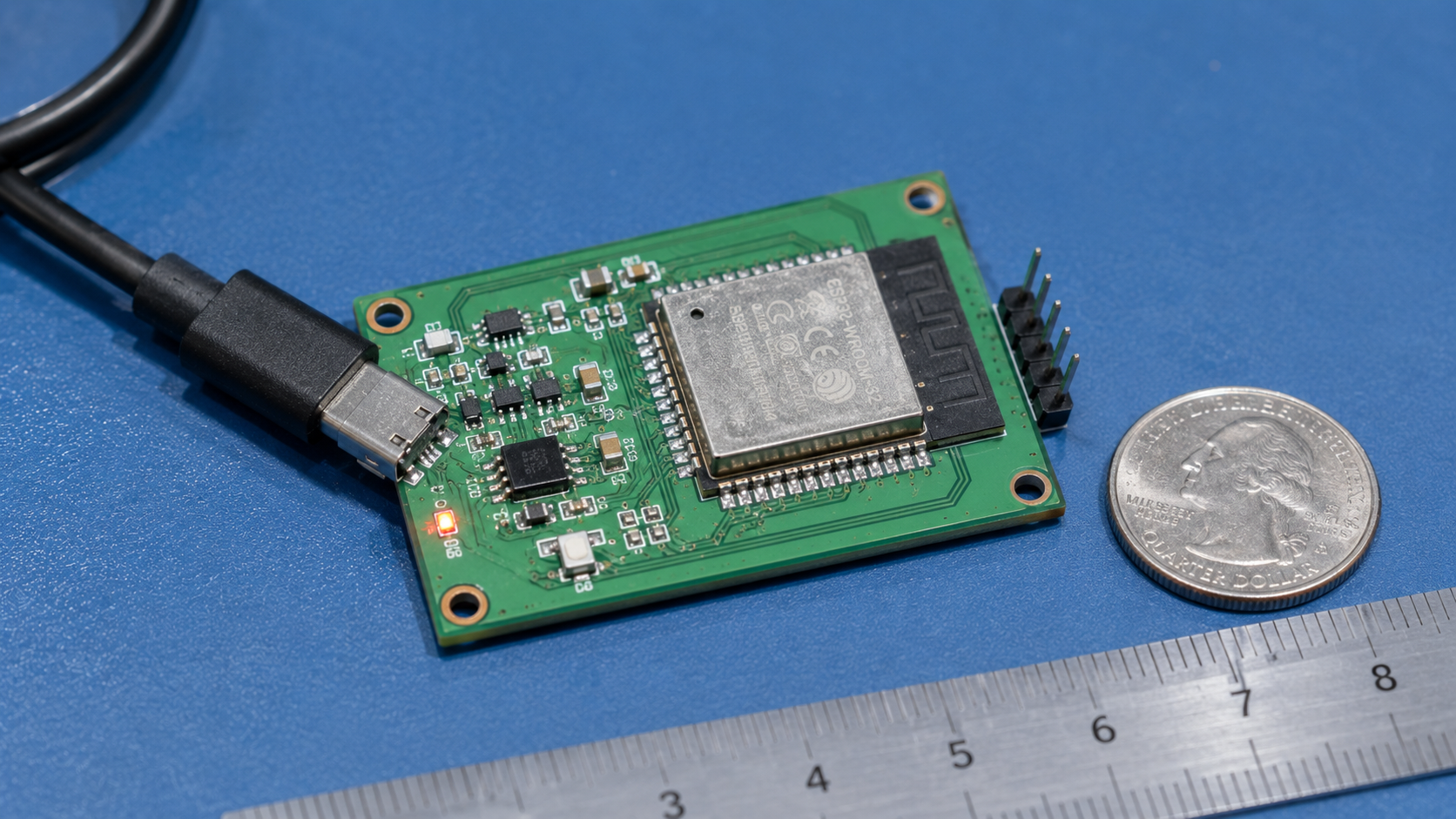
A hardware startup developing smart building solutions needed a reliable, cost-effective IoT sensor node for environmental monitoring. The device needed to collect temperature and humidity data and transmit it to a cloud platform via Wi-Fi, with the flexibility to be deployed in various indoor environments.
The client required a PCBA that was compact, power-efficient, manufacturing-ready, and capable of supporting both USB and battery power for flexible installation scenarios.
| Challenge Area | Specific Requirement |
|---|---|
| Wireless Connectivity | Stable Wi-Fi transmission to cloud server |
| Sensing Accuracy | Reliable DHT22 temperature & humidity readings |
| Power Flexibility | Support USB 5V or 3.7V battery input |
| Form Factor | Small footprint for versatile installation |
| Manufacturing | Cost-effective, small-to-medium batch ready |
Key Design Challenges:
RF Performance: Ensuring robust Wi-Fi signal with limited board space and proper antenna keep-out
Power Management: Balancing efficiency and quiescent current for battery-powered operation
Signal Integrity: Maintaining clean sensor communication in a compact layout
We adopted the ESP32-WROOM-32 module, which integrates the RF front-end, crystal oscillator, and Flash memory. This approach significantly simplifies RF circuit design while ensuring consistent Wi-Fi performance across production batches.
Module: ESP32-WROOM-32 – stable, well-documented, widely adopted
Peripheral Circuit: Minimal external components required – only stable 3.3V power and I/O connections
| Feature | Implementation |
|---|---|
| Input Voltage | USB 5V or 3.7V battery |
| Power Solution | High-efficiency LDO stepping down to 3.3V |
| Capacitor Placement | Input/output capacitors placed close to IC pins |
| Layout | Clear power paths with minimal parasitic impedance |
The DHT22 sensor uses a single-bus protocol requiring careful signal integrity attention:
Trace Routing: Signal lines kept short and close to ESP32 GPIO pins
Parallel Routing: Avoided to prevent crosstalk and signal degradation
Noise Suppression: Optional series resistor (100-200Ω) to suppress ringing
Strict adherence to ESP32-WROOM module datasheet requirements:
| Requirement | Implementation |
|---|---|
| Antenna Keep-out | No metal, no copper pour, no high-speed traces in antenna area |
| PCB Edge | Antenna placed at board edge with clearance |
| Matching Circuit | As per module reference design |
ESD protection devices placed close to the USB port
Differential pair routing with matched length and tight coupling
Critical signals accessible for debugging and verification:
Key power rails: 3.3V, 5V
Ground
Serial debug: TX/RX
| Outcome Dimension | Value Delivered |
|---|---|
| Compact Layout | Small rectangular board – USB on one side, DHT22 socket on the other, ESP32 module in center, mounting holes in corners |
| RF Performance | Reliable Wi-Fi connectivity achieved with proper antenna design |
| Power Efficiency | Low quiescent current supporting battery-powered operation |
| Cost Control | Optimized 2-layer design for small-to-medium batch production |
| Manufacturing Ready | Clear layout, SMT-friendly design, complete test points |
This case demonstrates AnyPCBA's capability in IoT hardware development:
✅ ESP32 platform integration – Modular design for faster development
✅ RF design expertise – Antenna placement and keep-out optimization
✅ Power management – LDO selection and layout for low-power operation
✅ Sensor signal integrity – Clean single-bus communication
✅ Cost-effective manufacturing – 2-layer design, optimized for production
Office and home environmental monitoring
Smart agriculture greenhouse data collection
Data center rack temperature/humidity monitoring
Laboratory environment parameter logging
Need a Custom PCBA for Your IoT Project?
AnyPCBA provides one-stop support from prototyping to production for IoT hardware – including wireless solutions (Wi-Fi/ZigBee/LoRa), sensor interfaces, power management, and low-power design.
Contact us to discuss your project →


