
In the fast-evolving field of telemedicine, hardware failure is not an option. When lives depend on the stability of a robotic surgical arm or a remote patient monitoring station, the motherboard architecture serves as the critical nervous system. Selecting the right foundation requires balancing cutting-edge performance with unwavering reliability. This guide provides an authoritative framework for engineers and decision-makers to choose PCBs that exceed healthcare's most rigorous safety standards.
The Intersection of Precision Engineering and Patient Safety
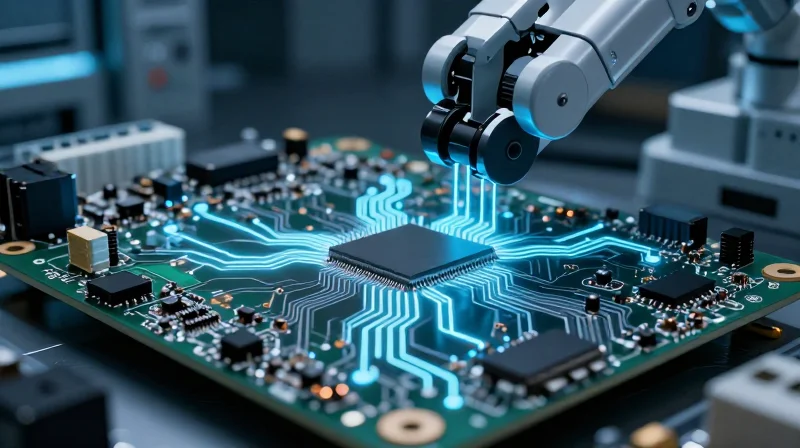
The Intersection of Precision Engineering and Patient Safety
In the context of telemedicine robotics, the motherboard serves as the central nervous system for life-critical operations. Unlike consumer-grade hardware, where a system crash results in inconvenience, a failure in a telemedicine interface can lead to delayed diagnoses, interrupted surgical assistance, or the loss of remote patient monitoring. Precision engineering at the PCB level is the primary defense against such risks, ensuring that electronic signals remain coherent even in environments saturated with electromagnetic interference (EMI) from other medical devices.
Key Engineering Differentiators
| Feature | Consumer Grade | Medical-Grade Robotics PCB |
|---|---|---|
| Component Selection | Off-the-shelf, low-cost | AEC-Q100 certified, long-lifecycle |
| EMI Shielding | Basic/Minimal | Advanced multi-layer grounding |
| Thermal Management | Active cooling reliant | Optimized heat dissipation pathways |
| Signal Integrity | Standard trace widths | Controlled impedance for low-latency |
Addressing Safety Through Hardware Design
- How does PCB layout impact latency?
Precision-routed differential pairs and controlled impedance minimize electromagnetic crosstalk and signal reflections, which are essential for the real-time, low-latency responsiveness required in remote robotic surgery. - Why is component lifecycle management critical?
Medical-grade boards use long-life components to prevent the need for frequent hardware redesigns, which would otherwise necessitate costly and dangerous re-certification of the medical system. - How is hardware-level failure minimized?
Through the use of high-TG (Glass Transition Temperature) materials and conformal coating, the board becomes resistant to thermal cycling and moisture, which are common failure points in active clinical environments.
Navigating Regulatory Compliance: ISO 13485 and Beyond
The Cornerstone of Compliance: ISO 13485
For manufacturers of telemedicine robotics, ISO 13485 is the non-negotiable benchmark for Quality Management Systems (QMS). When selecting a motherboard PCB, you must ensure your manufacturing partner not only holds this certification but applies it to their design-for-manufacturability (DFM) processes. This ensures traceability of every component and rigorous control over raw material quality, which is essential when a robotic failure could result in patient harm.
Navigating Essential Regulatory Standards
| Standard | Relevance | Focus Area |
|---|---|---|
| ISO 13485 | Medical QMS | Traceability and Quality Control |
| IEC 60601-1 | Medical Electrical Equipment | Basic Safety and Essential Performance |
| IPC-Class 3 | PCB Construction | High-Reliability Electronic Products |
Compliance Strategy and FAQ
- Why is IPC-Class 3 critical for telemedicine motherboards?
IPC-Class 3 denotes the highest standard of printed circuit board construction, ensuring survival in harsh environments and critical applications where downtime is not an option. - How does PCB material selection impact regulatory approval?
Materials must be RoHS and REACH compliant. Furthermore, selecting UL 94V-0 rated laminates is necessary to meet flammability safety requirements mandated by most medical device certifications. - What documentation should I demand from my PCB vendor?
Request a Certificate of Conformance (CoC), full material declaration reports, and documentation verifying the validation of your specific design against standardized environmental testing protocols.
Ultimately, your PCB selection process should be a subset of your broader Risk Management File (ISO 14971). By prioritizing partners who demonstrate transparency in their manufacturing audits and material sourcing, you minimize the risk of costly redesigns or regulatory delays during the FDA or EMA submission process.
Prioritizing Signal Integrity in High-Precision Robotics

In high-precision telemedicine robotics, the motherboard acts as the central nervous system. Even infinitesimal signal degradation can lead to mechanical latency, inaccurate diagnostic data, or control failures. Maintaining signal integrity requires a rigorous approach to PCB layout, trace geometry, and the mitigation of electromagnetic interference (EMI) to ensure absolute fidelity in motion control and sensory feedback.
Strategies for Mitigating Signal Noise and EMI
To prevent signal noise in environments shared with other sensitive medical instruments, engineers must implement advanced PCB design techniques. These include differential signaling to cancel out common-mode noise, the use of low-loss dielectric materials, and sophisticated grounding strategies.
| Technique | Purpose | Medical Application |
|---|---|---|
| Differential Pairs | Cancels electromagnetic noise | Real-time robot arm motor control |
| Impedance Matching | Prevents signal reflections | High-definition video for remote surgery |
| Faraday Cages/Shielding | Isolates circuitry from EMI | Sensitive haptic sensor arrays |
Common Concerns in PCB Signal Integrity
- How does PCB stack-up affect signal integrity?
Proper layer stacking allows for dedicated power and ground planes, which reduce loop inductance and create a stable reference for high-speed signals. - Why is material selection critical for medical robots?
Using high-Tg (glass transition temperature) materials with low dielectric constant (Dk) ensures consistent electrical performance despite the thermal cycling often found in clinical medical equipment. - What is the role of trace routing in noise prevention?
Avoiding sharp 90-degree corners and keeping sensitive analog traces separate from high-speed digital signals prevents crosstalk that could trigger system errors.
Advanced Thermal Management Strategies for 24/7 Uptime
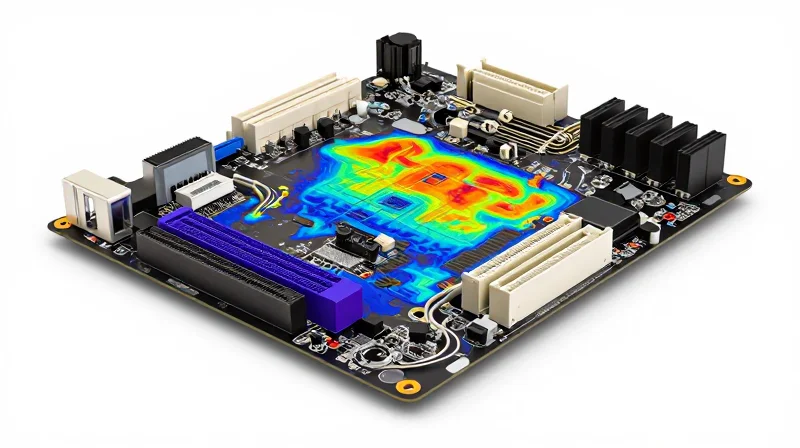
Thermal Dynamics in Medical-Grade Motherboards
For surgical robotics operating continuously, traditional thermal dissipation is insufficient. Selecting a PCB that maintains structural integrity under constant thermal cycling is critical to preventing component degradation and system throttling, which could compromise precision during delicate patient procedures.
Substrate Material Selection
| Material Type | Thermal Conductivity | Primary Application |
|---|---|---|
| Standard FR-4 | Low | General electronics |
| High-Tg FR-4 | Moderate | Continuous uptime systems |
| Metal Core (IMS) | Very High | Power-intensive robot actuators |
| Ceramic Substrates | Excellent | High-precision surgical interfaces |
Effective Thermal Routing Strategies
Beyond material choice, the layout design dictates heat distribution. Implementing thermal vias in a grid pattern directly beneath power-hungry components creates a conductive path to internal copper planes, effectively spreading heat away from sensitive processing units and preventing localized hotspots.
Frequently Asked Questions
- Why is High-Tg material preferred over standard FR-4?
High-Tg (Glass Transition temperature) materials prevent the PCB from softening or warping under the intense, prolonged heat generated by robotic control systems, ensuring long-term mechanical stability. - Can thermal vias negatively impact signal integrity?
When improperly placed, they can cause impedance discontinuities. However, with balanced placement and proximity to ground planes, they act as both thermal conduits and shielding structures. - Is active cooling mandatory for 24/7 robotics?
While passive dissipation is ideal for reliability, high-performance telemedicine systems often pair low-thermal-resistance substrates with active forced-air or liquid-cooling cycles to guarantee uptime.
Selecting Durable PCB Substrates for Clinical Environments
Material Performance in Clinical Environments
Clinical environments demand PCB substrates that transcend standard consumer-grade performance. Because telemedicine robotics frequently undergo rigorous sanitation—including exposure to vaporized hydrogen peroxide (VHP), isopropyl alcohol, and intense mechanical vibrations—the chosen substrate must demonstrate exceptional chemical resistance and structural integrity. High-Tg (Glass Transition Temperature) FR-4 is often the entry-level baseline, but specialized polyimide or ceramic-filled laminates are frequently required to prevent dielectric degradation during sterilization cycles.
| Substrate Material | Key Advantage | Clinical Application Suitability |
|---|---|---|
| High-Tg FR-4 | Balanced cost-performance | Standard diagnostic robotics |
| Polyimide | High heat/chemical resistance | Robotic arms in sterile zones |
| Ceramic-filled Laminates | Extreme dimensional stability | Precision imaging and remote surgery |
Criteria for Chemical and Mechanical Resilience
- How does moisture absorption impact medical robots?
Materials with low moisture absorption coefficients are essential to prevent surface leakage currents, which can introduce signal noise or cause intermittent short circuits in high-humidity clinical settings. - Why is Coefficient of Thermal Expansion (CTE) critical?
During frequent sterilization heating cycles, substrate materials must have a low CTE matched to copper traces; otherwise, cyclic expansion and contraction will lead to micro-cracking and eventual solder joint failure. - Does chemical exposure influence laminate selection?
Yes; standard epoxy resins can swell or degrade when exposed to clinical cleaning agents. Advanced laminates with improved chemical bonding architectures are required to maintain substrate rigidity over years of maintenance.
When finalizing the motherboard design, engineers must ensure that the substrate is not only electrically optimized but also mechanically inert. Testing materials against accelerated aging protocols, such as thermal shock and chemical submersion, is a non-negotiable step in the validation of any robotic system intended for patient care environments.
Power Distribution Networks: Ensuring Fail-Safe Operations

Architecting Power Redundancy for Critical Telemedicine
In the context of surgical or diagnostic telemedicine robotics, a power failure is not merely an inconvenience—it is a critical safety hazard. Designing for fail-safe operations necessitates a multi-layered approach to power distribution. Designers must implement dual-redundant power rails and integrated supercapacitor banks capable of supporting short-term operations during primary source transitions. By utilizing a distributed power architecture rather than a centralized one, engineers can isolate potential faults, ensuring that a localized short circuit on a non-essential peripheral does not trigger a catastrophic system shutdown.
Noise Mitigation and Signal Integrity
High-precision sensor arrays, such as haptic feedback sensors and high-definition optical encoders, are highly susceptible to electromagnetic interference (EMI) originating from power conversion stages. To protect sensitive data, the PCB must incorporate localized decoupling capacitors and multi-stage ferrite bead filtering. Maintaining clean power planes through dedicated layer stacks—specifically by sandwiching high-current signal layers between ground planes—significantly reduces loop inductance and mitigates high-frequency noise injection.
| Component Strategy | Primary Benefit | Implementation Priority |
|---|---|---|
| Split Power Planes | Isolates analog from digital noise | High |
| Supercapacitor Buffers | Prevents data loss during transients | Critical |
| Point-of-Load (POL) Regulators | Precise voltage control near sensors | Medium |
| Ferrite Bead Arrays | Suppression of EMI in high-speed lines | High |
Frequently Asked Questions
- How do I prevent voltage ripples from impacting sensor accuracy?
Utilize high-frequency ceramic decoupling capacitors directly at the sensor's power pins to shunt high-frequency noise to ground before it interacts with sensitive signal paths. - Is layer count a significant factor in power distribution?
Yes, increasing layer count allows for dedicated power and ground planes, which lowers impedance and provides superior return paths for high-speed current, directly improving signal stability. - Why is isolated power necessary for medical robotics?
Isolated power prevents leakage currents from traversing the PCB, protecting the patient from electrical hazards while simultaneously shielding delicate diagnostic hardware from chassis-borne noise.
Future-Proofing Your Hardware Architecture
Designing for Technological Longevity
To ensure that a custom motherboard PCB remains relevant in the fast-paced field of remote clinical care, engineers must prioritize modularity and over-provisioned signal integrity. As medical robotics move toward higher-resolution imaging and real-time AI analytics, your board must support future high-speed bus standards without requiring a total redesign of the underlying chassis or power infrastructure.
Scalability Strategy Matrix
| Design Consideration | Future-Proofing Approach | Benefit to Clinical Robotics |
|---|---|---|
| I/O Bandwidth | Include extra PCIe lanes on the board | Supports high-definition sensors/5G upgrades |
| Processing Power | Use standardized COM Express or SOM modules | Allows CPU/FPGA swaps without board replacement |
| Power Rails | Design for higher current headroom | Accommodates more advanced peripheral attachments |
Key Considerations for Long-Term Hardware Success
- How do I avoid becoming locked into legacy hardware?
Utilize System-on-Module (SOM) architectures. By separating the core compute logic from the carrier board, you can upgrade the processor unit while retaining the established peripheral interfaces and physical mounting points. - Why should I prioritize signal integrity margins now?
As data throughput requirements grow to support 4K telemetry or real-time diagnostic AI, the traces and vias on your board must meet stricter impedance requirements today, ensuring you aren't limited by noise or signal degradation in future software updates. - What is the role of firmware-level flexibility?
Ensure your PCB incorporates field-programmable gate arrays (FPGAs) or easily flashable EEPROM architectures to allow for remote hardware logic updates, which can be critical for responding to new surgical or patient care protocols without physical intervention.
Collaborating with Specialized Medical PCB Manufacturers
Establishing Technical Synergy with Medical PCB Partners
Selecting a manufacturer for telemedicine robotics goes beyond traditional PCB assembly; it requires a partnership with vendors who possess deep expertise in medical-grade standards. For high-precision patient care, the manufacturer must act as an extension of your engineering team, offering design-for-manufacturability (DFM) guidance that mitigates risks related to signal integrity, thermal management, and sterilization-compatible material selection.
Vendor Vetting and Quality Audit Checklist
| Audit Criteria | Requirement for Medical Robotics | Impact on Patient Safety |
|---|---|---|
| ISO 13485 Certification | Mandatory quality management system | Ensures consistent regulatory compliance |
| Cleanroom Capability | Controlled environment assembly | Prevents microscopic contaminants |
| Full Traceability | Component-level documentation | Critical for failure analysis and recalls |
Key Considerations for Long-Term Partnerships
- How do you evaluate vendor scalability?
Assess the manufacturer's ability to transition from high-mix, low-volume prototyping to full-scale production without compromising the stringent documentation standards required for medical certification. - Why is early design involvement crucial?
Involving the manufacturer during the PCB layout phase allows for real-time adjustments regarding power plane stability and EMI shielding, which are vital for noise-sensitive telemedicine sensors. - What constitutes an effective quality audit?
A robust audit should examine the vendor's environmental testing protocols, their sub-tier component supply chain management, and their response procedures for potential process deviations.
Ultimately, the ideal manufacturer for telemedicine hardware must demonstrate a commitment to transparency and lifelong support. By fostering a relationship built on frequent technical reviews and rigorous quality adherence, you ensure that your medical robotics platform remains stable, compliant, and ready to meet the evolving demands of remote clinical care.
Choosing the right motherboard architecture is more than a technical decision; it is a commitment to the safety and longevity of the patients who rely on your technology. By prioritizing signal integrity, thermal stability, and strict regulatory adherence, you ensure your telemedicine platform performs flawlessly under pressure. Are you ready to optimize your device's foundation? Contact our engineering team today for a comprehensive consultation on your next medical hardware project.
