In the PCBA manufacturing industry, the price war never stops. When you receive an SMT assembly quote that is 30% cheaper than others, your first reaction might be: "Are they cutting corners on the assembly process?" The reality is: in small-to-medium volume PCBA, components (BOM) typically account for 60% to 80% of the total cost. The assembly process fees simply cannot squeeze out that much margin. If the quote is 30% cheaper, the money saved is likely not on the machines, but on the materials.
For the exact same BOM, quoting with original, surplus (dismantled), or refurbished components can easily create a 20% to 30% price difference. Today, from the supply chain perspective of AnyPCBA, we deep-dive into the differences between these three sources and how to prevent your product from becoming a victim of "cheap components."
1. Three Types of Sources: What Exactly is the Difference?
Original Components
Shipped directly from the original manufacturer (OEM) or authorized distributors. They come in full original packaging with complete reel labels, batch numbers, date codes, and consistency documentation. They are the most expensive but offer the highest reliability.
Surplus Components (Dismantled / Excess Stock)
These are original components, but the packaging has been broken. They could be production line remnants, excess inventory, or clearance batches. The sources are highly mixed, and prices are usually 10% to 20% lower than original.
Hidden Risks: Once the packaging is opened, Moisture-Sensitive Devices (MSDs) begin absorbing moisture. If left in a high-humidity workshop for a few days, they are highly prone to solder beading, voids during reflow, or even the "popcorn effect" causing board delamination.
Refurbished Components (Recycled)
These are salvaged from e-waste (old boards). They are washed, re-tinned, sanded, re-marked, and packed into new carrier tapes. The price can be pushed down to about half of the original.
Fatal Risks: The pins have undergone a desoldering process, meaning the original plating is damaged. The newly plated layer has uneven thickness, leading to significantly degraded solderability. The components have also gone through thermal cycles, consuming their operational lifespan prematurely. These defects never show up in the appearance; they only emerge in batches after reflow soldering—by which time the boards are already ruined.
2. How to Identify Refurbished Components at Incoming Inspection
It is difficult to judge with a single glance, but the following four details can help you spot the traces:
Marking: Sanded and re-marked components often have uneven engraving depth and are off-center by half a millimeter.
Reel Label vs. Batch: If the batch number on the reel label does not match the date code on the component body, it's highly likely a mixed batch or re-labeled.
Carrier Tape: Re-sealed bags show secondary heat-seal marks, and the tape tension is often uneven.
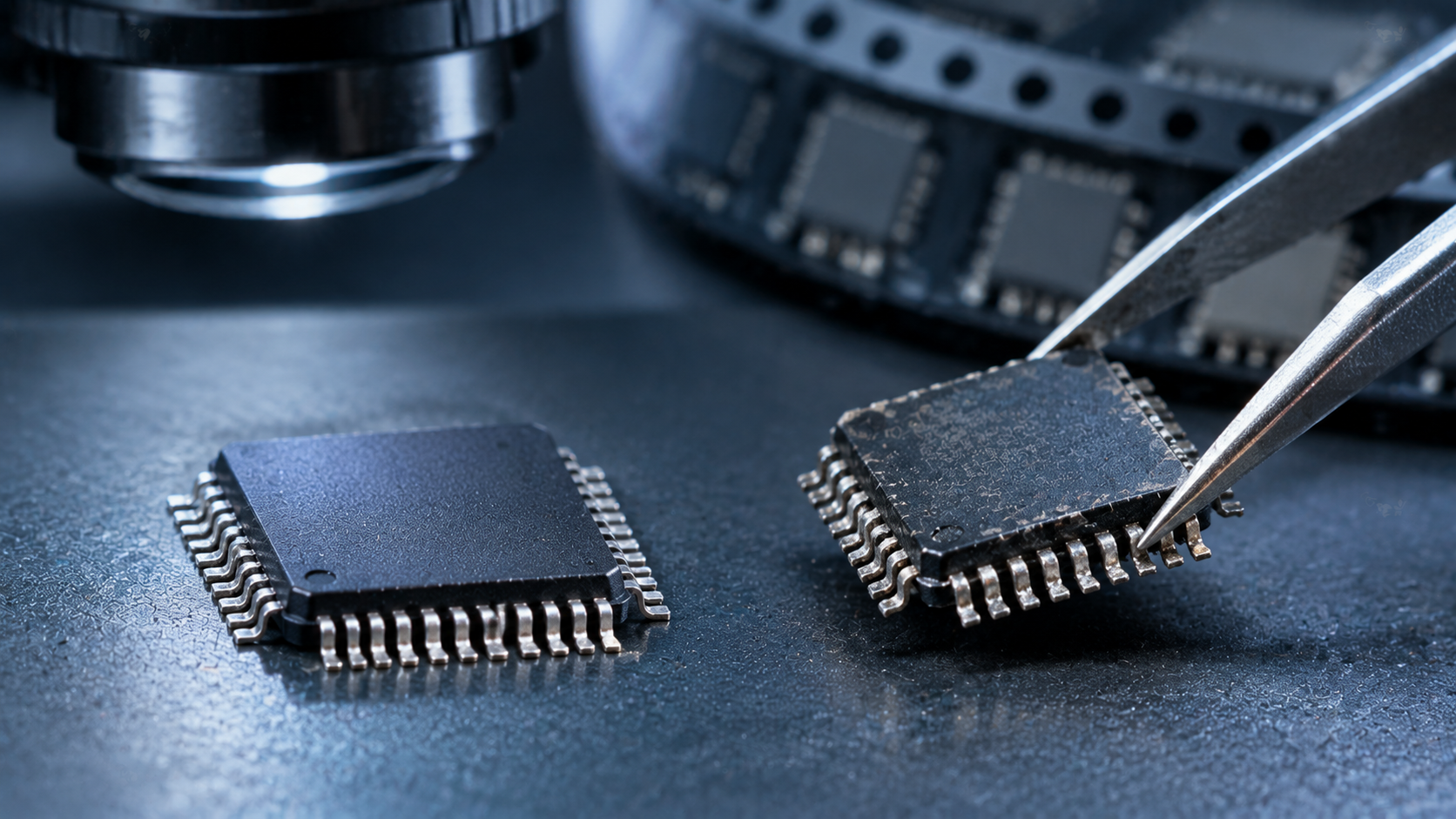
Pin Surface: Normal plating has a uniform matte finish. Refurbished parts often have localized shiny spots, dullness, or residual solder.
AnyPCBA's Approach: Visual inspection is not enough. For critical, expensive, or long-lead-time components, AnyPCBA conducts professional Solderability Tests, Plating Thickness Measurements, and Microsection Analysis. Furthermore, our MES system records the original manufacturer's batch during incoming inspection, ensuring full traceability.
3. Demand These 3 Columns on Every Supplier's Quote
To prevent suppliers from manipulating the BOM, AnyPCBA recommends demanding all factories to add these three columns to every line of the BOM when requesting a quote:
Full Part Number (including suffix and package)
Source Type (Original / Surplus / Refurbished)
Sourcing Channel (OEM Distributor / Spot Market / Customer Supplied)
Two Ironclad Rules to Establish:
For critical components, purchase receipts and batch numbers must be provided upon delivery.
Any alternative component (alternative model or brand) must have written confirmation. Factories are absolutely not allowed to "default substitute" to save costs.
4. The Real Cost of a 30% Discount
The price difference per board might only be a few cents or dollars. But what is the cost of a batch of cold solder joints? Desoldering, re-balling, re-testing, scrap, and delayed schedules.
For automotive (IATF 16949) or medical (ISO 13485) projects, the cost is even higher: if components of unknown origin are mixed into the batch, the traceability chain is broken. This cannot be fixed by simple rework.
Therefore, the criterion is not "how cheap it is," but "on which type of components is it cheap?"
Passive components (R, C, L): The price gap between original and surplus is small, and the risk is relatively low.
Critical components (MCU, PMIC, connectors, automotive/medical-specific parts): The price gap is huge, and the risk is equally massive. Getting one of these wrong results in returning the entire board.
As the industry saying goes: "Money saved on components usually gets paid back at the rework station."
Conclusion
The point is not whether the quote is low, but whether the origin of the components is clearly documented.
AnyPCBA relies on a robust supply chain system and strict quality control processes to provide transparent, traceable component sourcing and assembly services. We strictly prohibit the use of refurbished components from unknown sources and fully support the Consigned BOM model. Our DFM and supply chain teams will help you identify BOM risks from the very beginning, guarding the first gate of product reliability.