Mastering Variable Resistors: Types, Uses, and Applications
2025.01.18
Imagine controlling the brightness of a lamp or the volume of your favorite music – variable resistors make these everyday adjustments possible. These ingenious devices, which allow us to fine-tune electrical resistance, are essential in countless applications, from basic circuits to complex electronics. This article delves into the intricacies of variable resistors, their various forms, and their significant impact on technology and our daily lives. We'll uncover not only how they work but also how they are implemented in various scenarios, bridging the gap between theoretical understanding and practical application.
Understanding Variable Resistors: The Core Concept
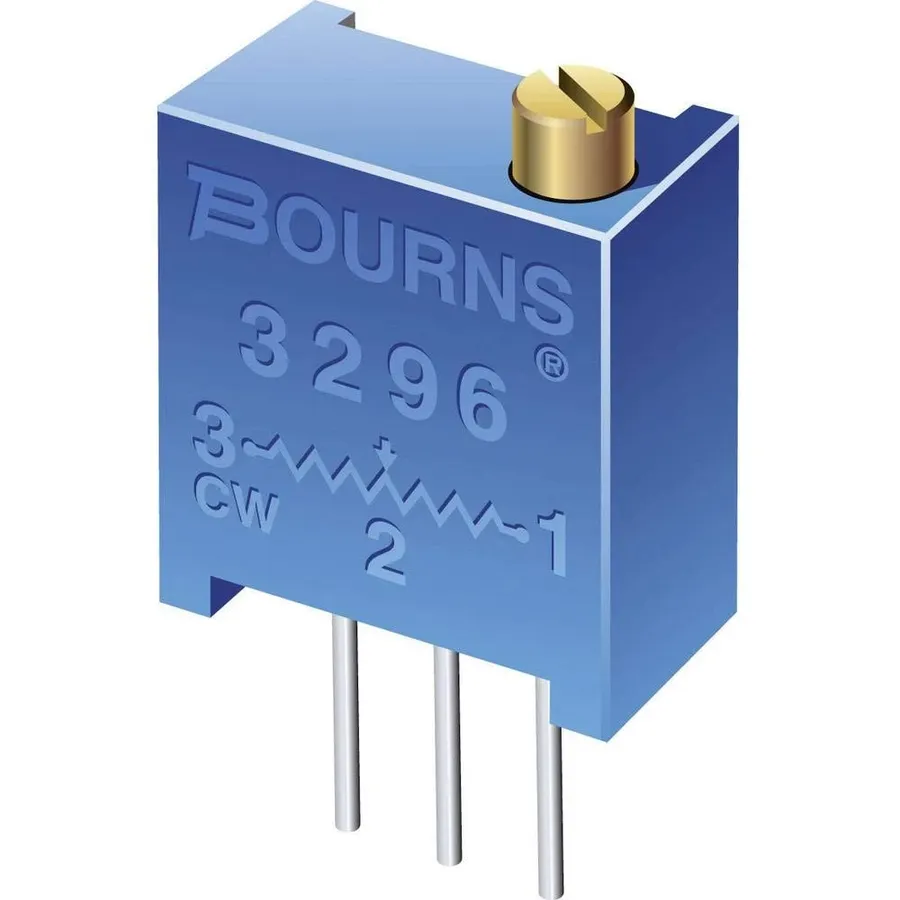
Variable Resistor
A variable resistor is an electrical component whose resistance can be adjusted, offering dynamic control over current flow within a circuit. Unlike fixed resistors that possess a constant resistance value, variable resistors allow users to alter the resistance manually or through an external control mechanism. This adaptability makes them essential in numerous applications where fine-tuning of electrical parameters is required, such as volume control in audio equipment or light intensity regulation.
Types of Variable Resistors: Potentiometers, Rheostats, and Trimmers
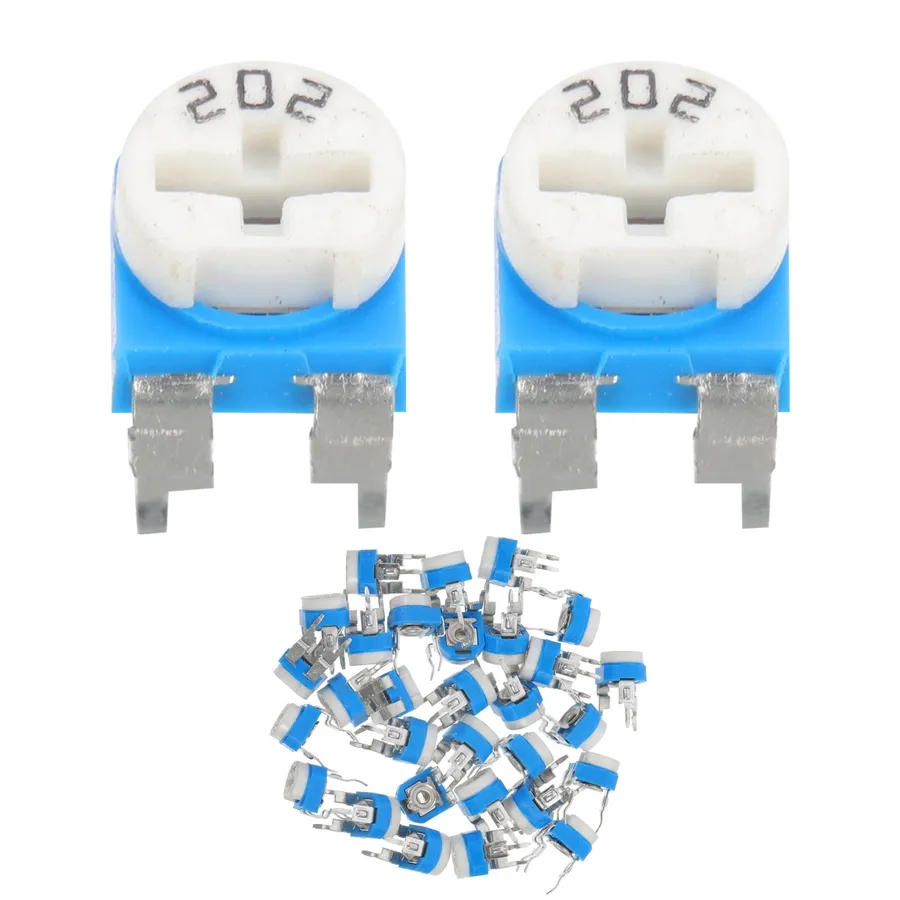
Trimmer Resistor
Variable resistors are essential components in electronic circuits, enabling the manual adjustment of resistance. This section provides an in-depth comparison of the three primary types: potentiometers, rheostats, and trimmer potentiometers, detailing their unique structures, functions, and applications. These components facilitate precise control over voltage and current flow, making them indispensable in diverse electronic systems.
Feature
Potentiometer
Rheostat
Trimmer Potentiometer
Structure
Three terminals: two fixed, one wiper
Two terminals: one fixed, one wiper
Small, adjustable with a screwdriver or similar tool
Function
Voltage divider, adjustable voltage output
Variable resistance in a circuit, adjustable current flow
Fine-tuning of resistance, rarely adjusted
Typical Applications
Volume controls, sensor adjustments, voltage dividers
Motor speed control, dimming lights, heater control
Calibration of circuits, fine-tuning in electronics
Adjustment Type
Rotary or linear knob
Rotary or linear knob
Screw or small adjustment tool
Durability
Designed for frequent adjustments
Designed for frequent adjustments
Typically designed for infrequent adjustments
Size
Varies, can be large for panel mounting
Can be large and robust for high current applications
Very small, designed for board mounting
Potentiometers Potentiometers are three-terminal devices functioning primarily as voltage dividers. They feature two fixed terminals connected to a resistive track and a third wiper terminal that moves along the track, adjusting the output voltage. Common applications include volume controls in audio equipment and sensor adjustments.
Rheostats Rheostats are two-terminal devices used for varying resistance directly in a circuit. They are often employed for controlling current, such as in motor speed control and light dimming circuits. One of the fixed terminals is connected to the wiper, varying resistance from one terminal to another.
Trimmer Potentiometers Trimmer potentiometers, or 'trim pots,' are small, adjustable devices primarily used for fine-tuning and calibration of circuits. They are not designed for frequent adjustment and usually require a tool, like a screwdriver, to adjust the resistance. Trimmers often have a limited range of adjustment but provide the precision necessary for delicate settings.
Potentiometer vs. Rheostat: Key Differences and When to Use Each
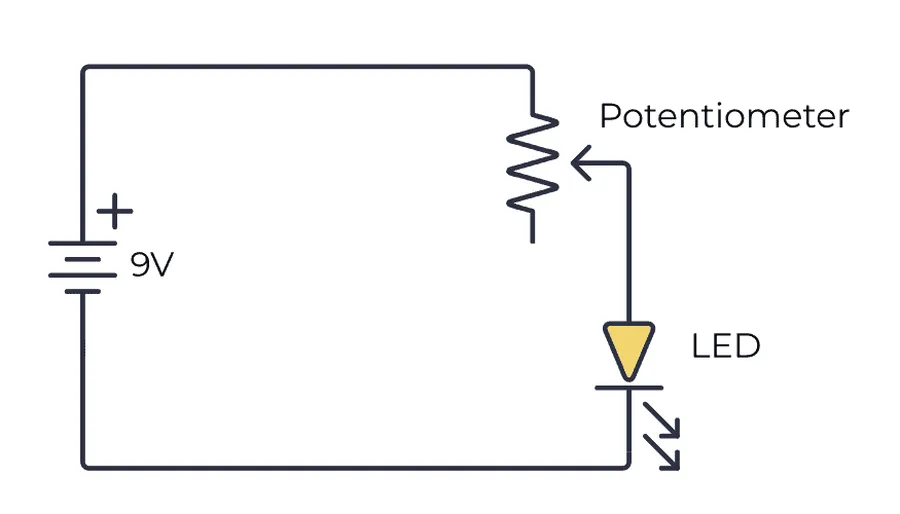
Potentiometer Circuit
Potentiometers and rheostats are both variable resistors, but they differ significantly in their construction, wiring configurations, and typical applications. Understanding these differences is crucial for selecting the appropriate component for a specific task. A potentiometer is primarily designed to act as a voltage divider, while a rheostat is used to control current by adjusting the resistance in a circuit.
Feature
Potentiometer
Rheostat
Primary Function
Voltage Divider
Current Controller
Number of Terminals
Three
Two (Sometimes Three, with one unused)
Wiring Configuration
Input voltage is applied across the two fixed terminals and the adjustable terminal is the output.
One terminal is connected to the circuit and the adjustable terminal is connected to the load. If there are three terminals, one end terminal is unused or connected to the adjustable terminal.
Typical Applications
Volume control, position sensing, calibration circuits
Motor speed control, light dimming, heating element control
Internal Construction
A resistive track with a wiper that moves to select different positions along the resistive element.
A resistive track and sliding contact or rotating contact to change the length of the resistive path.
Use Case Focus
Primarily focus on providing a variable voltage output.
Primarily focus on controlling the flow of current through a circuit.
The key difference between a potentiometer and a rheostat is in how they are connected in a circuit and used to adjust electrical parameters. A potentiometer is used in a voltage divider configuration, where the position of the wiper determines the output voltage, while a rheostat is used in series with the load to adjust the current flow. When selecting between the two, consider the function required in the circuit. Potentiometers are suitable for sensing or control applications where a varying voltage is needed, while rheostats are better for power control applications that require varying current.
Variable Resistor Functionality in Circuits
Variable resistors, key components in electrical circuits, enable the adjustment of both voltage and current flow by manipulating their resistance values. This functionality is achieved through their physical construction which allows for the position of a wiper contact on a resistive element to be changed, thus altering the amount of resistive material the current must pass through.
The fundamental principle behind a variable resistor's function is Ohm's Law (V = IR), where V is voltage, I is current, and R is resistance. When a variable resistor's resistance is increased, the current flowing through the circuit decreases (given a constant voltage source), and when the resistance is decreased, the current increases.
Variable resistors are not typically used in series with the load if a variable voltage drop is desired, such as when dimming a light. A common way to achieve variable voltage is with a potentiometer that allows for a fraction of the supply voltage to be used as an output.
While rheostats can also be used to vary current, they are less efficient and generate more waste heat as they function by dissipating excess electrical energy as heat, especially at low load resistance. Therefore, potentiometers are the preferred method for creating a variable voltage source, while rheostats are preferred when variable current control is needed.
Parameter
Potentiometer
Rheostat
Wiring Configuration
Three terminals: two ends of resistive element and one wiper
Two terminals: one end and the wiper of the resistive element
Primary Function
Adjust voltage division
Adjust current flow
Efficiency
More efficient in adjusting voltage
Less efficient, energy wasted as heat
Common Use
Voltage dividers, volume controls, sensor adjustments
Current limiting, motor speed control
The diagrams below illustrates a simple circuit with a potentiometer acting as a voltage divider, demonstrating how the output voltage (Vout) changes as the wiper position (and therefore the resistance) is adjusted. Similarly, it also demonstrates the use of a variable resistor as a rheostat to modify the current flow through a load.
Common Applications of Variable Resistors in Everyday Life
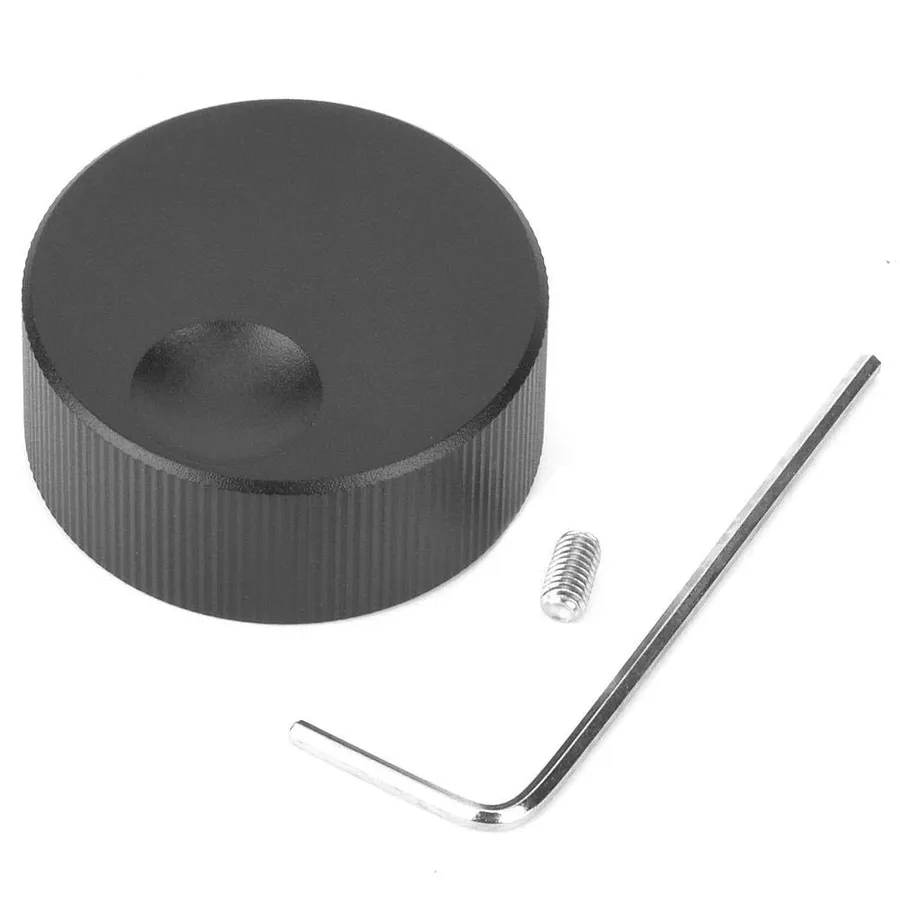
Volume Control Potentiometer
Variable resistors are ubiquitous in modern electronics, serving as crucial components for controlling and adjusting electrical parameters in a diverse array of applications. Their ability to dynamically alter resistance allows for precise control of current and voltage, making them indispensable in numerous everyday devices and industrial systems.
Audio Volume Control Potentiometers are commonly used as volume controls in audio equipment. By rotating the knob, the resistance changes, altering the amount of electrical signal that passes through to the speakers. This directly affects the volume, allowing for smooth and continuous adjustment.
Light Dimmers Rheostats, often implemented as rotary or slide controls, function as light dimmers. By increasing or decreasing the resistance in the circuit, the current flowing through the lighting element is modified, resulting in a corresponding change in light intensity. This is particularly common in household and stage lighting systems.
Sensor Adjustments Variable resistors are fundamental to calibrating sensors. In many sensor circuits, a potentiometer allows for fine-tuning of the sensor’s output, compensating for variations in the sensor itself or environmental changes. Examples include adjustments in temperature, pressure, and light sensors.
Motor Speed Control Rheostats can be used to regulate the speed of DC motors. By varying the resistance in the motor circuit, the current supplied to the motor is changed, directly controlling the rotational speed. This is found in fans, power tools, and various other motor-driven equipment.
Feedback Mechanisms Variable resistors are used in feedback control circuits to provide precise control and adjustments. In automation systems and servo motors, these resistors allow for the accurate positioning and movement of components. By using the variable resistor to feedback the desired position, the motor controller can adjust the output to reach the desired position.
Calibration of Test Equipment In test and measurement equipment, such as multimeters and oscilloscopes, variable resistors are used for calibration. They enable precise adjustment of internal circuits to ensure accurate readings are provided. Trimmer potentiometers are often used in these applications due to their small size and the ability to fine-tune the resistance.
Selecting the Right Variable Resistor: Key Considerations
Choosing the appropriate variable resistor for a specific application requires careful consideration of several key parameters. These parameters ensure that the selected component will function effectively and reliably within the intended circuit. The primary factors include the required resistance range, the acceptable tolerance, the power rating the resistor can safely handle, its physical size and mounting style, and the type of variable resistor best suited for the task.
Parameter
Description
Importance
Resistance Range
The minimum and maximum resistance values that the variable resistor can provide.
Ensures the resistor can provide the necessary range for the application.
Tolerance
The allowable variation in the resistor's stated resistance value.
Impacts the precision and accuracy of the circuit.
Power Rating
The maximum power (in watts) that the resistor can dissipate without overheating.
Prevents component damage and ensures safe operation.
Physical Size
The physical dimensions of the variable resistor.
Determines compatibility with the circuit board or enclosure and handling limitations
Mounting Style
How the resistor is connected to the circuit (e.g., through-hole or surface mount).
Affects ease of assembly and manufacturability.
Type
The type of variable resistor (e.g., potentiometer, rheostat, trimmer).
Determines the application of the resistor, precision, adjustment frequency, and long-term reliability.
Frequently Asked Questions about Variable Resistors
This section addresses common queries regarding variable resistors, providing clear and concise explanations to enhance your understanding of their functionality and applications. We will cover topics ranging from basic operational principles to distinctions between different types, including potentiometers, trimmers, and digital variants.
What is a variable resistor and how does it work? A variable resistor is an electrical component whose resistance can be adjusted. It achieves this by altering the length or material properties of the conductive path through which current flows. The adjustment mechanism can be mechanical, such as turning a knob or sliding a wiper, or electronic in the case of digital potentiometers.
What is the primary difference between a potentiometer and a variable resistor? The term 'variable resistor' is an umbrella term that encompasses all adjustable resistors. A potentiometer is a specific type of variable resistor, typically with three terminals. It functions as a voltage divider. A rheostat, another type, uses two terminals and is designed to control current flow. So, all potentiometers are variable resistors but not all variable resistors are potentiometers.
How do digital potentiometers differ from mechanical variable resistors? Digital potentiometers, also known as digipots, are electronically adjustable resistors, utilizing integrated circuits to change their resistance levels. They offer precise resistance control through digital interfaces (e.g., I2C, SPI), unlike mechanical variable resistors (like potentiometers or rheostats), which rely on physical adjustments. Digital potentiometers are often used in automated and precision control systems.
What are trimmer potentiometers ('trim pots') and when are they typically used? Trimmer potentiometers, or 'trim pots,' are small variable resistors designed for infrequent adjustments in circuits. They are typically used for initial calibrations or fine-tuning of electronic equipment. Due to their small size and construction they are not designed for frequent user interaction.
Can a variable resistor be used as a current limiter? Yes, a variable resistor, when configured as a rheostat (using two terminals), can be used to limit current in a circuit. By adjusting its resistance, you can control the amount of current that flows through a given path in the circuit. This is commonly seen in applications such as speed control in DC motors or controlling the brightness of a lamp.
What is a panel mount potentiometer? Panel mount potentiometers are designed with a threaded bushing that allows them to be mounted to a panel of an enclosure, with the adjustment shaft accessible from the front of the panel. This configuration enables easy user adjustment and is common in audio equipment and laboratory instruments.
What are the common applications of variable resistors? Variable resistors are employed across various applications, including volume control in audio systems, light dimming in lamps, calibration in sensors, and controlling motor speeds. Their ability to adjust voltage or current flow makes them versatile components for many electronic and electromechanical devices.
Advanced Applications and the Future of Variable Resistors
Variable resistors, while seemingly simple components, play a crucial role in a myriad of sophisticated applications, extending beyond basic volume controls and light dimmers. Their ability to precisely modulate electrical resistance makes them indispensable in automation, precision measurement, and advanced digital control systems. Furthermore, emerging trends in material science and microfabrication are driving innovation in variable resistor design, enhancing their performance and expanding their utility.
Below are examples of advanced applications and trends in variable resistor technology:
Automation and Robotics In robotics and automated systems, variable resistors are used as feedback elements in servo systems, enabling precise control over motor speed, position, and force. This is critical for applications requiring high accuracy and repeatability, such as industrial assembly lines and medical robotics. These feedback mechanisms rely on the predictable change in resistance to provide closed-loop control.
Precision Measuring Instruments Variable resistors are integral to precision measurement equipment like digital multimeters and specialized sensors. For instance, in strain gauges, a change in mechanical stress alters the resistance of the variable resistor, allowing for highly accurate force measurements. Similarly, in temperature sensors, the change in resistance with temperature variations is measured to provide precise readings. These applications are often found in scientific research and industrial process control.
Digital Control Systems Digital potentiometers, or digipots, are a subset of variable resistors that can be controlled digitally, often via microcontrollers. This technology enables precise and programmable control of resistance, which is vital in programmable power supplies, audio processing, and filter adjustment. Unlike mechanical potentiometers, digipots can be adjusted with greater accuracy and are less prone to wear and tear.
Emerging Trends in Material Science Advancements in materials science, especially in the development of new conductive polymers and nanomaterials, are leading to variable resistors with improved linearity, reduced noise, and lower temperature dependence. These materials allow for the fabrication of smaller, more reliable, and more accurate variable resistors. This is especially important in portable and wearable electronic devices.
Microfabrication and MEMS Technology Microelectromechanical systems (MEMS) technology is enabling the creation of extremely small and precise variable resistors on silicon chips. These miniature components are used in sensor technology and IoT devices. The small size and high precision of MEMS-based variable resistors are expanding their usage in biomedical devices and environmental monitoring applications, where space is constrained and performance is paramount.
Troubleshooting Common Issues with Variable Resistors
Variable resistors, while robust, are susceptible to certain issues that can affect their performance and reliability. Effective troubleshooting requires understanding common failure modes, their symptoms, and appropriate corrective actions. This section provides a guide for diagnosing and resolving frequent problems encountered with variable resistors.
Erratic Resistance Readings Symptoms: Inconsistent or fluctuating resistance values when the adjustment knob or slider is moved. Cause: Usually attributed to wear or oxidation on the resistive track or wiper contact. The wiper may be making intermittent contact with the resistive element. Solution: Clean the resistive track using a contact cleaner. Consider replacing the variable resistor if the problem persists or if there's evidence of significant physical wear. You may also need to check your measurement device to ensure its integrity.
Open Circuit Failure Symptoms: The variable resistor shows infinite resistance (open circuit) regardless of the adjustment position. Cause: A broken internal connection or a completely failed resistive element, often from excessive current or mechanical stress. Solution: Examine the component's connection points. Replace the variable resistor if there is no visible damage or if the internal damage is apparent.
Short Circuit Failure Symptoms: The variable resistor shows zero or very low resistance regardless of the adjustment position. Cause: Physical damage or breakdown of the internal resistive element or wiper contact causing a direct path between pins. Solution: Replace the variable resistor. Check for any external factors like overcurrent or shorts in the circuit that may have caused the failure and take corrective measures.
Mechanical Failure Symptoms: The adjustment knob or slider feels loose, stiff, or doesn’t move smoothly. Cause: Internal mechanical wear or damage to the potentiometer's gears or rotational mechanisms. Solution: If accessible, clean and lubricate moving parts. However, significant mechanical damage usually warrants component replacement.
Environmental Impact Symptoms: The variable resistor’s performance degrades due to environmental factors like humidity, dust, or corrosive atmospheres. This can cause resistance changes or make it harder to adjust. Cause: Accumulation of contaminants or corrosion on the resistive element or terminals. Solution: Protect the variable resistor from harsh environments. Use appropriate sealant, enclosures or a better environment if possible. Consider replacing the resistor if cleaning is not enough.
Temperature Effects Symptoms: Significant change in resistance depending on the ambient temperature. Cause: Variable resistors have a temperature coefficient that dictates how much resistance changes based on temperature. Solution: Be aware of the operating temperature limitations of variable resistors. Choose components based on the application's temperature needs. Some circuits may need to have compensation circuits designed in if the environment temperatures vary too much.
Component Age Symptoms: Changes in resistance readings, failure to adjust the resistance, or complete component failure. Cause: Variable resistors will degrade over time with use, the resistive tracks can become worn and intermittent, the contacts can become oxidized or loose, and the lubricant on moving parts may dry up. Solution: Consider component replacement after a certain period of service or if you observe signs of aging.
Preventive care is crucial for the longevity and reliability of variable resistors. Regular inspection of the component, ensuring correct operating conditions, and implementing protective measures can prevent many of these issues and save time and costs in the long run. When a replacement is necessary it is critical to use components that have the same ratings and characteristics as the original components, failure to do so may lead to more failures.
Variable resistors, from the familiar potentiometer to the less known rheostat and trimmers, form the backbone of electrical circuit control. Their ability to adjust electrical resistance empowers precise control across a wide array of applications. Understanding the nuances of their types and uses enables the effective design and troubleshooting of electronics. As technology advances, so too will the use of variable resistors, ensuring their place as a crucial element in our electrical landscape, powering innovation and enabling precision control in our daily devices.