In today's fast-paced world, security and convenience are paramount. Smart access control boards are at the forefront of this evolution, offering a seamless blend of technology and security for homes, offices, and various industries. But what exactly makes a smart access control board 'smart,' and how can it revolutionize your security infrastructure? Zero One Solution Limited, with its decade-long expertise in PCB solutions, dives deep into the world of smart access control boards, exploring their design, manufacturing, and the crucial role they play in modern security systems. We'll also highlight how our rapid prototyping and one-stop services can accelerate your product development in this dynamic field.
Introduction to Smart Access Control Boards
Smart Access Control Boards are the technological core of modern security systems, evolving significantly from traditional mechanical locks and keys. These sophisticated electronic circuit boards integrate advanced microcontrollers, secure communication modules, and diverse sensor interfaces to offer unparalleled control over entry points. They represent a paradigm shift in security, enabling dynamic authorization management, real-time monitoring, and seamless integration with broader smart building ecosystems, thus becoming indispensable for safeguarding assets and ensuring personnel safety across various sectors.
What defines a "Smart" Access Control Board compared to a traditional one? A "smart" access control board goes beyond simple locking mechanisms by integrating microprocessors, communication capabilities (like Wi-Fi, Bluetooth, or Ethernet), and sensor interfaces (RFID, biometric scanners). This allows for features such as remote management, real-time event logging, customizable access schedules, integration with other security systems (CCTV, alarms), and enhanced data security through encryption, features absent in purely mechanical or basic electronic systems.
Why are Smart Access Control Boards becoming increasingly important in modern security systems? Their importance stems from the demand for enhanced security, greater flexibility, and operational efficiency. They provide granular control over access, enabling administrators to instantly grant or revoke permissions, monitor access events remotely, and respond to incidents in real-time. This level of dynamic control, combined with data analytics and integration capabilities, offers a more robust, scalable, and adaptable security solution than traditional methods, meeting the complex demands of contemporary environments like smart homes, offices, and industrial facilities.
What are the primary advantages of transitioning from traditional locks to smart access control systems? The advantages are multifaceted: enhanced security through advanced authentication and encryption; improved convenience with keyless entry and remote management; increased operational efficiency by automating access processes and reducing the need for physical key management; detailed audit trails for compliance and forensic analysis; and scalability to easily accommodate growing user bases or additional access points without extensive hardware changes. Furthermore, they can significantly reduce the risks associated with lost or stolen physical keys.
How do Smart Access Control Boards contribute to overall building automation and smart infrastructure? Smart Access Control Boards are integral to building automation by acting as a critical component of the Internet of Things (IoT) ecosystem within a structure. They can communicate with other smart devices, such as lighting, HVAC, and alarm systems, to create integrated security and operational protocols. For example, access granted to a room could automatically adjust lighting and temperature, or an unauthorized access attempt could trigger an alarm and activate surveillance cameras. This interconnectedness optimizes energy consumption, enhances comfort, and streamlines facility management, pushing towards truly smart infrastructure.
What key security features are essential for a reliable Smart Access Control Board? Essential security features include robust encryption protocols (e.g., AES 256-bit) for data transmission and storage, secure boot mechanisms to prevent unauthorized firmware modifications, multi-factor authentication options (e.g., combining RFID with PIN or biometrics), tamper detection alerts, and resilience against common cyber threats like denial-of-service attacks. Secure hardware design, including physical tamper-proofing, is also crucial to protect against physical bypass attempts, ensuring the integrity and confidentiality of the access system.
Key Components of a Smart Access Control Board
Microcontroller on Access Control Board
A smart access control board is the technological core of modern security systems, meticulously engineered with several interconnected components that collectively enable intelligent and robust access management. Understanding these essential building blocks is crucial for appreciating the board's functionality and its pivotal role in enhancing security, convenience, and operational efficiency across diverse environments.
Microcontroller (MCU) The MCU acts as the brain of the access control board, processing data from various inputs, executing programmed logic for access decisions, and managing communication with other system components. It typically features integrated memory (Flash for program storage, RAM for data) and peripheral interfaces for comprehensive control.
Memory Modules (EEPROM/Flash) Dedicated memory modules store critical data such as user credentials, access logs, system configurations, and firmware. Non-volatile memory like EEPROM or external Flash is essential to retain this information even when power is lost, ensuring system integrity and continuity.
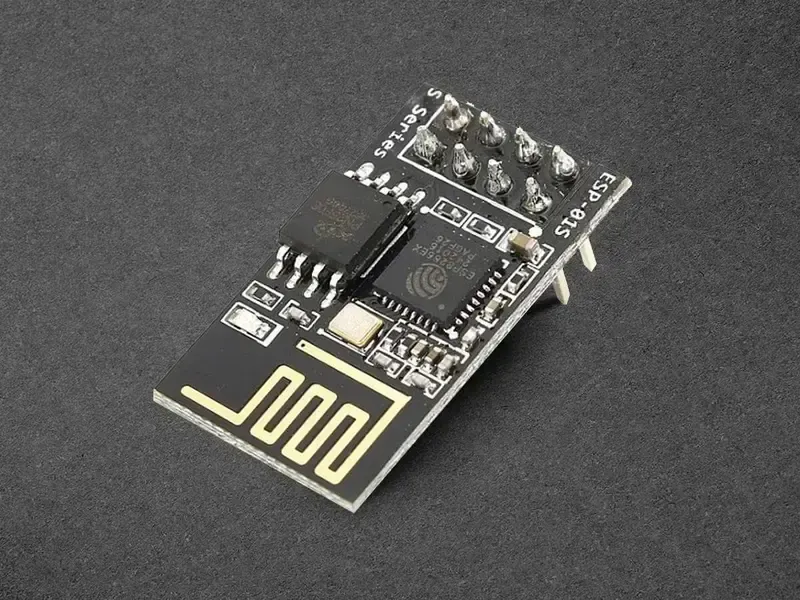
Communication Modules (Wi-Fi, Bluetooth, Ethernet, LoRa) These modules facilitate seamless data exchange between the access control board and centralized management systems, cloud platforms, or other IoT devices. Wi-Fi and Ethernet provide high-bandwidth connectivity for network integration, while Bluetooth and LoRa are ideal for short-range or low-power wide-area network (LPWAN) applications, respectively.
Sensor Interfaces (RFID, Biometric, Keypad) These interfaces are crucial for connecting various credential readers and sensors, translating their outputs into actionable data for the MCU. RFID interfaces (e.g., NFC, 125kHz) enable card-based access, biometric interfaces (e.g., fingerprint, facial recognition) provide advanced authentication, and keypad interfaces allow PIN-based entry.
Power Management Circuits (PMIC, Regulators) Robust power management is vital for reliable and efficient operation. These circuits regulate incoming power, distribute stable voltages to all components, and often include features like battery charging, low-power modes, and surge protection, ensuring continuous functionality and extended lifespan, especially in battery-backed systems.
Real-Time Clock (RTC) An RTC provides accurate time and date information, which is indispensable for timestamping access events, enforcing time-based access policies, and maintaining detailed audit trails for security and compliance purposes.
PCB Design Considerations for Access Control Boards
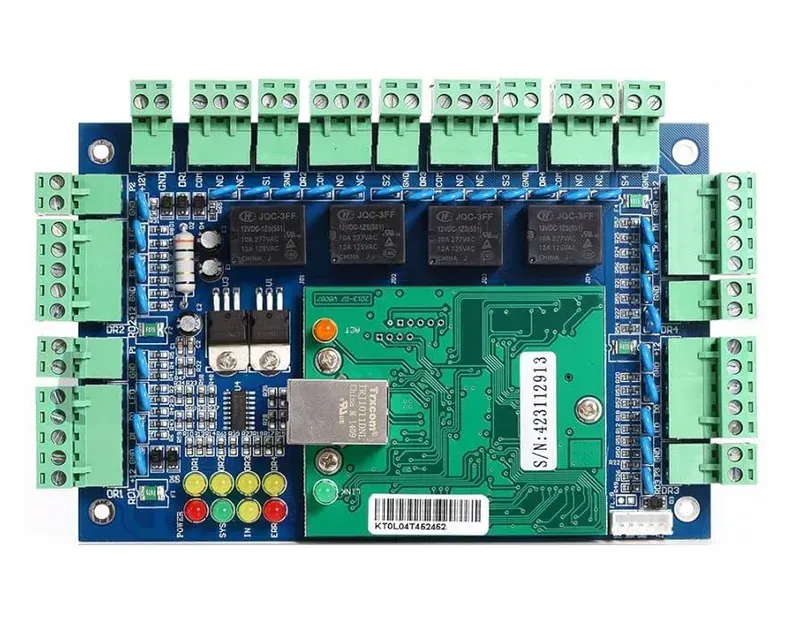
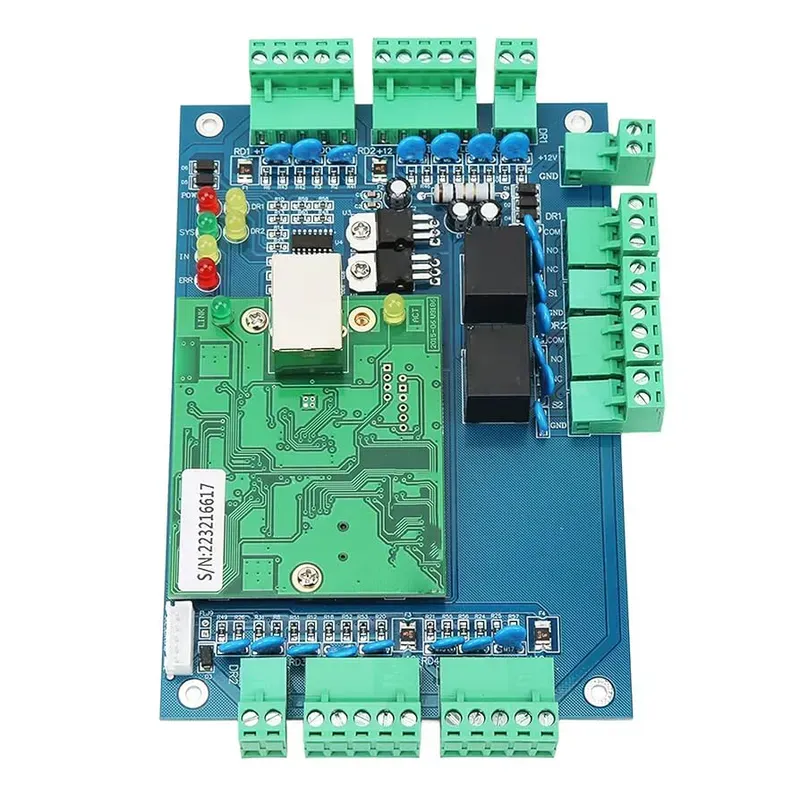
Access Control System PCB Board
Designing printed circuit boards (PCBs) for smart access control systems requires meticulous attention to detail, as these boards are the foundational hardware enabling robust security and seamless operation. Key considerations span electrical performance, physical layout, and environmental resilience, ensuring the final product delivers unwavering reliability in critical security applications. Our expertise at Zero One Solution Limited ensures these complex design challenges are met with precision, from rapid prototyping to production.
Design Aspect
Key Consideration
Impact on Performance
Signal Integrity
Minimize crosstalk, impedance matching for high-speed signals.
Ensures accurate data transmission (e.g., RFID, biometrics) and prevents false readings or system malfunctions.
Power Distribution
Robust power planes, decoupling capacitors, effective voltage regulation.
Guarantees stable power supply to all components, preventing brownouts, erratic behavior, and extends component lifespan.
Component Placement
Logical grouping of related components, separation of analog/digital circuits, heat-generating components.
Optimizes signal paths, reduces noise, improves thermal dissipation, and facilitates easier assembly and testing.
Thermal Management
Strategic use of vias, heat sinks, and consideration of component power dissipation.
Prevents overheating of critical components (e.g., microcontrollers, power ICs), enhancing reliability and longevity, especially in enclosed environments.
Minimizes susceptibility to external electromagnetic interference and reduces emissions, crucial for system stability and regulatory compliance.
Environmental Resilience
Selection of appropriate materials, conformal coating, wide operating temperature range.
Ensures reliable operation in varied environments (e.g., outdoor installations, temperature fluctuations, humidity) typical for access control systems.
Manufacturing and Assembly Process
SMT Assembly on PCB
The journey from a conceptual design to a fully functional Smart Access Control Board involves a meticulous manufacturing and assembly process, crucial for ensuring reliability and performance. This intricate process, honed by advanced engineering practices, transforms raw materials into sophisticated electronic modules, underpinning the security and efficiency of modern access systems.
PCB Fabrication This initial phase involves creating the bare PCB board. It begins with designing the circuit layout, which is then transferred onto copper-clad laminate material through photolithography. Subsequent steps include etching away unwanted copper, drilling holes for components, and applying solder mask and silkscreen layers. Precision is paramount to ensure signal integrity and proper component fit.
Component Sourcing and Kitting Once the PCBs are fabricated, the next critical step is sourcing all necessary electronic components, from microcontrollers and memory chips to resistors and capacitors. Quality assurance is vital here to prevent counterfeit parts. Components are then organized into kits, ready for the assembly line, ensuring efficient and error-free population.
Assembly (SMT and Through-Hole) PCB assembly primarily utilizes two techniques: Surface Mount Technology (SMT) and Through-Hole Technology (THT). SMT involves precisely placing miniature components onto solder pads on the board's surface, followed by reflow soldering. THT, used for larger or higher-power components, involves inserting leads through drilled holes and soldering them on the opposite side. A hybrid approach often optimizes performance and cost.
Testing and Quality Control Rigorous testing is indispensable at various stages. This includes In-Circuit Testing (ICT) to check for manufacturing defects, Functional Testing (FT) to verify the board's operational capabilities, and environmental stress testing (e.g., temperature and humidity cycling) to ensure durability. Automated Optical Inspection (AOI) and X-ray inspection further ensure solder joint integrity and component placement accuracy, guaranteeing the highest quality and reliability for mission-critical access control applications.
Connectivity and Communication Protocols
Wi-Fi Module
Seamless and secure communication forms the backbone of any effective Smart Access Control Board Solution, dictating the system's responsiveness, scalability, and overall reliability. The choice of communication protocols is paramount, influencing factors such as range, data throughput, power consumption, and resilience against interference and cyber threats. Understanding the nuances of each protocol is essential for architects and engineers designing advanced access control systems that meet contemporary security demands and user expectations.
Protocol
Key Advantages
Key Disadvantages
Typical Use Cases in Access Control
Wi-Fi (IEEE 802.11)
High bandwidth, ubiquitous infrastructure, IP connectivity
Higher power consumption, potential for network congestion, setup complexity
High speed, highly reliable, secure, long-distance via cable
Requires physical cabling, less flexible for wireless deployment, higher installation cost
High-security facilities, server rooms, networked reader systems
NFC (Near Field Communication)
Extremely short range, passive tag support, fast authentication
Very limited range (cm), susceptible to man-in-the-middle if not implemented securely
Contactless card readers, mobile phone access, secure key exchange
LoRaWAN
Ultra-low power, long-range (km), ideal for scattered devices
Low data rate, higher latency, requires specific gateway infrastructure
Remote site monitoring, perimeter access for large areas, IoT deployments
How do communication protocols impact the security of a Smart Access Control Board Solution? The chosen communication protocol significantly impacts security by defining the inherent encryption capabilities, authentication mechanisms, and vulnerability to various attacks. For instance, protocols like Ethernet offer robust built-in security features, while wireless protocols like Wi-Fi and Bluetooth require careful implementation of WPA2/3 or secure pairing to prevent eavesdropping and unauthorized access. Robust encryption algorithms (e.g., AES) and secure key exchange protocols are critical regardless of the underlying communication medium to protect credentials and commands in transit from interception or tampering. Without strong protocol-level security, even physically secure access points can be compromised through network vulnerabilities.
Security Features and Encryption in Smart Access Control Boards
At the core of any reliable smart access control board solution lies a robust security architecture, critical for safeguarding sensitive data and preventing unauthorized access. This goes beyond simple physical barriers, integrating sophisticated encryption algorithms, secure boot processes, and multi-factor authentication protocols to create an impenetrable digital fortress. For instance, the implementation of advanced encryption standards (AES) ensures that data transmitted between the board and its peripherals remains confidential and tamper-proof, a paramount consideration in modern security systems.
What are the essential encryption standards used in smart access control boards? The Advanced Encryption Standard (AES) is the most widely adopted and robust encryption standard for smart access control boards. It offers various key lengths (128-bit, 192-bit, 256-bit) to provide strong cryptographic protection for data at rest and in transit, ensuring the confidentiality and integrity of access credentials and communication signals.
How do secure boot mechanisms enhance the security of access control systems? Secure boot mechanisms ensure that only authenticated and authorized firmware can be loaded and executed on the access control board. This process typically involves cryptographic signatures that verify the integrity and authenticity of the bootloader and operating system, preventing the injection of malicious code or tampered software during system startup.
What role do authentication protocols play in preventing unauthorized access? Authentication protocols verify the identity of users and devices attempting to gain access. These protocols, such as multi-factor authentication (MFA) combining something you know (password), something you have (RFID card), and something you are (biometrics), significantly reduce the risk of unauthorized entry by requiring multiple forms of verification, making it exponentially harder for attackers to compromise the system.
How are cryptographic keys managed and protected within smart access control boards? Cryptographic keys, vital for encryption and decryption, are typically stored and managed within secure hardware modules, such as Hardware Security Modules (HSMs) or Trusted Platform Modules (TPMs), embedded directly on the PCB. These modules provide a secure environment for key generation, storage, and cryptographic operations, protecting them from physical tampering and software-based attacks.
What measures are taken to protect sensitive user data on access control boards? Protection of sensitive user data involves a multi-layered approach: data encryption both at rest (on memory modules) and in transit (during communication), secure storage in isolated memory regions, regular security audits, and adherence to data privacy regulations. Anonymization or pseudonymization techniques may also be employed for non-critical data to further reduce risk.
Power Efficiency and Battery Management
Optimizing power efficiency and implementing robust battery management are critical for smart access control boards, especially those deployed in remote or wirelessly connected environments where continuous power is not guaranteed. Effective power management extends device longevity, reduces maintenance, and enhances overall system reliability. This goes beyond mere component selection; it involves meticulous PCB design, intelligent firmware algorithms, and a deep understanding of power consumption profiles across various operational states.
Power Management Technique
Description
Advantage for Access Control Boards
Low-Power Microcontrollers (LPMCs)
Utilizing MCUs designed for minimal power consumption, often featuring multiple power modes (e.g., active, idle, sleep, deep sleep).
Significantly extends battery life, crucial for battery-powered or intermittently powered access points.
Sleep Modes & Wake-up Mechanisms
Implementing software-controlled sleep states for components when not actively in use, with intelligent wake-up triggers (e.g., RFID scan, motion detection).
Reduces average power draw, allowing for longer operation periods between charges or battery replacements.
Efficient Power Conversion Circuits (e.g., Buck/Boost Converters)
Employing high-efficiency DC-DC converters to step down or step up voltage with minimal energy loss, ensuring stable and clean power delivery.
Maximizes the usable energy from batteries, minimizes heat generation, and improves system stability.
Why is power efficiency paramount for smart access control boards? Power efficiency is paramount because many smart access control systems, particularly those in distributed or mobile applications, rely on battery power or intermittent power sources. Maximizing battery life reduces operational costs, minimizes the frequency of battery replacement or recharging, and ensures continuous security functionality even during power outages, thereby enhancing overall system reliability and user convenience. It's a key factor in deployment flexibility and long-term cost-effectiveness.
Zero One Solution's Capabilities in Access Control PCB Solutions
At Zero One Solution Limited, we are acutely aware that the successful deployment of a robust smart access control system hinges on the underlying PCB's reliability, performance, and security. Leveraging over a decade of industry leadership, our specialization in rapid prototyping, integrated PCB design, advanced manufacturing, and comprehensive assembly services positions us as the ideal partner for developing cutting-edge access control board solutions. Our one-stop service model, supported by a strategically optimized global supply chain, significantly accelerates time-to-market while ensuring unparalleled quality and cost-efficiency for our clients.
Rapid Prototyping for Iterative Development We excel in delivering rapid PCB prototypes, enabling quick iteration and validation of design concepts for smart access control boards. This agility is crucial for developers to test new features, optimize performance, and identify potential issues early in the development cycle, significantly reducing overall project timelines and costs associated with rework.
Precision PCB Design and Engineering Expertise Our veteran engineering team provides expert PCB design services tailored specifically for the complex requirements of access control systems. This includes meticulous attention to signal integrity for secure data transmission, optimized power distribution for reliable operation, strategic component placement for compact form factors, and efficient thermal management to ensure long-term stability and performance of high-density boards.
Advanced Manufacturing and Assembly Capabilities From high-precision fabrication to advanced surface-mount technology (SMT) and through-hole assembly, we manage the entire manufacturing process with stringent quality control. Our state-of-the-art facilities are equipped to handle diverse production volumes, from small-batch R&D prototypes to large-scale mass production, ensuring consistent quality and adherence to industry standards for smart access control boards.
Applications of Smart Access Control Boards
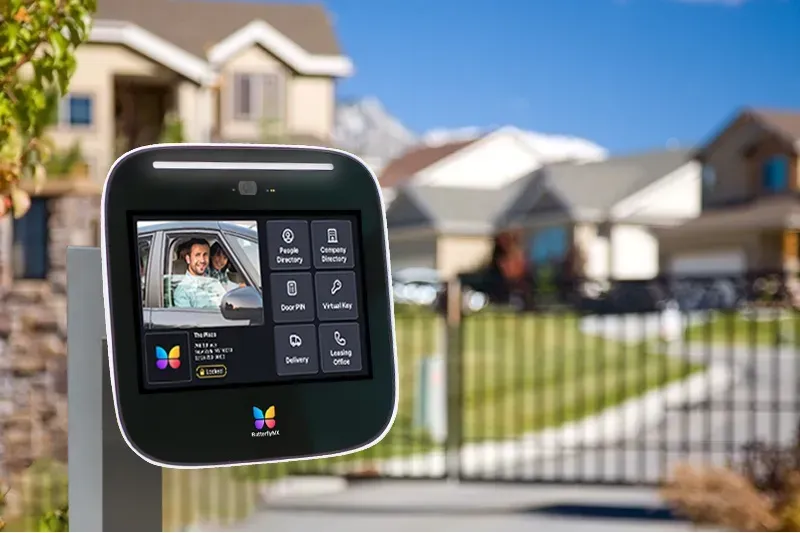
Residential Security Access Control
Smart Access Control Boards are foundational to modern security infrastructure, enabling sophisticated, granular control over physical access across a multitude of environments. These boards integrate advanced electronics with communication protocols, transforming traditional entry systems into intelligent, networked solutions capable of dynamic management and enhanced security. Their versatility makes them indispensable in securing assets and regulating access in diverse sectors, driving efficiency and safety through technological innovation.
Residential Security Systems Smart access control boards elevate home security beyond conventional locks, offering features like remote entry management via smartphones, visitor access scheduling, and integration with smart home ecosystems. This allows homeowners to manage access for family, guests, or service providers from anywhere, enhancing convenience and peace of mind. For example, a resident can remotely unlock a door for a delivery, or grant temporary access to a pet sitter, with real-time logging of all entries and exits providing an audit trail.
Commercial Office Buildings In corporate environments, smart access control boards provide robust solutions for managing employee and visitor access, crucial for data security and asset protection. They facilitate multi-factor authentication (e.g., RFID cards, biometrics) and enable time-based access restrictions, ensuring only authorized personnel can enter specific areas during designated hours. This granular control is vital for sensitive departments like R&D labs or data centers, where access is strictly limited to authorized personnel, improving compliance and minimizing security breaches. The system can also track attendance and provide detailed access logs for audit purposes.
Industrial Facilities and Warehouses Industrial settings often contain valuable equipment and hazardous materials, making stringent access control imperative. Smart access control boards can be integrated with industrial automation systems to manage entry into production zones, storage areas, and equipment rooms. They enable zone-specific access permissions, ensuring only qualified personnel operate machinery or handle sensitive materials, thus preventing accidents and theft. For instance, a technician might only have access to a specific manufacturing line during their shift, while a supervisor has broader access across multiple zones.
Application Area
Key Benefit of Smart Access Control Board
Example Use Case
Residential
Enhanced convenience & remote management
Granting temporary access to a house cleaner via mobile app
Commercial
Granular access control & audit trails
Restricting access to server rooms to IT personnel only
Industrial
Safety compliance & asset protection
Limiting entry to hazardous chemical storage to certified operators
Educational
Improved campus security & student safety
Managing dormitory access and classroom schedules
Healthcare
Patient data security & restricted access to sensitive areas
Controlling entry to pharmacies and patient record archives
How do smart access control boards enhance security beyond traditional locks? Smart access control boards provide dynamic, real-time control, unlike static traditional locks. They enable features such as remote access management, time-based entry restrictions, multi-factor authentication (e.g., biometrics, RFID, PINs), and detailed event logging. This offers superior oversight, immediate revocation of access, and a comprehensive audit trail, significantly reducing vulnerability to unauthorized entry and enhancing accountability. Traditional locks, conversely, only offer a physical barrier and lack any form of logging or remote management capabilities, making them less secure against determined threats.
In conclusion, smart access control boards are revolutionizing security systems by offering enhanced convenience, security, and connectivity. Zero One Solution Limited is dedicated to providing cutting-edge PCB solutions that empower businesses to innovate and thrive in this rapidly evolving market.
Ready to take your access control systems to the next level? Contact Zero One Solution Limited today to explore our comprehensive PCB design, manufacturing, and assembly services. Let us help you bring your smart access control board vision to life. Visit our website or contact our team for a consultation and discover how we can accelerate your product development and secure your future.