In the world of electronics, the 1k resistor is a fundamental component, often as ubiquitous as a common brick in construction. From powering a simple LED, where a single 1k resistor can cost as little as $0.015, to complex circuit designs, these tiny components play a crucial role. This article delves into the factors influencing the price of 1k resistors, helping you make informed purchasing decisions, understand its value, and explore its applications in your projects.
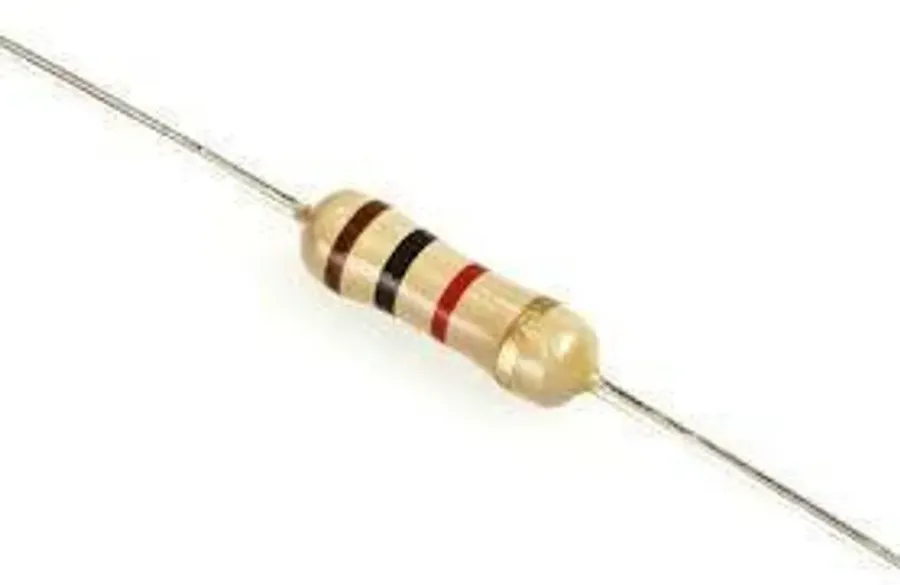
The price of a 1k resistor, a fundamental component in electronics, is influenced by several key factors. These include the material composition (carbon film or metal film), the precision of its resistance value (tolerance), the amount of power it can handle (power rating), and the quantity purchased. Understanding these factors enables informed purchasing decisions and optimizes cost-effectiveness for various electronic projects.
| Factor | Description | Impact on Price |
|---|---|---|
| Material Type | Carbon film vs. metal film | Metal film resistors are typically more expensive |
| Tolerance | Variation from the nominal value | Lower tolerance (more precise) resistors cost more |
| Power Rating | Maximum power the resistor can handle | Higher power ratings generally increase cost |
| Quantity | Number of units purchased | Bulk purchases reduce per-unit cost |
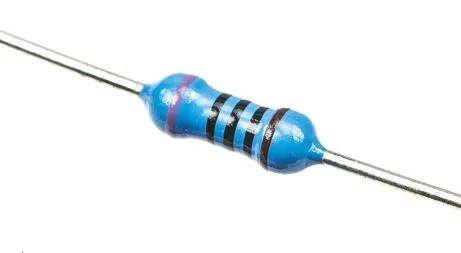
The choice between carbon film and metal film 1k resistors significantly impacts cost and performance. Metal film resistors, prized for their superior precision and stability, typically command a higher price compared to carbon film resistors, which are more economical. This section will delve into a detailed comparison of these two resistor types, exploring their characteristics, advantages, and disadvantages to aid in informed decision-making.
| Feature | Carbon Film Resistors | Metal Film Resistors |
|---|---|---|
| Construction | Carbon film deposited on a ceramic substrate | Thin metal film deposited on a ceramic substrate |
| Tolerance | Typically 5% or 10% | Typically 1%, 0.5%, or even 0.1% |
| Temperature Coefficient | Higher, less stable with temperature changes | Lower, more stable with temperature changes |
| Noise | Higher noise levels | Lower noise levels |
| Stability | Less stable over time | More stable over time |
| Cost | Lower | Higher |
| Typical Applications | General-purpose circuits, less critical applications | Precision circuits, sensitive analog applications |
As the table illustrates, metal film resistors offer higher precision (lower tolerance) and better stability with temperature fluctuations and time, making them ideal for critical applications where accuracy is paramount. However, these benefits come at a premium, rendering carbon film resistors a more cost-effective choice for general-purpose electronics where minor variations in resistance are acceptable. For example, in basic LED circuits, a carbon film resistor will generally be sufficient, but in high precision circuits, a metal film resistor would be needed.
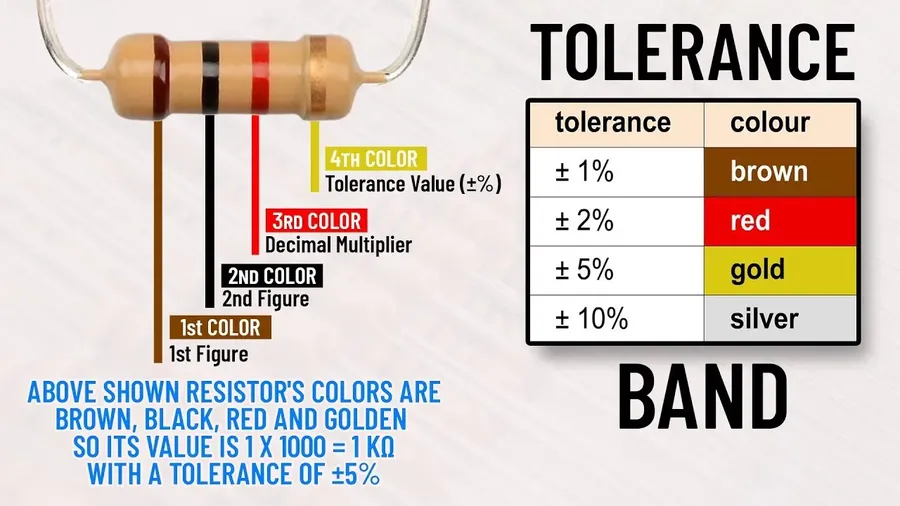
Resistor tolerance, a critical specification, directly influences the cost of a 1k resistor. It signifies the permissible deviation of a resistor's actual resistance from its stated value. Tighter tolerance, indicating higher precision, generally corresponds to a higher price due to the more rigorous manufacturing processes and quality control measures required.
The cost difference is primarily due to the increased difficulty in maintaining a precise resistance value during manufacturing. This requires more advanced machinery, stringent process control, and more thorough testing.
| Tolerance (%) | Typical Resistance Range (for 1kΩ) | Typical Cost | Applications |
|---|---|---|---|
| 1% | 990Ω - 1010Ω | Higher | Precision circuits, instrumentation, audio equipment |
| 5% | 950Ω - 1050Ω | Moderate | General purpose electronics, prototyping |
| 10% | 900Ω - 1100Ω | Lower | Less critical applications, hobbyist projects |
Choosing the appropriate tolerance is crucial for circuit functionality. While 1% tolerance resistors provide greater accuracy, they can be unnecessary for less critical applications, resulting in increased costs without tangible benefits.
The trade-off between cost and precision requires engineers and hobbyists to carefully consider their project requirements and budget when selecting resistors.
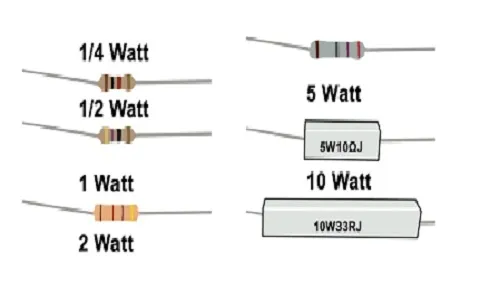
The power rating of a 1k resistor, typically expressed in watts (W), is a critical factor that significantly influences both its physical dimensions and cost. This rating specifies the maximum amount of power the resistor can safely dissipate as heat without being damaged. Common power ratings include 1/4W, 1/2W, and 1W, among others, each catering to different application needs.
A higher power rating generally correlates with a larger physical size and a higher price, due to the increased materials and construction required to manage greater heat dissipation. Selecting the correct power rating is essential to ensure the reliability and longevity of your electronic circuits. Using a resistor with an insufficient power rating can lead to overheating, performance degradation, or even component failure.
| Power Rating | Typical Physical Size | Typical Applications | Relative Cost |
|---|---|---|---|
| 1/8W | Very small, often surface-mount | Low-power circuits, signal conditioning | Lowest |
| 1/4W | Small, cylindrical axial-lead | General purpose, breadboarding | Low |
| 1/2W | Medium, larger axial-lead | Slightly higher current applications, motor control | Medium |
| 1W | Large, bulkier axial-lead | Power supplies, high-current LEDs | High |
| 2W or higher | Large, heat sink required | High power circuits, voltage regulators | Higher |
The primary factor driving the increased cost associated with higher power ratings is the need for more robust construction and materials. Resistors rated for higher power dissipation often use larger resistive elements, which demand more of the base material and better quality insulating materials, thereby increasing the unit cost. The heat generated by the resistor needs to be adequately managed to prevent failures, this will effect the size of the component and the overall cost.
When selecting a 1k resistor, it's crucial to not only consider the resistance value but also the power rating based on the circuit conditions it will be subjected to. The power dissipation (P) across the resistor is calculated by P = I^2 * R, where 'I' is the current flowing through the resistor and 'R' is the resistance. Calculating power is important to not exceed the rated power of the component.
In conclusion, power rating is an essential parameter for 1k resistors that affects size, cost, and suitability for a particular application. Understanding the power rating is critical for designing reliable and efficient electronic circuits. Always consider the application when deciding the power rating of the resistor and take into account that a derating factor of 2 may be necessary for a safety margin.

The cost of a 1k resistor can vary significantly depending on where it is purchased. This section compares prices from various sources, ranging from major online retailers to specialized electronics suppliers, to help you find the best deals. Bulk purchasing options are also examined for potential cost savings. Notably, single 1k resistors can be found for as low as $0.015 when bought in large quantities.
| Retailer/Supplier | Price per 1k Resistor (Single) | Price per 1k Resistor (Bulk, e.g., 1000) | Notes |
|---|---|---|---|
| Amazon | $0.10 - $0.30 | $0.02 - $0.05 | Varies by seller; often available in small packs and bulk. |
| Walmart | $0.15 - $0.40 | Not typically sold in large bulk | Limited selection; primarily smaller packs |
| Jameco Electronics | $0.08 - $0.25 | $0.015 - $0.04 | Specialized supplier; good for bulk purchases; often ships in large quantities. |
| Tayda Electronics | $0.05 - $0.20 | $0.01 - $0.03 | Specialized supplier; known for competitive pricing; often ships in large quantities. |
| Digi-Key | $0.15 - $0.40 | $0.03 - $0.08 | Large supplier; extensive selection; generally higher prices but may be suitable for large purchases. |
| Mouser Electronics | $0.18 - $0.45 | $0.04 - $0.10 | Large supplier with a wide range of components. |
Note that these prices can fluctuate based on market conditions, specific resistor type (carbon vs. metal film, tolerance, power rating), and the quantity purchased. The prices are approximate and are given to highlight the trends between the suppliers and are not a commitment to exact pricing at the time of purchase. It's important to always check current prices before making any purchasing decision.
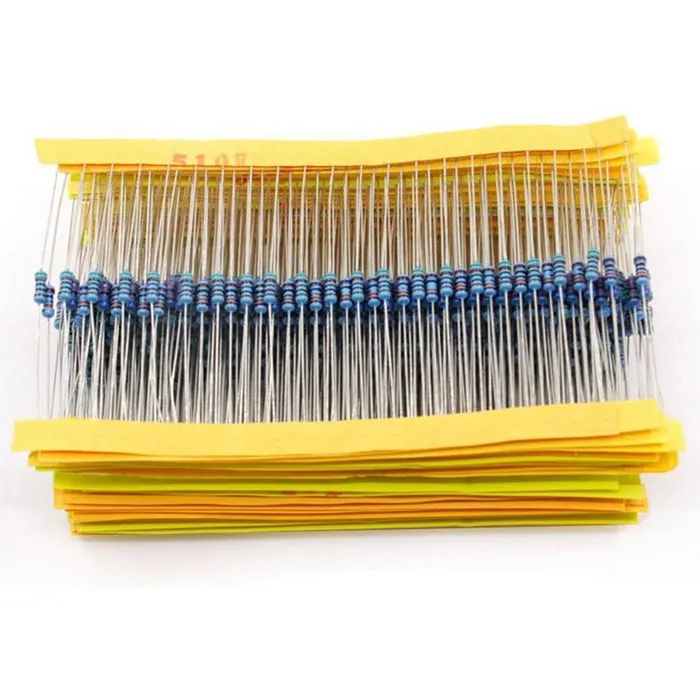
The cost of 1k resistors varies significantly depending on whether you purchase them individually or in bulk. Bulk purchases typically offer substantial cost savings per unit, making it a crucial consideration for projects requiring multiple resistors.
| Quantity | Approximate Price per Resistor | Total Cost |
|---|---|---|
| 1 | $0.10 - $0.20 | $0.10 - $0.20 |
| 10 | $0.05 - $0.10 | $0.50 - $1.00 |
| 100 | $0.02 - $0.05 | $2.00 - $5.00 |
| 1000 | $0.01 - $0.03 | $10.00 - $30.00 |
| 10000 | $0.005 - $0.02 | $50.00 - $200.00 |
The table above illustrates the trend of decreasing cost per resistor as the quantity increases. This is due to several factors, including reduced packaging costs, lower handling fees, and the economies of scale that manufacturers and distributors can achieve when dealing with large volumes.
Determining the optimal purchasing strategy depends largely on your project requirements and the potential for future use. For hobbyists or individuals working on small, one-off projects, purchasing a small quantity might be the most cost-effective approach. However, for larger projects or for businesses that routinely use 1k resistors, buying in bulk is almost always more advantageous.
It is also worthwhile to compare prices from different suppliers and take advantage of quantity discounts where applicable. Some suppliers might offer tiered pricing for different bulk quantities, enabling even greater cost savings.

The 1k resistor serves as a fundamental component in numerous electronic circuits, with its selection significantly impacting circuit behavior. Choosing the correct type, tolerance, and power rating is crucial for reliable performance. This section outlines common applications and provides guidance for optimal 1k resistor selection.
The most common applications of 1k resistors include current limiting for LEDs and voltage division. Let's delve into each:
When selecting a 1k resistor, consider the following factors:
| Factor | Considerations |
|---|---|
| Type (Carbon Film vs. Metal Film) | Metal film resistors offer higher precision and temperature stability, suitable for critical applications. Carbon film resistors are more cost-effective for less demanding use cases. |
| Tolerance | Choose a lower tolerance resistor (e.g., 1%) for precise applications, such as analog circuits. Higher tolerances (e.g., 5%) are generally suitable for less critical applications like LED current limiting. |
| Power Rating | The power rating should be selected to handle the power dissipated across the resistor, calculated as P = I²R, where P is power (watts), I is current (amperes), and R is resistance (ohms). A safety margin is generally recommended to ensure long term reliability. For example, if you know the current will be 3mA and your resistance is 1000 ohms then the power rating must be at least 0.009 Watts (P=0.003 x 0.003 x 1000). Therefore it is recommended you use a 0.25W resistor. |
Here are some practical examples of 1k resistor usage:
This section addresses common queries regarding 1k resistors, providing clarity on their resistance value, applications, and appropriate usage scenarios. Understanding these aspects is crucial for anyone working with electronic circuits.
The price of a 1k resistor, starting from as little as $0.015, is influenced by several factors including material, tolerance, and quantity. Whether you’re working on a simple LED project or designing complex circuitry, understanding these nuances is crucial. By comparing suppliers and considering bulk purchasing, you can maximize the value of your electronics projects. Remember, choosing the right resistor is not just about price but also about performance and reliability.

