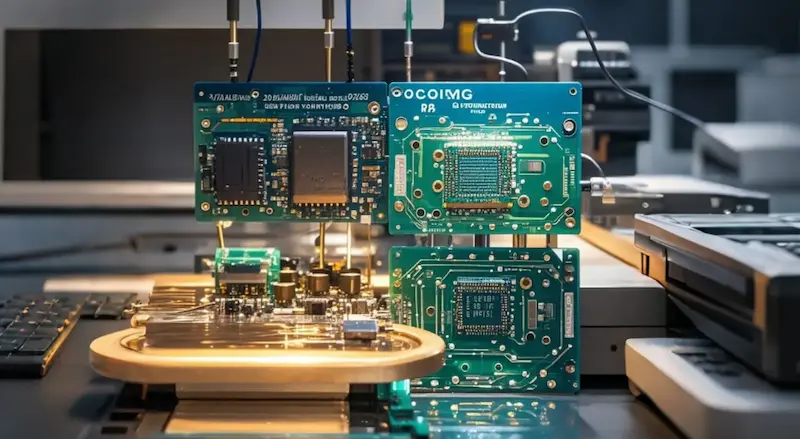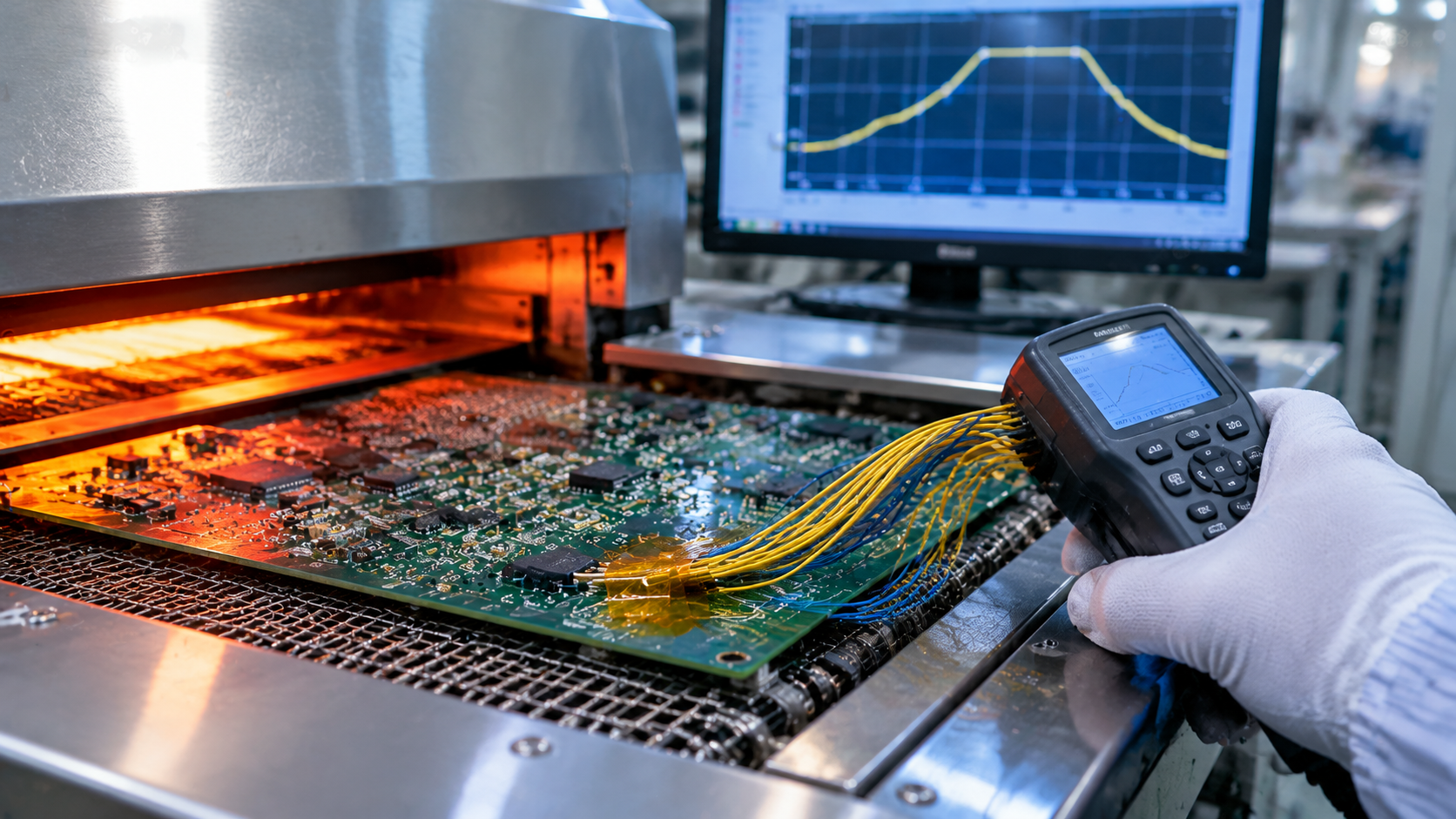
Introduction: The reflow profile is one of the most critical factors in SMT assembly. It determines how solder paste melts and forms reliable joints with PCB pads and component leads. This guide breaks down the four stages of a reflow profile—preheat, soak, reflow, and cooling—and explains how each stage affects wetting, mechanical strength, and long-term reliability.
Description: Based on AnyPCBA's small-to-medium volume PCBA manufacturing experience, this guide explains how to set an SMT reflow profile—covering preheat, soak, reflow, and cooling stages, common misconceptions, and a practical verification checklist—to reduce solder defects and improve joint reliability.
SMT (Surface Mount Technology) reflow soldering is a core process in PCBA assembly.
By precisely controlling the temperature profile inside the reflow oven, the alloy in the solder paste melts and forms reliable metallurgical joints with the PCB pads and component leads. Whether the profile is set correctly directly determines the wetting, mechanical strength, and long-term electrical reliability of the solder joints.
At AnyPCBA, we understand that there is no "universal" reflow profile—only the profile best suited to a specific product. This article breaks down the four stages of the reflow profile from a manufacturing perspective and explains their critical impact on joint quality.
After components are placed, the PCBA passes through the reflow oven for soldering. Incorrect profile settings create two major risks:
Ramping too fast: causes uneven heating between the PCB and components, creating thermal shock that can induce micro-cracks in MLCCs or board warpage.
Improper peak temperature or soak time: leads to cold joints, solder balls, tombstoning, and insufficient solder fill.
In particular, different board thicknesses, copper weights, component packages (such as BGA and QFN), and solder paste types all impose significantly different requirements on the reflow profile.
A standard reflow profile consists of four stages:
Function: Gradually heat the PCB and components to equalize surface temperature and reduce thermal shock.
Failure risk: Ramping too fast creates uneven heating—especially the large temperature difference between large components and tiny SMDs—which affects welding consistency.
Function: Equalize temperatures across different PCB areas and components, while promoting flux volatilization and removing oxides from pads and leads.
Failure risk: Insufficient soak time degrades wetting (causing cold joints); excessive soak time over-volatilizes the flux (losing activity) or pre-oxidizes the solder paste.
Function: The critical stage for joint formation. When the temperature exceeds the liquidus of the solder alloy, the solder melts and, under the action of flux, wets the pads and leads to form intermetallic compounds (IMC).
Failure risk: Insufficient peak temperature causes incomplete fusion or cold joints; excessive temperature or time can damage heat-sensitive components or create an excessively thick, brittle IMC layer that cracks easily.
Function: The solder solidifies to form joints with mechanical strength and electrical conductivity.
Key point: Cooling rate directly affects the microstructure and grain morphology of the joint. Too fast causes high internal stress; too slow produces coarse grains that reduce joint strength. Control the cooling rate appropriately based on solder paste and product requirements.
Absolutely not.
Many engineers, when facing soldering defects, immediately assume "not enough temperature—add more heat." This is an extremely dangerous misconception. Reflow profiles must be customized to the solder paste supplier's process window, combined with the PCB structure and component temperature limits—never simply by raising oven temperature.
In addition, different PCB prototype batches, board thicknesses, and component layouts change the overall thermal capacity of the assembly. Even for the same product, changing material lots or board suppliers often requires re-validating the reflow profile.
At AnyPCBA, our engineering team strictly executes the following checklist for reflow soldering:
Material confirmation: Do PCB material, thickness, and copper weight meet process requirements?
Solder paste matching: Does the solder paste type and alloy composition (such as SAC305) match the product's high-reliability requirements?
Profile design: Have preheat, soak, peak temperature, and cooling rate been scientifically calculated?
Measurement verification: Has the profile been validated by actual measurement using a KIC thermal profiler?
Thermal capacity differences: Are there significant temperature differences among high-thermal-capacity components (such as BGA and QFN)? (Avoid large components with unmelted solder or small components already overheating.)
Post-solder inspection: After reflow, are there cold joints, solder bridges, tombstoning, or other joint anomalies? We pair this with 100% AOI and X-Ray inspection.
Reflow quality depends not only on peak temperature—it is the combined result of preheat, soak, reflow, and cooling.
Only by setting the profile correctly and validating it with actual thermal measurement can soldering defects be reduced. At AnyPCBA, we provide one-stop service from PCB fabrication and SMT assembly to finished product delivery, controlling every degree of temperature so our customers can focus on product innovation.
If you encounter issues in PCBA processing or soldering processes, contact us through the AnyPCBA website.