Introduction: In SMT assembly, solder paste and red glue (SMT adhesive) serve different purposes—one creates the electrical and mechanical solder joint, the other simply holds components in place. Choosing the right process—or combining both—directly affects cost, yield, and reliability. This guide compares the two processes, explains their applications and limitations, and provides selection criteria for mixed SMT/DIP assembly.
Description: Based on AnyPCBA's small-to-medium volume PCBA manufacturing experience, this guide compares solder paste and red glue processes in SMT—covering their roles, applications, quality trade-offs, and the selection logic for mixed SMT/DIP assembly.
Surface Mount Technology (SMT) is a core technology in modern electronics manufacturing, used to place electronic components onto Printed Circuit Boards (PCBs).
In SMT, solder paste and red glue (SMT adhesive) are two common methods for securing components. While both aim to keep components firmly attached to the board, they differ fundamentally in material properties, equipment requirements, process flow, and suitable applications.
For hardware engineers, understanding these differences helps optimize DFM (Design for Manufacturing) and avoid yield disasters in mass production.
Solder paste is a mixture of metal solder powder, flux, and binders. It is printed onto pads through a stencil, and after component placement, it melts in the reflow oven at high temperatures to form a true electrical and mechanical connection.
Characteristics: Conductive, thermally conductive, and high joint strength. This is the default process for most modern PCBA.
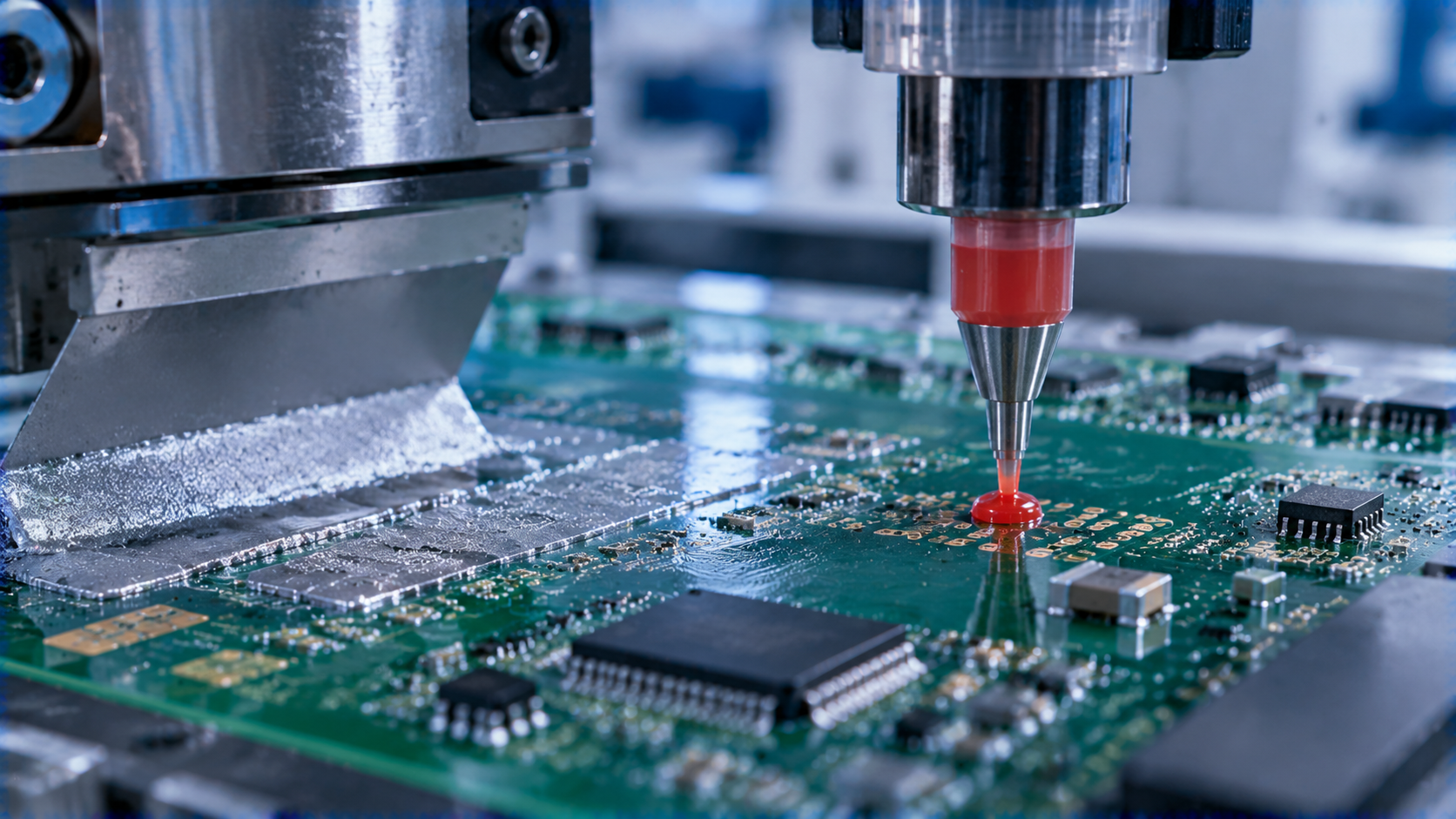
Red glue (SMT adhesive) is typically a thermosetting epoxy resin. It is dispensed or stencil-printed onto the PCB (usually between two pads), and after component placement, it is cured by heat to hold the component firmly to the board surface.
Characteristics: Non-conductive, low curing temperature. Its core function is not soldering, but fixation.
If solder paste can conduct and solder, why is red glue still needed? The answer usually lies in wave soldering requirements.
In traditional mixed-technology assembly (SMT + DIP), expensive wave solder pallets are typically required to protect bottom-side SMT components during wave soldering.
With the red glue process, SMT components are firmly fixed by adhesive and can pass directly through wave soldering, eliminating pallet costs. This is especially attractive for small-batch, cost-sensitive orders.
During wave soldering, SMT components face downward. If the red glue process is poorly controlled, the solder wave can wash components away. Therefore, when using red glue, components must be large enough and spaced widely enough.
Red glue is also commonly used to prevent heavy components (such as large inductors) from shifting before reflow—a "fixation + assistance" role.
In actual production, choosing a process—or combining them—depends on three dimensions.
Red glue (dispensing): If the number of dispense points is high, the dispenser becomes the bottleneck of the entire SMT line. If stencil printing is used, the stencil precision requirements are extremely high, and AI (Automated Inspection) must precede placement.
Solder paste: Mature process with high precision, but mixed assembly typically requires reflow carriers to protect bottom-side components.
Red glue: Adhesion is poor on cylindrical or glass-bodied packages (such as cylindrical diodes or crystals), making them prone to falling off. Red glue is also moisture-sensitive; improper storage can lead to missing solder or component loss after wave soldering.
Solder paste: High solder joint strength and low defect rates. Even very small components can be soldered reliably through reflow.
Solder paste process: Reflow carriers represent a significant initial investment, and solder material costs are slightly higher.
Red glue process: Adhesive is a unique consumable, but pallet costs are eliminated.
Selection principles:
Many SMT components, few through-hole components: Prefer solder paste; solder through-hole parts afterward.
Many through-hole components, few SMT components: Red glue can be used, with SMT components passing through wave soldering for higher throughput.
| Dimension | Solder Paste Process | Red Glue Process |
|---|---|---|
| Function | Soldering (conductive) | Fixation (non-conductive) |
| Temperature | High temperature (typically 240°C+) | Low-temperature curing (typically ~150°C) |
| Joint Strength | Very high | Moderate (depends on adhesive quality) |
| Main Drawback | High pallet cost | Component loss, missing solder, component size limitations |
At AnyPCBA, we handle PCBA projects ranging from 5-piece prototypes to 5,000-piece production runs every day. Our recommendations on solder paste versus red glue:
Do not choose red glue solely to save pallet costs. Although red glue is cheaper, it cannot meet the precision and reliability requirements of miniaturized, high-density boards (such as 0201 components and BGAs). For industrial, automotive, or medical-grade products, stick with solder paste and pallets.
Red glue storage and shelf life: If a customer uses mixed red glue assembly, we strictly control refrigerated storage, warm-up time, and usage validity to prevent moisture-induced component loss after wave soldering.
Special fixation needs: If a board carries heavy components, we use localized red glue dispensing during SMT combined with reflow soldering—a "mixed process."
Whether your design is pure SMT, pure through-hole, or mixed technology, AnyPCBA can provide the most suitable process plan through DFM review. If you have questions about red glue or solder paste processes, or need high-quality PCBA processing services, contact us through our website.