
In the high-stakes automotive market, the precision of a Blind Spot Detection (BSD) system can determine both a vehicle's safety rating and the manufacturer's bottom line. As pressure grows to shorten time-to-market while slashing production costs, OEM suppliers face a critical choice: compromise quality or evolve manufacturing processes. This article explores how strategic design for manufacturability (DFM) and rigorous testing protocols offer a sustainable path to higher ROI.
The Intersection of DFM and Automotive Profitability

The Direct Correlation Between DFM and Profit Margins
In the highly competitive market for Blind Spot Detection components, profit margins are often squeezed by high failure rates and assembly inefficiencies. By implementing DFM, OEM suppliers shift from a reactive 'find and fix' approach to a proactive 'design for excellence' methodology. When PCB layouts are optimized for automated assembly, soldering defects are minimized, and test yields increase, directly preserving capital that would otherwise be lost to rework and scrap.
Strategic Impact of Early-Stage Decisions
| Decision Stage | Cost Impact | Profitability Lever |
|---|---|---|
| Conceptual Design | Low | Highest potential for cost avoidance |
| PCB Layout/DFM | Medium | Reduces labor and assembly time |
| Full Production | High | High rework costs and yield loss |
Frequently Asked Questions on DFM Implementation
- How does PCB design influence final assembly costs?
Poorly optimized PCB designs necessitate complex jigging, manual intervention in pick-and-place lines, and higher test failure rates, all of which inflate the cost-per-unit for BSD modules. - Can DFM accelerate time-to-market for new automotive sensors?
Yes, by designing for manufacturing feasibility first, engineers eliminate the need for extensive design iterations between prototyping and mass production, significantly compressing the development cycle. - Is the investment in DFM tools justified for lower-volume BSD parts?
Absolutely. While high-volume projects see the most immediate ROI, DFM prevents systemic quality errors that cause reputational damage and warranty claims, regardless of production volume.
Case Study: Identifying the Root Causes of Assembly Inefficiency

The Anatomy of Assembly Inefficiency
Assembly inefficiency in blind spot detection (BSD) modules often stems from a disconnect between high-precision sensor requirements and outdated mechanical assembly processes. When PCB assembly fails to account for the thermal expansion coefficients of sensor housings, or when optical alignment relies on manual calibration rather than automated vision systems, the result is a high rate of rework and excessive scrap costs that erode the margins of OEM suppliers.
Common Failure Points in BSD Manufacturing
| Failure Source | Primary Impact | Root Cause |
|---|---|---|
| Sensor Alignment | Increased Yield Loss | Manual jig-based calibration variability. |
| Thermal Stress | Intermittent Connectivity | Incompatible housing/PCB expansion coefficients. |
| Solder Joint Integrity | High Field Failure Rates | Inconsistent reflow profiles for compact PCBs. |
Strategic Root Cause Analysis
To maximize ROI, manufacturers must transition from reactive troubleshooting to proactive root cause identification. By implementing real-time data collection at each stage of the Surface Mount Technology (SMT) line, firms can correlate specific process parameters with eventual defect rates.
- How do design-for-manufacturing (DFM) oversights impact assembly costs?
Poor DFM choices, such as high-density component placement that interferes with automated optical inspection (AOI), force reliance on costly manual inspection and extend cycle times. - Why is automated alignment superior for BSD production?
Automated vision-guided assembly eliminates human error, ensures sub-millimeter precision, and provides traceable data for every unit produced, significantly reducing post-assembly rework. - What is the role of digital twin modeling in reducing defects?
Digital twinning allows manufacturers to simulate thermal and mechanical stresses on the BSD module before physical production, identifying potential failure points in the virtual design phase.
Strategic Material Selection for Thermal and Mechanical Stability
Engineering Material Robustness for Automotive Environments
Selecting the optimal laminate for Blind Spot Detection (BSD) systems requires a rigorous assessment of thermal expansion coefficients (CTE) and dielectric stability. Automotive environments subject hardware to extreme temperature swings, moisture ingress, and constant mechanical vibration; failure to choose materials with high Glass Transition Temperatures (Tg) often leads to solder joint fatigue and delamination. By prioritizing high-Tg FR-4 or specialized metal-clad laminates early in the design cycle, OEMs can minimize warranty returns and the significant costs associated with post-assembly repair.
Comparative Material Analysis for BSD Modules
| Material Type | Thermal Stability | Cost Profile | Best Use Case |
|---|---|---|---|
| Standard FR-4 | Low | Lowest | Cabin-integrated sensors |
| High-Tg FR-4 | Moderate | Medium | External mirror-mount units |
| Metal-Core PCB | High | Highest | High-power radar emitters |
Optimizing ROI Through Material Standardization
Beyond technical performance, material standardization is a primary driver of cost-efficiency. Utilizing a limited set of proven substrates across multiple product lines reduces inventory complexity, increases negotiating power with suppliers, and stabilizes manufacturing parameters. This standardization allows for repeatable assembly processes, significantly reducing the downtime required to calibrate pick-and-place machines for varying thermal properties of different laminates.
Frequently Asked Questions on Material Selection
- How does Tg impact assembly costs?
Materials with low Tg soften during repeated thermal cycles in assembly, leading to pad lifting and internal layer defects that increase scrap rates and rework labor. - Can material choice reduce assembly time?
Yes, selecting materials with predictable thermal expansion allows for faster reflow profiles and reduces the need for complex cooling cycles in high-throughput lines. - Is metal-clad material always necessary?
Not necessarily; metal-clad is only required for radar modules requiring active heat dissipation, while high-Tg FR-4 is often sufficient for standard sensor housings.
Optimizing Layouts for High-Speed Automated Assembly
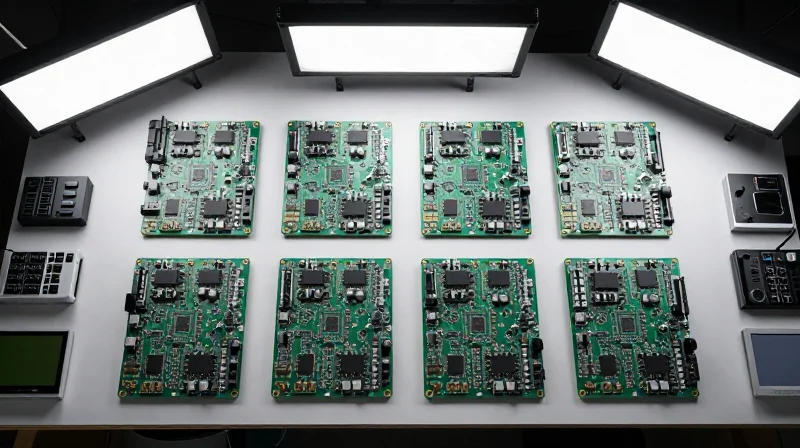
Streamlining Throughput via Intelligent Panelization
Effective panelization is the cornerstone of automated assembly efficiency. By maximizing board density within the panel while maintaining clearance for routing tools and gripper keep-out zones, manufacturers can significantly reduce cycle times. Implementing multi-up panel designs not only accelerates the pick-and-place process but also minimizes the number of board transitions required across the SMT line.
| Panelization Strategy | Throughput Impact | Recommended Application |
|---|---|---|
| Single-up | Lowest | Prototyping/Massive power electronics |
| Array-based (2x2 or 3x3) | Moderate | Standard PCB sensor modules |
| High-Density Nested | Highest | Miniature radar/camera PCBs |
Placement Optimization and Fiducial Management
Placement accuracy for Blind Spot Detection (BSD) systems hinges on precise fiducial recognition. To minimize defects, designers must place fiducials at the diagonal extremes of the panel to allow the vision system to calculate local scaling and rotation offsets accurately. Furthermore, aligning component orientations to minimize the rotation angle of the placement head is a simple yet often overlooked technique that yields immediate throughput gains.
Key Considerations for Automated Assembly
- How does component orientation affect speed?
Matching component orientation with the placement head’s default angle reduces theta-axis movement, directly shaving milliseconds off each pick-and-place cycle. - Why are global and local fiducials necessary?
Global fiducials handle panel-level alignment, while local fiducials compensate for board-level thermal expansion, essential for high-frequency BSD radar components. - What is the impact of edge rails on cost?
Standardized edge rails prevent machine jams and accommodate universal board handling, reducing setup time and tool wear across different manufacturing runs.
Implementing Advanced Automated Testing Protocols

The Transition to AI-Driven Optical and In-Circuit Testing
Manual inspection of complex electronic control units (ECUs) and sensor arrays is inherently prone to fatigue and human error, which drives up warranty claims and scrap rates. By transitioning to AI-powered Automated Optical Inspection (AOI) and advanced In-Circuit Testing (ICT), OEM suppliers can establish a closed-loop quality system that detects micro-fractures, solder joint anomalies, and sensor misalignment at the nanometer scale during the earliest stages of assembly.
| Testing Method | Primary ROI Driver | Key Efficiency Gain |
|---|---|---|
| AI-Powered AOI | Reduced False Negatives | Real-time defect trend analysis |
| In-Circuit Testing (ICT) | Electrical Integrity Verification | Zero-touch parametric validation |
| Automated Functional Testing (FCT) | End-of-line certification | Rapid firmware deployment validation |
Best Practices for Scalable Automated Testing
- How does predictive defect modeling lower assembly costs?
By leveraging historical data from past production batches, AI algorithms can predict when machine calibration drifts, allowing for maintenance before defects actually manifest in the hardware. - What is the role of digital twins in the testing phase?
A digital twin allows engineers to simulate the testing environment for blind spot detection hardware, ensuring the testing protocols are optimized before the physical line is even commissioned. - How can manufacturers integrate testing into existing SMT lines?
Modular testing stations should be integrated directly into the SMT line as 'inline' check-points, eliminating the need for offline batch inspection and reducing Work-in-Progress (WIP) costs.
Technical Implementation Strategy
def trigger_quality_gate(sensor_data, threshold):
    if sensor_data['impedance'] > threshold:
        flag_assembly_error('Component Impedance Out of Range')
        return False
    return True
Ultimately, the shift toward automated, data-centric testing reduces the Total Cost of Quality (TCoQ). By catching defects early—before expensive final assembly steps—OEM suppliers can capture significant savings while ensuring the safety-critical reliability of blind spot detection technology.
The 20% ROI Breakthrough: Quantifying the Gains
For OEM suppliers, the shift toward a 20% ROI threshold is rarely the result of a single technological silver bullet; rather, it is the cumulative effect of marginal gains across the manufacturing lifecycle. By integrating high-speed SMT placement with AI-driven optical inspection, manufacturers can isolate defects at the source, effectively slashing the 'Cost of Poor Quality' (COPQ) that typically erodes margins in sensor production.
Financial Impact of Defect Reduction
| Performance Metric | Traditional Baseline | Optimized Workflow | Financial Impact |
|---|---|---|---|
| First-Pass Yield | 88% | 96% | +8% Revenue Efficiency |
| Inspection Time | 45s/unit | 12s/unit | 73% Labor Cost Reduction |
| Scrap Rate | 3.5% | 0.8% | Substantial Material Savings |
Key Drivers of the 20% ROI
- Why does automated optical inspection (AOI) accelerate ROI?
AOI systems eliminate the latency of manual inspection, identifying micro-fractures in solder joints before they progress to final assembly where failure costs increase exponentially. - How does component panelization influence assembly costs?
Optimized panel designs reduce scrap rate during substrate cutting and improve utilization of expensive sensor-grade silicon, directly lowering the per-unit material overhead. - What is the role of AI in predictive maintenance for SMT lines?
Predictive algorithms anticipate tooling wear, preventing unscheduled downtime that historically accounts for a 5-7% drag on quarterly production quotas.
To sustain this 20% benchmark, OEM suppliers must shift from reactive quality management to a data-centric ecosystem. Every defect identified by an automated protocol should serve as a feedback signal to upstream design engineers, fostering a virtuous cycle of design-for-manufacturing (DFM) improvements. By reducing rework cycles by 40% and increasing throughput, the capital expenditure on advanced testing equipment is typically amortized within 18 months, effectively securing the long-term profitability of the blind spot detection product line.
Ensuring Long-Term Reliability and Safety Compliance

Engineering Reliability Through Lifecycle Validation
Long-term reliability is not a final step but an outcome of integrated design-for-reliability (DfR) practices. By shifting from periodic inspection to continuous, data-driven validation, OEM suppliers can proactively identify wear patterns and environmental stressors that lead to field failures. This approach significantly reduces the cost of potential recalls and warranty claims while strengthening brand reputation.
Comparing Reliability Assurance Strategies
| Strategy | Primary Benefit | Cost Impact |
|---|---|---|
| Burn-in Testing | Early latent defect detection | High Initial Capital |
| Digital Twin Simulation | Accelerated aging analysis | Reduced Prototyping |
| Continuous Monitoring | Real-time failure prediction | Low Long-term OpEx |
Compliance and Operational Governance
Strict adherence to automotive safety standards, particularly ISO 26262, is mandatory for hardware and software in blind spot detection. Suppliers must maintain a rigorous traceability matrix that links every component specification to specific safety requirements. This governance ensures that cost-reduction efforts do not inadvertently compromise safety functionality.
- How does automated testing improve long-term safety compliance?
Automated protocols provide an immutable audit trail of testing parameters for every unit, ensuring consistent adherence to safety specifications that manual inspection cannot guarantee. - Can cost reduction efforts be reconciled with ISO 26262?
Yes, by utilizing process-based efficiency improvements—such as refined SMT workflows—rather than lowering the grade of components, suppliers can maintain ASIL compliance while optimizing margins. - What role does AI play in reliability?
AI-driven optical inspection models can detect micro-cracks or solder anomalies that often lead to environmental moisture ingress, effectively preventing field failures before they occur.
Future-Proofing Your Supply Chain
Adapting to Next-Generation Sensor Architectures
As the industry shifts from ultrasonic sensors to high-resolution radar and LiDAR-based blind spot detection systems, OEM suppliers must prioritize modular design. By decoupling the hardware sensor layer from the processing software, manufacturers can upgrade software algorithms over the air (OTA) without necessitating a complete mechanical redesign of the sensor assembly.
| Strategy | Benefit | Impact on ROI |
|---|---|---|
| Modular Hardware | Component Reuse | High (Lower R&D cost) |
| OTA Compatibility | Lifecycle Extension | Medium (Value retention) |
| Predictive Analytics | Reduced Downtime | High (OEE improvement) |
Strategic Implementation of Predictive Maintenance
Transitioning from reactive troubleshooting to predictive maintenance is essential for future-proofing. By integrating IoT sensors directly into the assembly lines that produce blind spot hardware, suppliers can detect tool wear and process deviations before they manifest as manufacturing defects. This closed-loop feedback system minimizes scrap rates and stabilizes production costs as volume demand for advanced ADAS systems grows.
Frequently Asked Questions
- How does software-defined hardware impact supply chain flexibility?
It allows suppliers to use a standardized hardware chassis across multiple vehicle platforms, adjusting only the firmware to meet specific OEM safety requirements, thus reducing inventory overhead. - Why is data interoperability critical for future ADAS components?
As blind spot detection integrates with broader sensor fusion ecosystems, ensuring that component data can communicate seamlessly with central vehicle ECUs prevents costly integration failures. - What role does AI play in long-term cost reduction?
AI-driven visual inspection systems evolve alongside product changes, meaning the testing infrastructure does not need to be replaced when sensor dimensions or specifications are modified.
By aligning PCB design with advanced manufacturing techniques, OEM suppliers can significantly lower their total cost of ownership without sacrificing the stringent safety standards required for modern vehicles. Ready to optimize your production line? Contact our engineering team today to audit your current designs and start your path to 20% cost savings.
