Passive components, the unsung heroes of electronics, are fundamental to virtually every circuit board. Unlike their active counterparts, passive components don't require external power to operate. Imagine them as the supporting cast, enabling the main actors (active components) to perform their tasks. This article delves into the fascinating world of passive components, exploring their various types, functions, and real-world applications, empowering you to understand their vital role in modern electronics.
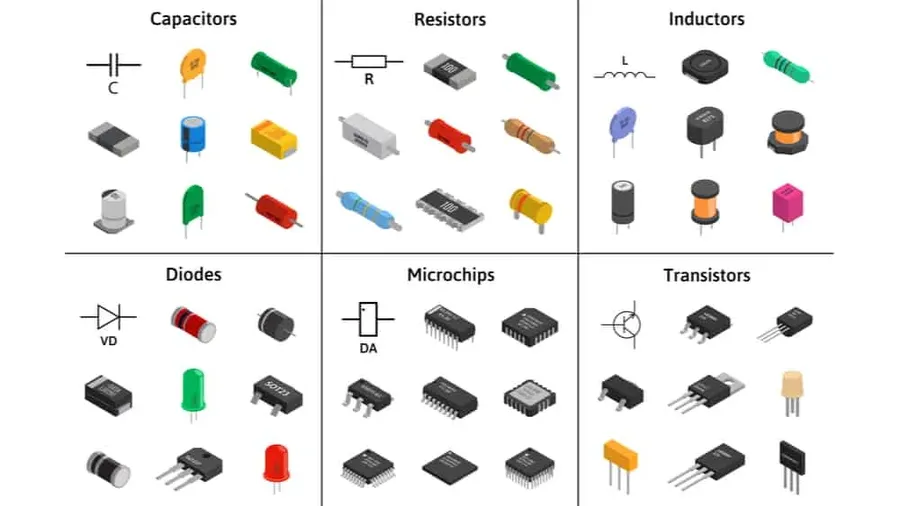
Passive components are fundamental building blocks in electronic circuits that do not generate power but rather manage energy flow by dissipating, absorbing, or storing energy. Unlike active components, passive components rely on an external power source, typically from an active component, to function. These components are crucial for shaping and controlling electrical signals, and are essential for the proper operation of any electronic system.
Passive components are vital for managing energy within circuits, performing various essential functions that do not involve amplification or signal generation. Their primary function is to modify the characteristics of electrical signals, which is crucial for circuit operation. They primarily manipulate energy flow through three core actions:
It is essential to recognize that passive components do not generate power; instead, they manipulate the energy provided by active components within the circuit. This dependence on external power sources underscores their passive role in a system's overall function.
Passive components are fundamental building blocks in electronic circuits, primarily responsible for managing energy flow without introducing a gain or requiring an external power source for their basic operation. They play a critical role in shaping circuit behavior by controlling current, storing energy, or filtering signals, and the main categories include resistors, capacitors, and inductors. While diodes are sometimes considered passive, they exhibit non-linear characteristics.
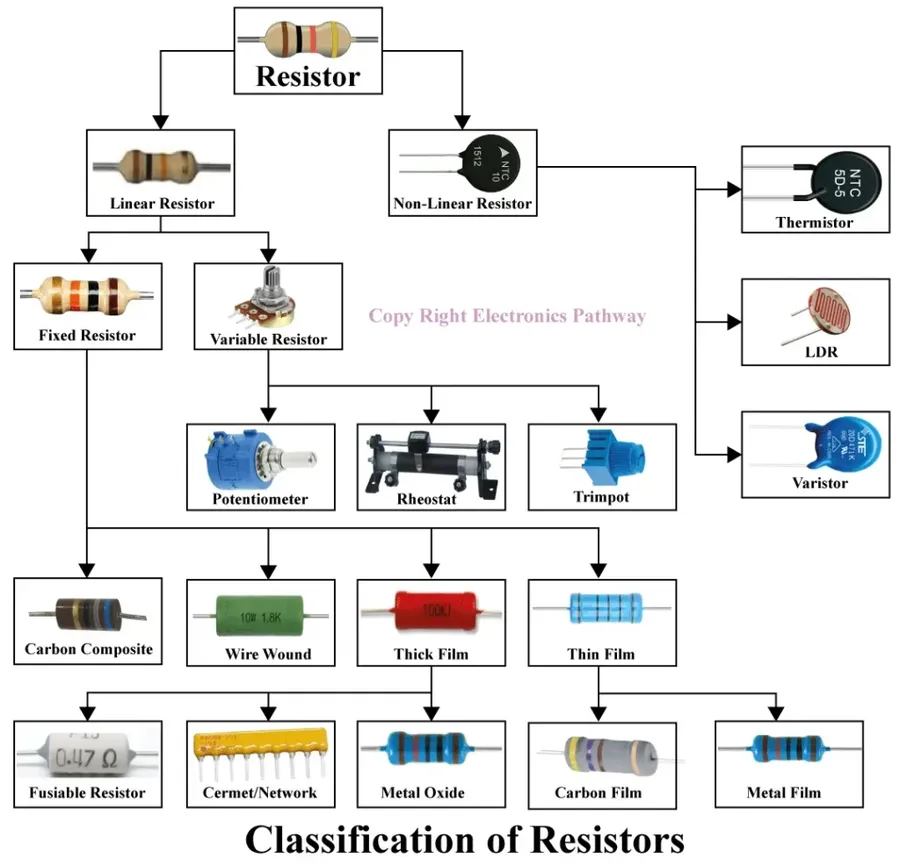
Resistors are fundamental passive components that impede the flow of electrical current within a circuit. This opposition to current flow, measured in ohms (Ω), is their defining characteristic, enabling precise control over current levels and voltage distribution. Resistors do not amplify or generate a signal; they simply dissipate electrical energy as heat.
Resistors come in diverse forms, each suited to different applications:
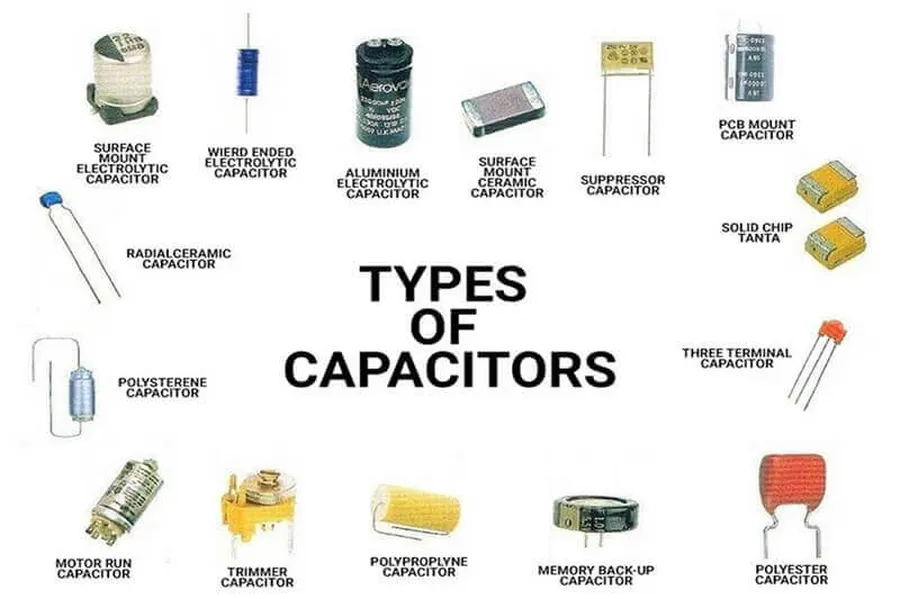
Capacitors are fundamental passive components in electronic circuits, primarily functioning to store electrical charge. They achieve this by accumulating electrons on their conductive plates, separated by a dielectric material. This ability to store charge is crucial in various applications, from smoothing power supply fluctuations to timing circuits and filtering.
The basic principle behind a capacitor involves two conductive plates separated by an insulating material, the dielectric. When a voltage is applied, charge accumulates on the plates, creating an electric field within the dielectric. The amount of charge stored is proportional to the applied voltage and the capacitor's capacitance, which is measured in Farads (F).
| Capacitor Type | Dielectric Material | Typical Capacitance Range | Key Applications |
|---|---|---|---|
| Ceramic Capacitors | Ceramic | pF to µF | Bypassing, decoupling, high-frequency applications |
| Electrolytic Capacitors | Aluminum Oxide, Tantalum Oxide | µF to mF | Power supply filtering, large energy storage |
| Film Capacitors | Polyester, Polypropylene | pF to µF | Audio circuits, precision timing, high-voltage applications |
Different types of capacitors are employed based on specific requirements of the application. Ceramic capacitors are known for their low cost and stability at high frequencies. Electrolytic capacitors offer large capacitance values, suitable for energy storage applications, though they are typically polarized, and film capacitors provide high precision and stability, ideal for audio and timing applications.
The applications of capacitors are diverse. In decoupling, capacitors reduce noise and ripple in power supply lines. In filtering, they remove unwanted frequency components from signals. And in energy storage, they act like temporary batteries, providing backup power or bursts of energy, such as in flash photography.
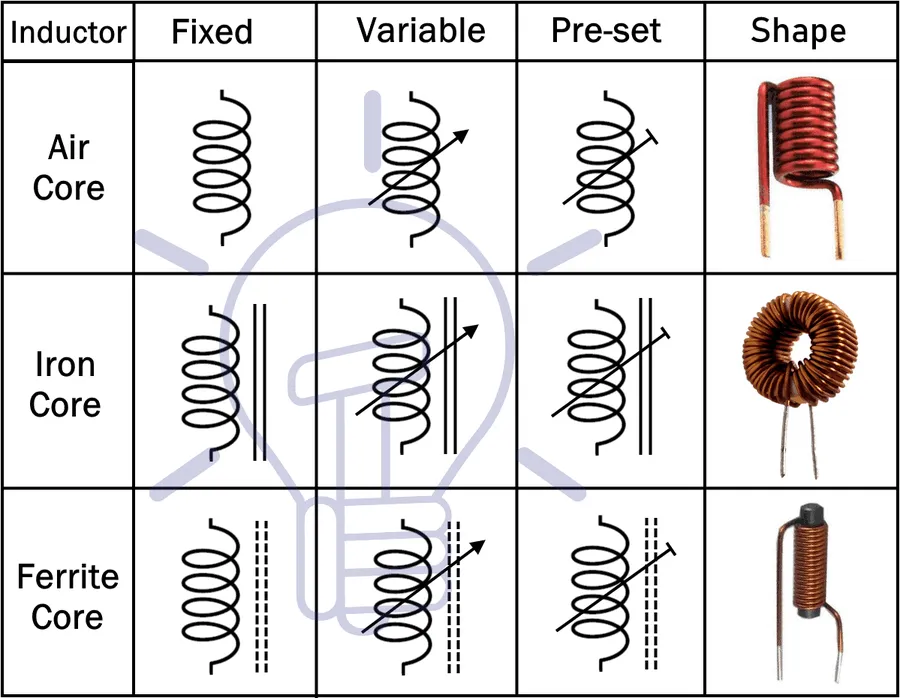
Inductors are fundamental passive components that store energy within a magnetic field, which is generated when an electrical current passes through them. Unlike resistors that impede current flow and capacitors that store electrical charge, inductors resist changes in current, making them vital for managing magnetic energy in circuits. This property is crucial in various electronic applications, from signal filtering to energy storage.
The core operating principle of an inductor involves its interaction with a changing magnetic field, directly related to changes in current flow. According to Faraday's Law, a changing magnetic field induces a voltage in the inductor, which opposes the change in current that created the field in the first place. The proportionality between the induced voltage and the rate of change of current is measured by inductance (L), in Henrys. Inductors have a characteristic impedance to AC currents, known as inductive reactance (XL), which increases linearly with frequency, defined as XL=2πfL, where f is the frequency of the applied AC current. This relationship underscores their utility in frequency-dependent applications.
| Inductor Type | Core Material | Typical Applications | Advantages | Disadvantages |
|---|---|---|---|---|
| Air-Core Inductors | Air | High-frequency applications, resonant circuits, radio transmitters | Low core losses at high frequencies, no saturation effect | Lower inductance values, less effective magnetic flux confinement |
| Ferrite-Core Inductors | Ferrite | Switch-mode power supplies, filtering applications, EMI suppression | High inductance values in a smaller size, high permeability and saturation point | Core losses at higher frequencies, potential for saturation |
| Iron-Core Inductors | Iron | Power applications, transformers, AC line filtering | High inductance values, low cost | Core losses and saturation can be significant |
| Toroidal Inductors | Various (Ferrite, Iron Powder) | EMI filtering, power conditioning, high frequency circuits | Low magnetic leakage, high inductance | Can be more challenging to wind |
The relationship between current and inductor is defined by the inductor's constitutive equation: V=L(dI/dt), where V is the voltage across the inductor, L is the inductance, and dI/dt represents the rate of change of current through it. Thus, the voltage across an inductor is proportional to the rate of change of the current flowing through it. If the current through the inductor is constant (dI/dt = 0), then there's no induced voltage across it. This relationship dictates that a change in current flow creates a back electromotive force (EMF) that tries to maintain the existing current level, resulting in the storage or release of energy in the magnetic field.
Common applications of inductors include:
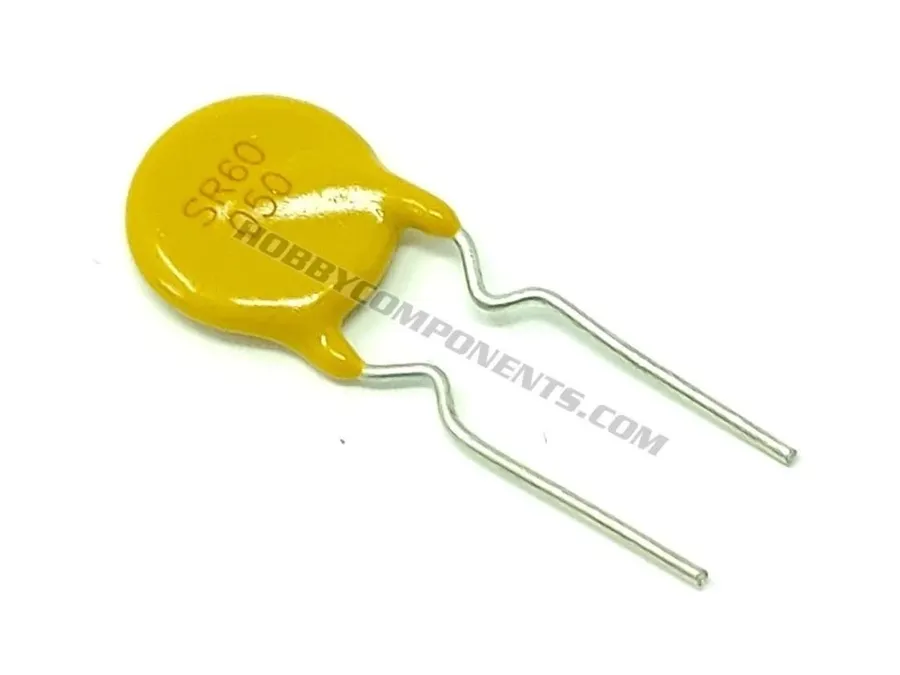
While resistors, capacitors, and inductors form the cornerstone of passive components, several other specialized components play crucial roles in electronic circuits. These components, including thermistors, varistors, potentiometers, and antennas, do not generate power but are indispensable for specific functions, such as providing varying electrical resistance, storing electrical energy, or facilitating signal transmission.
These passive components, while not active in the sense of generating energy, provide essential functionalities, modifying or managing electrical signals within a system. Their specific characteristics and behavior are paramount to the performance and reliability of electrical circuits.
The fundamental distinction between active and passive components lies in their energy behavior within an electronic circuit. Active components require an external power source to operate and can amplify or generate a signal, while passive components manage energy without generating it, instead dissipating, storing, or releasing it.
| Feature | Passive Components | Active Components |
|---|---|---|
| Energy Source | Do not require external power source; manage existing energy. | Require an external power source to function. |
| Signal Amplification | Cannot amplify or generate a signal. | Can amplify or generate a signal. |
| Primary Function | Control current flow, store electrical charge, manage magnetic fields, or provide resistance. | Control current flow, amplify or generate signals. |
| Examples | Resistors, capacitors, inductors, thermistors, varistors, potentiometers, antennas | Transistors, diodes, operational amplifiers, integrated circuits (ICs) |
| Circuit Control | Influence circuit behavior by managing energy passively. | Actively control circuit behavior and logic, including signal modification. |
Selecting the appropriate passive component is crucial for the optimal performance and reliability of any electronic circuit. This section provides guidance on how to choose the right components, emphasizing the importance of understanding datasheets and considering critical factors such as tolerances, power ratings, temperature coefficients, and voltage ratings.
Accurate component selection is more than simply picking parts; it's about understanding how each parameter affects circuit behavior. Careful attention to these details ensures that the circuit not only functions as intended but also remains reliable over its operational lifespan.
Here are some key practical considerations for selecting passive components:
Understanding resistor color codes and capacitor markings is also essential. These markings enable you to quickly identify component values without relying on a multimeter, and they are important especially in situations where datasheets are unavailable.
For resistors, the color bands indicate the resistance value, tolerance, and temperature coefficient. Each band corresponds to a number or multiplier. For capacitors, markings typically indicate the capacitance, voltage rating, and sometimes the tolerance. Learning these standards helps in identifying the component's functionality.
| Parameter | Resistors | Capacitors | Inductors |
|---|---|---|---|
| Primary Function | Limit current flow | Store electrical charge | Store energy in magnetic field |
| Key Consideration | Resistance, Tolerance, Power Rating | Capacitance, Voltage Rating, Temperature Coefficient | Inductance, Current Rating, Core Type |
| Datasheet Check | Resistance value, color code, power dissipation | Capacitance value, markings, tolerance | Inductance value, current rating, core material |
| Practical Tip | Check color bands | Check markings and tolerances | Consider the frequency of operation |
This section addresses common questions regarding passive components, clarifying their function, types, and distinctions from active components. The aim is to provide clear, concise answers to enhance understanding of these essential elements in electronic circuits.
Passive components may not be as flashy as their active counterparts, but they form the bedrock of all electronic circuits. From controlling the flow of current with resistors, to storing energy with capacitors, and shaping magnetic fields with inductors, each passive component plays a critical role in ensuring that electronic devices function as designed. Understanding these fundamental elements allows you to appreciate the complexity and ingenuity behind every electronic gadget and opens the door for you to dive into electronic design and assembly. As technology advances, the importance of passive components remains constant, making them an essential area of knowledge for anyone interested in electronics.

